
Executive Overview
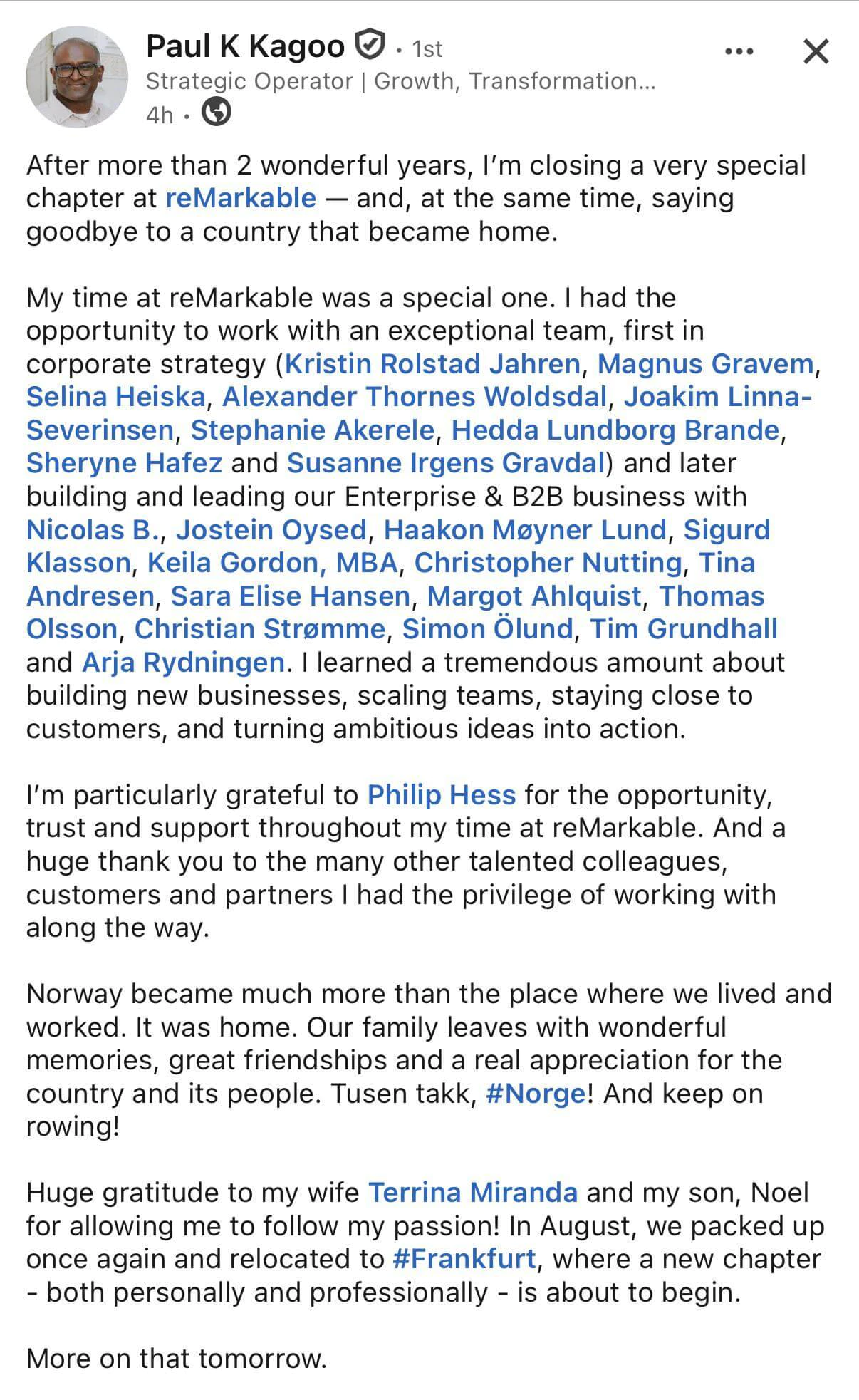
The landscape of professional productivity hardware experienced a notable shift this week with the departure of Paul K. Kagoo, General Manager of Enterprises & B2B at reMarkable. Kagoo’s exit, announced via a public LinkedIn farewell, arrives at a critical juncture for the Norwegian paper tablet manufacturer. While reMarkable has long enjoyed a dominant position in the consumer market—capturing the hearts of writers, academics, and creatives seeking a distraction-free digital notebook—its push into the corporate sector has faced a mounting wall of skepticism.
For years, the company has attempted to carve out a lucrative niche within enterprise environments, pitching its minimalist e-paper devices as the ultimate digital paper replacement for modern professionals. However, Kagoo’s departure brings long-simmering industry debates to a boil: Can a hardware ecosystem built fundamentally on closed-source minimalism and offline-first workflows ever truly satisfy the rigorous security, integration, and compliance demands of the enterprise?
This article explores the structural hurdles facing reMarkable’s B2B strategy, dissects the widening chasm between consumer-grade digital notebooks and corporate IT requirements, and evaluates reMarkable’s official stance as it navigates this pivotal leadership transition.
Read Also
Detailed Chronology: The Rise and Stall of reMarkable’s B2B Push
The Consumer Triumph
Founded in Oslo, Norway, reMarkable captured international attention with its flagship paper tablets, promising an antidote to the notification-heavy environments of modern laptops and tablets. By mimicking the friction, tactile feedback, and low-latency response of traditional paper using Canvas display technology, the company quickly established itself as the gold standard for personal note-taking.
The Enterprise Pivot
As consumer adoption matured, leadership sought new avenues for growth, naturally eyeing the enterprise sector. Organizations spend billions annually on digital transformation, workplace productivity tools, and hardware upgrades. To capture a slice of this lucrative market, reMarkable appointed leaders like Paul K. Kagoo to spearhead B2B sales, enterprise partnerships, and corporate account management.
Over the past several years, the company instituted webshop features tailored to corporate buyers—such as automated VAT capture, enterprise invoicing, and tiered quantity discounts starting at five devices—while actively courting prominent early adopters like Salesforce, UNESCO, and Mainstreet Credit Union.
The Turning Point
Despite these institutional wins, scaling the B2B division proved intensely challenging. The fundamental friction between reMarkable’s core product ethos—which prioritizes isolation from web distractions—and the hyper-connected nature of corporate operations created a bottleneck. With Kagoo’s recent departure, industry analysts are left questioning whether reMarkable will double down on its enterprise experiment or quietly pivot back to its consumer bread and butter.
Supporting Context & Metrics: The Hard Realities of Enterprise IT
Breaking into the B2B hardware market is notoriously difficult for niche tech brands. Unlike individual consumers who purchase devices based on aesthetic appeal or personal productivity habits, corporate IT departments operate under stringent governance protocols, risk management frameworks, and regulatory constraints.
1. The Security and Patching Dilemma
A primary roadblock for devices like the reMarkable in corporate settings is vulnerability management. While reMarkable devices utilize data encryption, enterprise security teams require granular control over endpoints. If a zero-day vulnerability is discovered in the device’s operating system, corporate IT and cybersecurity teams have no native way to mitigate, isolate, or patch the threat independently. They are entirely reliant on the manufacturer’s update cycle.
Furthermore, many corporate security frameworks forbid devices that cannot be integrated into Mobile Device Management (MDM) platforms or Endpoint Detection and Response (EDR) solutions. The stark reality is that many reMarkable tablets currently utilized in corporate boardrooms likely violate internal IT policies, operating in a "shadow IT" gray zone that keeps CISOs awake at night.
2. The Integration Deficit
Modern enterprise workflows are anchored to massive software ecosystems. Microsoft 365 remains the undisputed king of corporate operations, driving email via Outlook, document collaboration via SharePoint and Word, and team communication via Teams. While reMarkable offers integrations with cloud storage solutions like Google Drive, Dropbox, Microsoft OneDrive, and SharePoint, the user experience remains largely siloed.

Enterprise workflows demand deep, bidirectional integration:
- Real-time document co-authoring.
- Seamless calendar syncing.
- Automated transcription and AI-driven summarization of meeting notes routed directly into enterprise repositories.
ReMarkable’s insistence on maintaining a "distraction-free" environment inherently limits its ability to support these complex, interconnected software suites.
3. Source Code and Customization Access
Enterprise environments—particularly in finance, healthcare, and government sectors—frequently demand access to device source codes or customized firmware builds to ensure compliance with strict data sovereignty laws. Because reMarkable operates on a closed ecosystem, businesses cannot audit the code deeply or tailor the device’s AI and data-handling capabilities to meet proprietary internal standards.
Official Statements and Corporate Defense
In response to growing industry commentary regarding the viability of its enterprise strategy, reMarkable provided an official statement to Good e-Reader, vigorously defending its B2B track record and operational readiness:
"Business sales have been an active part of how reMarkable operates for years and remain so. Businesses buy from us directly through the webshop, which handles what a procurement process needs out of the box — company details and VAT number captured at checkout, invoice issued automatically with the order confirmation, bank transfer alongside card and Klarna, and quantity discounts applied automatically from five devices.
Our vendor registration details are published for procurement teams. Our business solutions team speaks with B2B customers daily and handles larger orders, tax-exempt quotes, evaluation units, and enterprise terms. Published customers include Salesforce, UNESCO, and Mainstreet Credit Union, to name a few."
This statement highlights that reMarkable has built a functional, self-service procurement pipeline designed to frictionlessly capture small-to-medium business (SMB) orders and mid-market corporate evaluations. However, industry observers note that streamlining checkout logistics is only half the battle; maintaining long-term enterprise software compatibility and security compliance requires an entirely different order of magnitude in ongoing operational investment.
Future Outlook: Back to Basics or Double Down?
Paul K. Kagoo’s exit forces a strategic crossroad for reMarkable management. The company faces two distinct paths moving forward:
Option A: Refocus on the Consumer Core
Many analysts argue that reMarkable should abandon its sprawling B2B ambitions and return to its foundational strengths. Serving consumers—writers, students, architects, and independent professionals—has allowed the brand to build fervent loyalty without the crushing overhead of enterprise compliance, custom IT integrations, and corporate procurement cycles. By focusing purely on hardware innovation, writing feel, and software simplicity tailored to individuals, reMarkable can protect its profit margins and brand identity.
Option B: Radical Enterprise Transformation
Alternatively, if reMarkable chooses to press forward in the enterprise space, it must undergo a profound architectural evolution. This would require opening up APIs for deep Microsoft 365 and Google Workspace integration, developing robust MDM capabilities for corporate IT administrators, introducing enterprise-grade AI meeting assistants, and offering flexible deployment models that satisfy the most stringent cybersecurity compliance audits.
Conclusion
As reMarkable searches for Kagoo’s successor—or weighs restructuring its leadership team altogether—the broader tech industry watches closely. The paper tablet revolution proved that digital ink could successfully replace physical notebooks for millions of individuals. Whether that same minimalist magic can survive the bureaucratic, highly integrated realities of the modern corporate enterprise remains one of the hardware sector’s most compelling unanswered questions.




Comments
Facebook App ID not configured. Please add it in the Customizer.