
The rise of the Moroccan national football team—popularly known as the Atlas Lions—has transcended the traditional boundaries of athletic competition, evolving into a complex socio-political phenomenon. From the bustling streets of Astoria, Queens, to the administrative headquarters of the Royal Moroccan Football Federation, the team serves as a powerful mirror for the global Moroccan diaspora, the nation’s economic reliance on remittances, and the profound domestic tensions underlying modern North African statecraft.
Following their historic, ground-breaking semifinal run at the 2022 FIFA World Cup in Qatar—where Morocco became the first African nation to reach the tournament’s penultimate stage—the Atlas Lions have transformed from regional dark horses into global contenders. Yet, this meteoric ascent on the pitch has not occurred in a geopolitical vacuum. It has been accompanied by intense domestic criticism regarding state priorities, questions of national identity surrounding a heavily diaspora-composed squad, and the bittersweet melancholia experienced by millions living far from their ancestral homes.
This investigative report examines the intersection of football, migration, and national identity, tracing the journey of the Atlas Lions through recent international tournaments, the mechanics of transnational scouting networks, and the complex emotional landscape of fans who find their homeland reflected in ninety minutes on a television screen.
Read Also
Detailed Chronology: From Queens to Monterrey and Beyond
June 29: The Dramatic Showdown in Monterrey
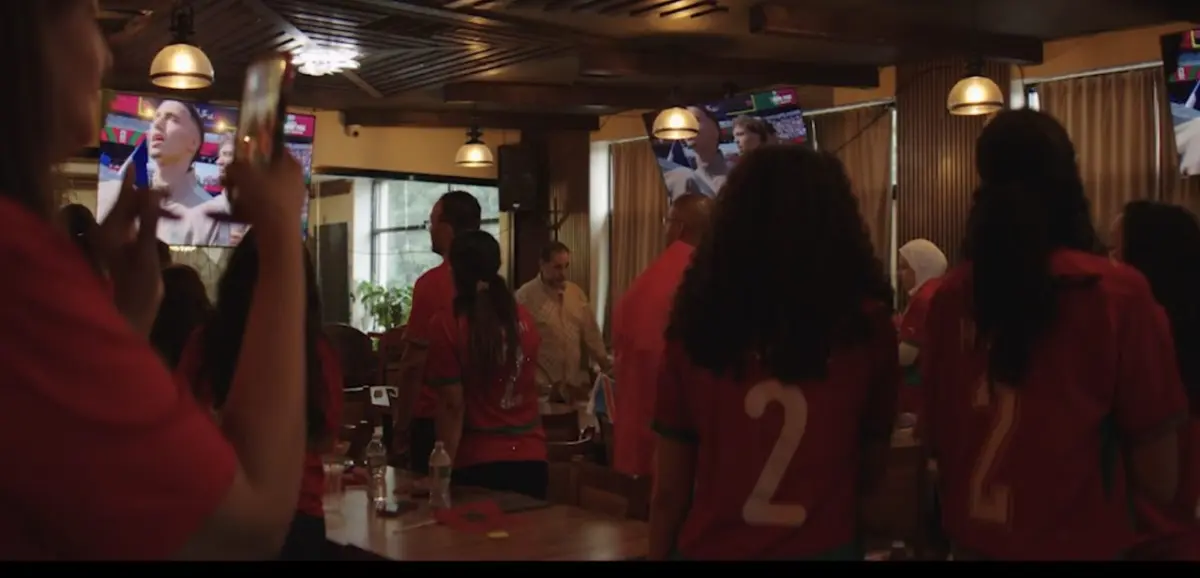
The air inside Zikrayat, a Middle Eastern restaurant and lounge nestled in the heart of Astoria, Queens, was thick with tension. On June 29, a partisan crowd of dozens of Moroccan fans—predominantly clad in the team’s striking red-and-green jerseys—watched as Morocco faced a formidable Dutch side in Monterrey, Mexico.
For much of the match, defeat loomed large. The North African squad trailed well into the second half, leaving supporters bracing for heartbreak. However, a miraculous equalizer in the ninetieth minute altered the trajectory of the game, forcing extra time. As the penalty shootout commenced, Moroccan players gathered in a circle on the pitch, raising their hands in a quiet religious supplication. Inside Zikrayat, the collective breath of the room was held; patrons lowered their heads, stared fixedly at the monitors, and awaited destiny.
When Ismael Saibari’s winning penalty slammed into the back of the net, the room erupted. The high-pitched, howling trill of a zaghrouta—the traditional North African ululation of joy—pierced the air, mingling with the cheers of dancing patrons. Outside, fireworks illuminated the Queens skyline, echoing the jubilation unfolding thousands of miles away.
The Steinway Street Phenomenon
Weeks earlier, Steinway Street had transformed into a vibrant extension of Rabat and Casablanca ahead of Morocco’s opening tournament match against Brazil. Hours before kickoff, the neighborhood bled red and green. Commuters stepping off the M60 bus were immediately enveloped in a sea of supporters wearing jerseys bearing the names of stars like Achraf Hakimi.
Sidewalk vendors hawked flags and scarves from folding tables, chanting "Dima Maghrib!" ("Always Morocco!") at passing traffic. Inside packed neighborhood cafes like Noisette, patrons sipped mint tea, indulged in pastries, and spoke in rapid Darija (Moroccan Arabic). Supporters had traveled from across the tri-state area—some arriving from Philadelphia after dropping children off at exhibition games in New Jersey—seeking the communal energy that only Astoria’s close-knit North African enclave could provide.
The Quarterfinal Reality Check
Despite the euphoria in Queens, the tournament’s later stages exposed the ongoing evolution—and occasional vulnerabilities—of the squad. Facing their 2022 semifinal rivals, France, in the tournament quarterfinals, the Atlas Lions struggled to replicate their historic Qatar magic.
Despite heroic saves from goalkeeper Yassine Bounou, Morocco created few offensive opportunities and ultimately fell 2–0. While the defeat against a presumptive tournament favorite was met with pragmatic acceptance, it left many supporters grappling with a new reality: reaching the quarterfinals is no longer enough. The fanbase, having tasted elite-tier success, now demands competitive dominance, marking a permanent shift in expectations.
Supporting Context & Metrics: Economics, Migration, and the Diaspora
The Remittance Economy and the National Team
The composition of the Moroccan national team offers a striking metaphor for the nation’s broader socio-economic realities. Of the 26 players representing Morocco in recent major competitions, an overwhelming majority—nineteen—were born outside of the country, raised in European football hotbeds like the Netherlands, Spain, and France.
This heavy reliance on diaspora talent mirrors Morocco’s national economy. According to recent financial data, Moroccans living abroad contribute nearly $13 billion annually in remittances, accounting for roughly 8 percent of the country’s Gross Domestic Product (GDP). Aboubakr Jamaï, a prominent Moroccan journalist and public intellectual based in Madrid, notes the structural parallel:
"The team [has become] a metaphor for the Moroccan economy and Moroccan society. We rely heavily on our emigrants. Remittances play an enormous role in the country’s economy. Football tells a similar story."
This financial lifeline sustains domestic households by funding rent, healthcare, and education. Simultaneously, state-backed economic incentives encouraging dual nationals to invest at home have embedded the diaspora permanently into the structural fabric of the Moroccan state.
The Engineering of Athletic Success
The integration of diaspora talent was not left to chance. It represents the product of calculated state investment and sophisticated scouting infrastructure. Central to this strategy has been the development of institutions like Salé’s Mohammed VI Football Academy.
Former technical director Nasser Larguet spearheaded an aggressive overseas scouting network designed to identify, recruit, and retain dual-national youth players playing within elite European club academies. By offering world-class training facilities, professional infrastructure, and cultural engagement, the Royal Moroccan Football Federation convinced top-tier talents—such as Achraf Hakimi, raised in Madrid by Moroccan parents—to commit to the Atlas Lions.
This dynamic was crystallized during the 2022 World Cup, when manager Walid Regragui delivered a stirring pre-match address to his players:
"You chose Morocco, why? For your parents! Don’t lie. You need to fight to the death [for them]."
Official Statements and Sociopolitical Tensions
The meteoric rise of Moroccan football has unfolded against a complex backdrop of domestic political discontent. The millions of dollars channeled into sporting infrastructure and prestige projects have frequently drawn criticism from civil society organizations and youth activists.
During the autumn preceding the tournament, protests swept Moroccan cities as Generation Z activists demanded that the state prioritize basic socio-economic needs—specifically healthcare, public education, and youth employment—over heavy spending on international athletic events.
In what critics characterized as a public relations gesture rather than genuine systemic reform, the state released a small cohort of jailed political activists on the eve of the tournament’s opening matches, having already served time under contentious convictions. Despite these domestic tensions, Morocco’s athletic ambitions remain unabated, underscored by the country’s official status as a co-host for the 2030 FIFA World Cup alongside Spain and Portugal.
Furthermore, the team’s transition from global underdog in Qatar to dominant regional power during subsequent continental competitions—such as the Africa Cup of Nations (AFCON)—has sparked complex debates across the continent. While matches characterized by contentious refereeing decisions, brief walkouts, and subsequent legal battles cemented Morocco’s formidable administrative and athletic standing, they also transformed the team’s public perception from a universally beloved representative of the Global South into a dominant regional powerhouse capable of inspiring both admiration and regional suspicion.
Future Outlook
As Morocco looks toward the horizon—marked by the co-hosting responsibilities of the 2030 World Cup and the ongoing development of domestic and international talent pipelines—the national football team remains inextricably linked to the identity of its people.
The questions raised by supporters and analysts alike point to a profound maturation of Moroccan football culture. The debates over diaspora representation, which dominated the discourse upon the team’s return to the international stage in 2018, have largely subsided, replaced by an expectation of excellence.
For the millions of Moroccans living both within the kingdom and across the global diaspora—from the cafes of Astoria to the neighborhoods of Casablanca—the Atlas Lions are more than a collection of athletes. They are a transnational reflection of an enduring culture: resilient, contradictory, deeply passionate, and forever caught in the beautiful tension between longing for home and making a life across the world.




Comments
Facebook App ID not configured. Please add it in the Customizer.