
Executive Overview
The digital reading landscape is undergoing a quiet yet profound transformation, moving away from bulky, dedicated tablets toward hyper-portable, smartphone-inspired form factors. Leading this charge is digital reading giant iReader (also recognized globally under its PalmRead banner), which has officially pulled back the curtain on its most compact e-reader to date: the iReader Tango 2S.
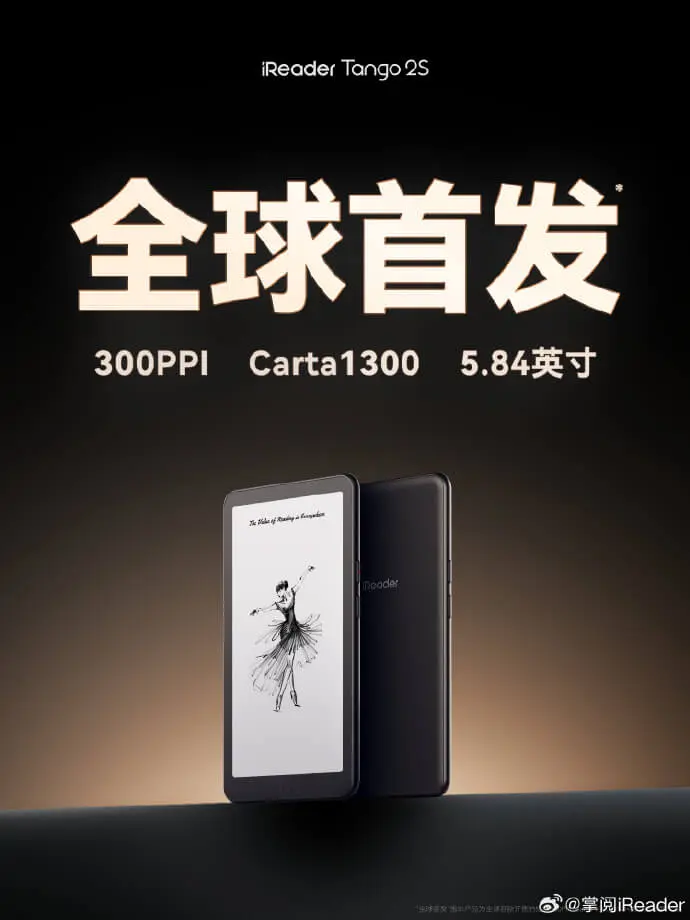
Teased through striking promotional artwork and initial specifications shared by the company, the Tango 2S represents a strategic pivot toward true pocketability. Designed specifically for users who demand the eye-safe, glare-free benefits of electronic paper without the physical footprint of a traditional e-reader, this new device aims to redefine mobile literature consumption. At the heart of the Tango 2S is a state-of-the-art 5.84-inch E Ink Carta 1300 monochrome display boasting a crystal-clear 300 PPI (Pixels Per Inch) pixel density. By shrinking the display size while maintaining high-end visual fidelity, iReader has carved out a distinct niche that bridges the gap between modern smartphones and traditional dedicated e-readers.
This latest announcement directly challenges established market leaders in the pocket e-reader category—most notably the Onyx Boox Palma series. While iReader has yet to disclose concrete details regarding official launch dates, global market availability, or final retail pricing, the initial teaser campaign has generated substantial industry buzz. The device arrives on the heels of the original iReader Tango and the iterative Tango 2, signaling a robust, rapidly evolving product ecosystem.
Read Also
This comprehensive report examines the trajectory of the Tango series, details the technical engineering behind the Tango 2S, contextualizes the device within the broader e-reader market, and analyzes what this ultra-compact form factor means for the future of mobile reading.
Detailed Chronology: The Making of the iReader Tango Lineup
To understand the engineering achievement and market positioning of the new Tango 2S, it is essential to trace the chronological development of iReader’s specialized smartphone-sized e-reader ecosystem.
Phase 1: The Genesis of the Phone-Form Factor (The Original iReader Tango)
For years, the e-reader market was dominated by standardized dimensions—typically 6-inch to 10-inch screens optimized for backpack or bedside table use. Recognizing an untapped demographic of commuters, urban professionals, and minimalists who preferred reading with one hand while standing on crowded transit, iReader engineered the original Tango.
Establishing the blueprint for the entire series, the first-generation Tango abandoned traditional widescreen proportions. Instead, it adopted a sleek, elongated smartphone chassis built around a 6.13-inch E Ink Carta 1300 display. This initial model immediately captured industry attention by packing high-end internals into a pocketable device. It featured a robust octa-core processor capable of handling demanding reading apps, physical side page-turn buttons for tactile navigation, and an impressive 3,900mAh battery capable of delivering up to 27 days of standby performance. Furthermore, the first-gen Tango introduced a specialized 30Hz fast refresh mode, effectively mitigating the traditional ghosting and sluggish scrolling associated with older electronic paper screens.
Phase 2: Refinement and Iteration (The iReader Tango 2)
Following the commercial success and positive critical reception of the inaugural model, iReader launched the Tango 2. Rather than reinventing the wheel, the Tango 2 served as a direct, iterative successor. It maintained the proven 6.13-inch compact blueprint while implementing minor, targeted hardware refinements under the hood.
These updates focused heavily on optimizing power efficiency, improving software stability, and enhancing touch-response latency. The Tango 2 cemented iReader’s reputation as a serious contender in the pocket-device category, proving that the form factor was not a passing novelty but a permanent, viable product line.
Phase 3: The Micro-Revolution (The Unveiling of the iReader Tango 2S)
The natural progression of this design philosophy culminates in the newly teased iReader Tango 2S. Marking a departure from the 6.13-inch standard set by its predecessors, the Tango 2S scales down the physical footprint even further by adopting a 5.84-inch panel.
By achieving this reduction without sacrificing visual clarity—maintaining the prized 300 PPI resolution using cutting-edge Carta 1300 technology—iReader has solved a significant engineering hurdle. The Tango 2S officially stands as the most compact model in the company’s history, signaling to the market that consumer demand leans heavily toward true, pocket-sized convenience.
Supporting Context & Technical Metrics
The competitive edge of the iReader Tango 2S lies in its underlying hardware specifications and the engineering breakthroughs that make a 5.8-inch 300 PPI monochrome panel possible. A granular analysis of its technical metrics reveals why this device represents a significant leap forward.
Display Technology: The 5.84-Inch Carta 1300 Breakthrough
The defining feature of the Tango 2S is its display. Utilizing E Ink’s latest Carta 1300 electronic paper film, the screen offers a noticeable performance upgrade over older Carta 1200 and Carta 1000 panels. Carta 1300 delivers a roughly 15% improvement in response time and a noticeable enhancement in contrast ratios, resulting in deeper blacks and cleaner, brighter white backgrounds.
Achieving a 300 PPI density on a smaller 5.84-inch screen requires precision manufacturing to ensure that pixel matrices remain razor-sharp. For the end-user, this means text rendered in various fonts, sizes, and weights appears as crisp as laser-printed paper, entirely eliminating the pixelation or jagged edges occasionally found on legacy budget e-readers. Furthermore, because it retains a monochrome configuration, it avoids the light-transmittance penalties and muted contrast ratios inherent in current color e-paper technologies (such as Kaleido 3), making it an ideal medium for pure, distraction-free text consumption.

Ergonomics and the Smartphone Form Factor
In an era where standard smartphones routinely exceed 6.5 to 6.8 inches—making one-handed operation cumbersome—the Tango 2S’s 5.8-inch smartphone-shaped chassis feels remarkably natural in the hand. Weighing significantly less than a standard mobile phone or a larger 7-inch e-reader, the device reduces wrist fatigue during extended reading sessions.
The slender aspect ratio allows it to slip effortlessly into a jacket pocket, small purse, or even tight jeans pockets. This physical design philosophy directly mirrors the ergonomics of modern communication devices, lowering the learning curve for users transitioning from reading apps on their phones to a dedicated, eye-safe e-ink display.
Performance Architecture and Power Management
While complete spec sheets for the Tango 2S are still rolling out, industry expectations—based on the pedigree of the original Tango and Tango 2—point toward an advanced octa-core processing architecture paired with ample RAM. This hardware muscle is crucial for a pocket e-reader, as users often expect smooth multitasking, rapid PDF rendering, and seamless execution of third-party Android reading applications (such as Kindle, Kobo, Google Play Books, and local reading suites).
Power management remains a cornerstone of the Tango lineage. While the Tango 2S features a slightly smaller physical footprint than the 6.13-inch models, iReader’s engineering team has historically prioritized high-density battery cells. Given that the original Tango utilized a 3,900mAh battery yielding nearly a month of standby time, the Tango 2S is expected to deliver exceptional battery longevity, easily lasting multiple days of active, heavy reading on a single charge.
Official Statements and Industry Positioning
While iReader has maintained a measured approach regarding the official commercial rollout of the Tango 2S, promotional materials and teaser banners released by the company offer clear insight into their corporate strategy.
The promotional campaign, highlighted by bold typography and sleek product renderings on dark gradient backgrounds, emphasizes terms such as "Global Debut," "Ultra-Compact," and "Pure Reading." Industry analysts note that these marketing choices are calculated to position iReader not merely as a domestic Chinese hardware manufacturer, but as an aggressive global innovator capable of setting trends in the niche portable e-reader sector.
Head-to-Head Competition: The Battle for the Pocket E-Reader Crown
The release of the Tango 2S is widely interpreted as a direct challenge to the Onyx Boox Palma series, which has largely dominated the western and Asian markets for smartphone-styled e-readers. Up until now, consumers seeking a high-performance, Android-powered e-reader in a phone form factor had few alternatives outside of Onyx’s ecosystem.
By introducing a device with an even more refined 5.84-inch form factor equipped with the latest Carta 1300 screen technology, iReader is undercutting the competition’s dimensions while matching or exceeding display sharpness. This rivalry is expected to accelerate hardware innovation across the board, compelling competitors to refine their own compact form factors, improve screen contrast, and optimize software for one-handed navigation.
Future Outlook: The Rise of Micro-E-Readers
As the dust settles on the initial announcements surrounding the iReader Tango 2S, industry watchers are looking toward the horizon to predict the trajectory of the e-reader market. Several key trends are emerging as a direct result of this micro-revolution:
1. Mainstreaming of the "Phone-Reader" Category
For over a decade, the e-reader market was rigidly divided into standard reading tablets and specialized folding devices. The success of the Tango series—and now the introduction of the even smaller 2S—proves that a third major category has matured: the "phone-reader." As digital fatigue grows and users actively seek devices free from notifications, social media algorithms, and eye-strain-inducing OLED/LCD screens, pocket-sized e-ink devices are uniquely positioned to capture a wider demographic.
2. The Quest for Global Availability
One of the most pressing questions surrounding the Tango 2S is its distribution model. While iReader products enjoy massive popularity in Asian markets, western enthusiasts frequently rely on import channels or specialized third-party retailers (such as Good e-Reader) to acquire these niche devices. As demand for alternative, distraction-free mobile technology surges in North America and Europe, consumer advocates and tech analysts alike are watching to see if iReader will establish more direct, localized global distribution channels for the Tango 2S.
3. Software Ecosystems and Open Android Integration
Hardware dimensions are only half the battle. The future viability of pocket e-readers will depend heavily on software adaptability. Users increasingly demand open operating systems—typically based on modern iterations of Android—that allow them to sync reading libraries across multiple platforms. Whether iReader implements an intuitive, highly optimized custom launcher on top of a versatile Android OS for the Tango 2S will heavily influence its adoption rate among international power users.
Conclusion
The iReader Tango 2S is far more than an incremental update; it is a calculated masterclass in hardware miniaturization. By successfully cramming a high-resolution, 300 PPI Carta 1300 display into a diminutive 5.84-inch smartphone chassis, iReader has raised the bar for portable digital reading. As we await final pricing, release dates, and comprehensive performance benchmarks, one thing remains certain: the era of the pocket-sized, distraction-free e-reader has officially arrived, and it is sleeker, sharper, and more accessible than ever before.



Comments
Facebook App ID not configured. Please add it in the Customizer.