
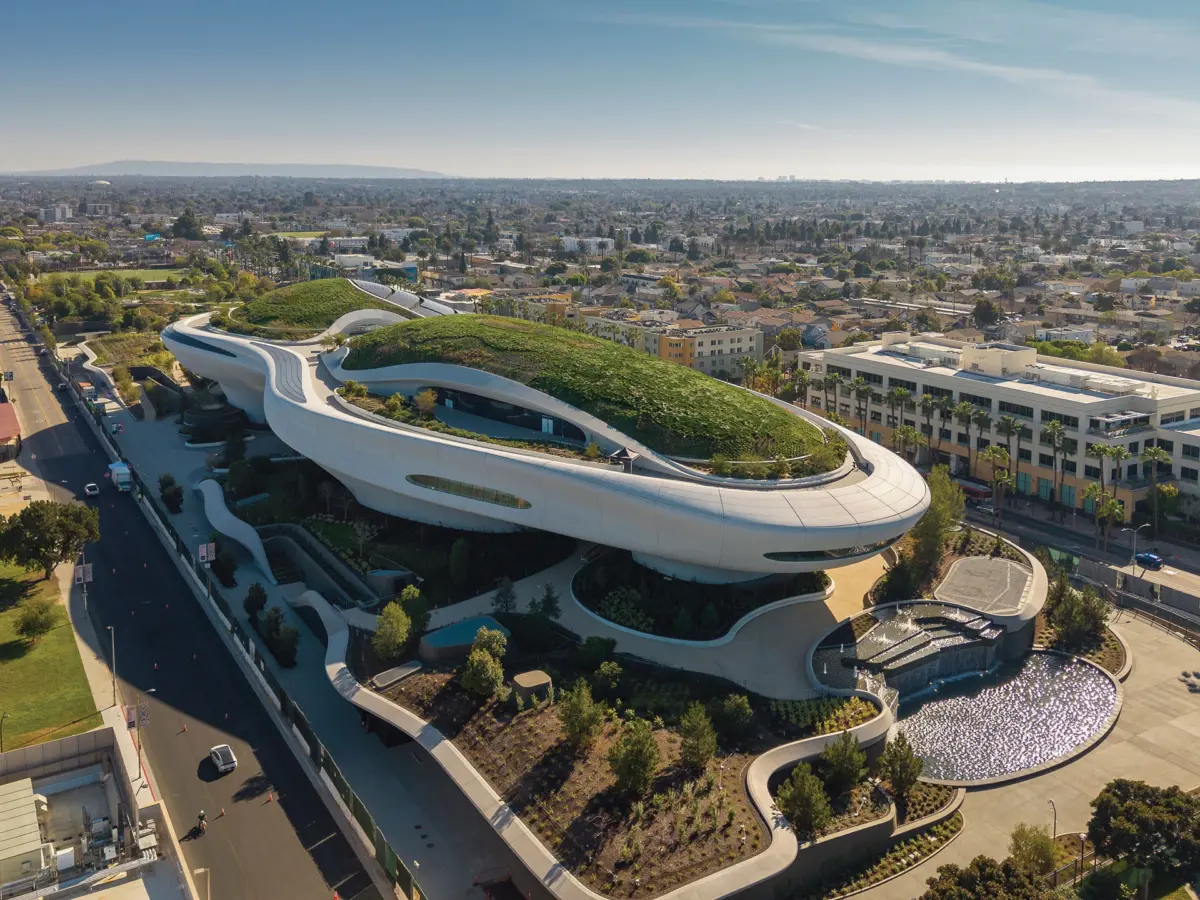
Executive Overview
The long-awaited, highly publicized debut of the Lucas Museum of Narrative Art—a monumental $1 billion cultural institution spearheaded by legendary filmmaker George Lucas and his wife, prominent businesswoman and investor Mellody Hobson—was intended to be a watershed moment for the art world. After more than a decade of protracted bureaucratic wrangling, site relocations, and staggering architectural ambitions, the museum finally flung open its doors to the press and its founding members. Yet, even as critics grapple with the institution’s eclectic holdings—ranging from Frida Kahlo self-portraits and Pokémon illustrations to prehistoric cave painting replicas and iconic Star Wars memorabilia—a darker narrative is unfolding behind the scenes.
Beneath the sheen of Hollywood glamour and philanthropic triumph, the institution is mired in legal turbulence. According to recent investigative reports by the Los Angeles Times, the museum is currently the target of four separate lawsuits initiated by disgruntled construction contractors and subcontractors. Chief among these is a high-stakes legal challenge brought forward by J.E. Snyder Electric, a subcontractor that performed critical electrical work on the project under primary contractor Siemens Industry, Inc.
At the heart of J.E. Snyder Electric’s lawsuit lies a provocative and legally explosive premise: that the Lucas Museum of Narrative Art has fundamentally misrepresented its legal status. The suit alleges that the institution systematically promoted, contracted, and labeled its massive Exposition Park construction as a "private, non-profit development" solely to bypass the rigorous administrative oversight, registration mandates, and bonding requirements dictated by the California Public Contract Code, Civil Code, and Labor Code.
Read Also
If the courts determine that the Lucas Museum should legally be classified as a "public work" rather than a purely private entity, it could set a disruptive precedent for public-private cultural partnerships across California. It would also open the floodgates for retroactive regulatory scrutiny, financial liabilities, and further litigation. As the legal community and cultural sector watch closely, this unfolding dispute forces a critical examination of the blurred boundaries between private philanthropy and public infrastructure when multi-million-dollar state assets and nominal land leases enter the equation.
Detailed Chronology: From Concept to Controversy
The road to the Lucas Museum’s grand opening in Los Angeles’s Exposition Park has been nothing short of a grueling odyssey. Understanding the current legal challenges requires tracing the historical trajectory of the project, which encountered fierce opposition, geographical displacement, and complex bureaucratic negotiations long before a single brick was laid.
The Chicago and San Francisco Roadblocks
The genesis of the museum dates back to 2014, when George Lucas initially envisioned a home for his vast, personal collection of narrative art—valued in the billions and encompassing fine art, illustration, comic art, and cinematic artifacts. Lucas initially targeted his hometown of Chicago as the ideal site for the project. Proposing a futuristic, wave-like structure along the city’s picturesque lakefront, Lucas pledged to personally fund the entire construction cost.
However, the Chicago initiative immediately collided with fierce local opposition. A civic advocacy group known as "Friends of the Parks" filed a federal lawsuit blocking the museum’s construction on public trust land. The legal battles dragged on for two years, bogged down by debates over open-space preservation, public access, and the appropriate use of lakefront property. Frustrated by the protracted delays and political gridlock, Lucas officially abandoned Chicago in 2016, briefly turning his gaze toward San Francisco’s Treasure Island before encountering similar political and logistical headwinds.
The Los Angeles Rescue and the 99-Year Lease
Recognizing the stalemate, municipal leaders in Los Angeles—long eager to bolster their standing as a premier global capital for contemporary and narrative arts—stepped in. By 2017, an agreement was struck to anchor the museum in Exposition Park, a cultural hub already home to the California Science Center, the Natural History Museum of Los Angeles County, and the Los Angeles Memorial Coliseum.
To facilitate the project, the museum entered into a landmark land lease agreement with the state-run California Science Center. Under the terms of the deal, the Lucas Museum secured the rights to use prime public land in Exposition Park for a staggering 99-year term at a rate of precisely $30 a year—effectively a nominal, below-market lease.
With the site secured, construction commenced on the sprawling, futuristic architectural marvel designed by MAD Architects. Over the next several years, thousands of workers, dozens of specialized contractors, and multiple tiers of subcontractors poured their labor into the multi-million-square-foot facility. Yet, as the final glass panels were installed and the inaugural exhibitions were curated, financial friction among the construction labor force began to boil over.
By the time the museum welcomed its first wave of journalists and dignitaries, four distinct lawsuits had been quietly filed by contractors demanding compensation and accountability. Among them, J.E. Snyder Electric’s complaint emerged as the most legally consequential, directly targeting the foundational legal definition of the museum itself.
Supporting Context & Metrics: Unpacking the "Public Work" Argument
The core legal argument advanced by J.E. Snyder Electric hinges on statutory definitions under California law regarding what constitutes a "public work." While the museum’s leadership has consistently championed the project as a wholly private philanthropic gift, the plaintiff’s legal team argues that the financial and structural mechanics of the development tell a fundamentally different story.
The Statutory Definition of a Public Work
Under California law, a construction project is frequently classified as a "public work" if it involves the expenditure of public funds, the transfer of public assets for less than fair market value, or the lease of public land for nominal or below-market rent. J.E. Snyder Electric’s lawsuit zeroes in on these precise statutory triggers.
According to the legal filing:
- The Land Concession: The 99-year lease of state-owned land in Exposition Park for $30 annually constitutes a massive, below-market public subsidy.
- Asset Transfers: The project allegedly benefited from structural integration with state-managed infrastructure, which the plaintiffs argue amounts to an indirect transfer of public value.
- Regulatory Evasion: By labeling the development as a private, non-profit venture from its inception, the institution allegedly sidestepped the stringent prevailing wage laws, bonding mandates, and administrative oversight mechanisms required for public works projects in California.
Financial Footprint of the Project
To contextualize the dispute, it is helpful to examine the sheer scale of the Lucas Museum’s financial ledger:
- Total Construction & Endowment Cost: Estimated in excess of $1 billion, funded entirely through private capital provided by George Lucas and Mellody Hobson.
- Lease Terms: 99-year duration at a cumulative cost of $2,970 ($30 per year).
- Construction Mitigation Payments: To offset public inconveniences during construction, the museum agreed to pay $2.1 million to cover temporary surface parking deficits, alongside funding for local soccer park upgrades and ongoing green space maintenance.
- Pending Litigation Value: While exact damages sought by J.E. Snyder Electric and the three other suing contractors remain sealed or unquantified in public filings, construction payment disputes of this magnitude typically involve millions of dollars in unpaid labor, materials, and interest.
The Subcontractor Dynamic
A crucial element of the current legal battle is the contractual hierarchy. J.E. Snyder Electric did not hold a direct contract with the Lucas Museum; rather, they operated as a subcontractor hired by Siemens Industry, Inc., which served as a primary contractor for the electrical systems.
According to reports, J.E. Snyder Electric alleges that they performed extensive, specialized work on the museum’s complex electrical infrastructure but have yet to receive full compensation for their labor. When payment disputes stall within upper contractor tiers, subcontractors frequently leverage statutory mechanic’s liens, stop notices, or expansive legal claims—such as reclassifying the project status—to compel accountability and recover owed funds from deep-pocketed property owners. A spokesperson for Siemens Industry, Inc. did not immediately respond to media inquiries or requests for comment regarding the withheld payments.
Official Statements and Legal Rebuttals
The collision between the subcontractor’s aggressive legal theory and the museum’s formidable legal defense has sparked a war of words in the legal and cultural press. Both sides have staked out uncompromising positions.
The Plaintiff’s Perspective: A Matter of Legal Reality
Legal representatives for J.E. Snyder Electric argue that the labels applied by deep-pocketed developers cannot override statutory realities. In comments provided to the Los Angeles Times, a lawyer for the electrical subcontractor cut to the core of their legal thesis:
"We contend this rent concession makes the project a public work. The institution actively promoted, contracted, and labeled the construction as a ‘private, non-profit development’ to bypass the rigorous administrative, registration, and bonding mandates of the California Public Contract Code, Civil Code, and Labor Code."
The plaintiffs maintain that if a project utilizes public land essentially free of charge and relies on state-run entities to facilitate its physical existence, it must be held accountable to the same transparency, labor protections, and regulatory compliance standards as any government-backed infrastructure project.
The Museum’s Defense: A "Manufactured Fiction"
In sharp contrast, legal counsel representing the Lucas Museum of Narrative Art has dismissed the lawsuit as a baseless and opportunistic maneuver designed to extract leverage in an ordinary commercial dispute. In a strongly worded statement to the press, the museum’s attorney forcefully rejected the "public work" characterization:
"The Lucas Museum is one of the largest private cultural gifts in American history: more than $1 billion, every penny of it private. No public funds. No public financing. No public debt. The claim that this is a ‘public work’ is a fiction, manufactured for leverage in a routine payment dispute by a subcontractor who has no direct contract with the Museum."
Furthermore, the museum’s defense underscores the extensive community benefits and financial concessions the institution voluntarily agreed to provide during the planning and construction phases. These included a $2.1 million cash outlay to mitigate local parking shortages caused by the construction, vital funding for the modernization of a nearby community soccer park, and binding commitments to maintain surrounding public green spaces in Exposition Park. From the museum’s standpoint, these concessions were acts of civic goodwill, not acknowledgments of public-work status.
Future Outlook: Implications for the Art World and Public-Private Partnerships
As the four lawsuits weave their way through the California judicial system, the ramifications of this legal battle extend far beyond the immediate financial dispute between a subcontractor and a billionaire-backed institution.
Precedent for Cultural Institutions
If the courts were to validate J.E. Snyder Electric’s argument—ruling that nominal land leases and municipal cooperation transform a privately funded cultural project into a "public work"—it would send shockwaves through the museum and non-profit sectors. Across the United States, major cultural institutions frequently occupy public parkland under nominal lease agreements with municipal or state governments. Imposing public contract codes, prevailing wage structures, and state bonding mandates retroactively onto these private developments would fundamentally alter how museums are built, financed, and operated.
The Vanity Project Debate and Public Perception
Compounding the legal headaches is the ongoing cultural debate surrounding the museum’s mission and aesthetic footprint. Dedicated to "narrative art"—broadly defined by its founders as any creative work that tells a story—the museum houses a dizzying array of high and low culture. Visitors can marvel at authentic Frida Kahlo self-portraits, examine intricate illustrations of Pokémon characters, study meticulously crafted replicas of prehistoric Lascaux cave paintings, and stand face-to-face with sculptures of iconic characters from the Star Wars cinematic universe.
While Hollywood executives and film industry professionals have championed the institution as a long-overdue celebration of visual storytelling, traditional art critics have been notably harsh. Writing in his scathing review for ARTnews, Senior Editor Maximiliano Durán captured a prevailing skepticism among fine art purists:
"In hindsight, the $1 billion price tag was perhaps the best indication that the Lucas is, ultimately, a vanity project."
This tension between populist storytelling and high-art elitism mirrors the broader legal friction surrounding the museum. To its founders and supporters, the institution is an unalloyed philanthropic gift to the public—a temple of narrative imagination designed to inspire future generations. To its critics and unpaid contractors, however, the museum’s towering concrete-and-steel facade risks concealing systemic labor disputes, administrative shortcuts, and the blurred legal boundaries of billionaire-funded civic developments.
What Lies Ahead
In the coming months, judges in Los Angeles will be tasked with untangling the complex web of subcontractor agreements, statutory definitions of public works, and state lease covenants. Whether J.E. Snyder Electric can successfully pierce the private veil of the Lucas Museum remains to be seen. Regardless of the legal outcome, the controversy serves as a cautionary tale for future mega-philanthropic projects: even when every dollar of construction is privately financed, the entanglement of public land and state assets ensures that accountability will remain firmly in the public eye.





Comments
Facebook App ID not configured. Please add it in the Customizer.