
Executive Overview
Joe Swanberg’s two-decade journey through independent American cinema represents one of the most intriguing stylistic trajectories in modern filmmaking. Emerging in 2005 as an architect of the DIY "mumblecore" movement, Swanberg built an extraordinary artistic apparatus out of micro-budget constraints, naturalistic improvisation, and an informal ensemble of previously unknown actors. His early work famously launched major talents—most notably Greta Gerwig—before pivoting abruptly in 2013 toward star-driven ensemble projects like Drinking Buddies and his critically acclaimed three-season Netflix anthology series, Easy (2016–2019).
Following a six-year hiatus from feature-length directing, Swanberg returns with The Sun Never Sets, a narrative set in Anchorage, Alaska, starring Dakota Fanning and frequent collaborator Jake Johnson. While the film retains Swanberg’s signature method—combining rigorous structural outlines with unscripted, actor-driven dialogue—it marks a fundamental paradigm shift in his thematic orientation. Moving away from the dense psychological shading and observational messiness of his early work, The Sun Never Sets operates with a stark, almost architectural clarity. By thrusting its core ideological premises to the foreground, the film functions as a deeply philosophical, nearly allegorical examination of contemporary romantic commitment, self-delusion, and human destiny.
Detailed Chronology: The Architectural Arc of Joe Swanberg’s Cinema
Swanberg’s filmography can be understood through three distinct evolutionary phases, each characterized by evolving production scales, narrative strategies, and theoretical approaches to performance.
Read Also
       [Phase 1: DIY / Mumblecore Era]
       (2005–2012)
       • Micro-budgets (low four-figures)
       • 13 features (incl. "Hannah Takes the Stairs")
       • Raw, real-time observational intimacy
                         │
                         ▼
       [Phase 2: Mainstream & Ensemble Pivot]
       (2013–2019)
       • Star-studded casts ("Drinking Buddies")
       • Multi-season episodic storytelling ("Easy")
       • Expanded budgets and broader reach
                         │
                         ▼
       [Phase 3: Formalist Abstraction]
       (Present)
       • Six-year feature hiatus ends
       • "The Sun Never Sets" (Anchorage, AK)
       • Conceptual rigor & pictorial neutrality
Phase 1: The Micro-Budget DIY Era (2005–2012)
Swanberg began his career making ultra-low-budget features with budgets frequently in the low four figures. Between 2005 and 2012, he completed an astonishing thirteen features, serving as his own cinematographer, editor, and producer.
- 2005: Debut feature releases introduce a stripped-down, handheld aesthetic focused on young adults navigating artistic ambitions, romantic entanglements, and identity formation.
- 2007: Directs Hannah Takes the Stairs, starring Greta Gerwig. The film becomes a touchstone of the mumblecore movement, establishing Swanberg’s signature working methodology: loose narrative blueprints populated by improvised performances from a recurring stock company.
- 2008–2012: Prolific output explores real-time interpersonal dynamics, socio-political commentary, and youthful uncertainty, capturing the cultural milieu of twenty-something artists and intellectuals.
Phase 2: The Mainstream & Ensemble Pivot (2013–2019)
- 2013: Swanberg makes a dramatic leap into higher-budget indie production with Drinking Buddies, starring Jake Johnson, Anna Kendrick, Olivia Wilde, and Ron Livingston. The film proves that his improvised method can scale effectively to mainstream stars.
- 2014–2015: Directs subsequent star-powered features (Happy Christmas, Digging for Fire), deepening his collaboration with Jake Johnson.
- 2016–2019: Creates, writes, and directs three seasons of the Netflix original series Easy. The anthology format allows him to refine his scene construction while examining modern love, technology, and art across a diverse cross-section of Chicago residents.
Phase 3: The Six-Year Hiatus and Re-emergence (Present)
- 2019–2024: Following the conclusion of Easy, Swanberg steps away from feature filmmaking, reflecting on two decades of artistic output.
- Present: Re-emerges with The Sun Never Sets, his fourth collaboration with Jake Johnson and his first feature in six years. Co-starring Dakota Fanning, the project synthesizes the star power of his mid-career work with a new, highly formalized narrative abstraction.
Narrative Blueprint & Plot Analysis: "The Sun Never Sets"
Set against the rugged, open backdrop of Anchorage, Alaska, The Sun Never Sets presents a romantic dynamic governed by rigid personal boundaries and self-imposed rules.
                                  [JACK & WENDY'S RELATIONSHIP]
                                  • Warm, tender, collaborative
                                  • Conflict: Jack refuses marriage/kids
                                                │
                                                ▼
                                    [JACK'S STRATEGIC PAUSE]
                                    • Imposes 6-month break
                                    • Mandates Wendy date other men
                                                │
                                                ▼
                                    [CATALYSTS & ESCALATION]
                                    • Grudging date with friend (Brandon)
                                    • Surprise return of ex-lover Chuck
                                                │
                                                ▼
                                   [UNINTENDED CONSEQUENCES]
                                   • Instant spark with Chuck
                                   • Jack frantically attempts backtrack
The Domestic Dynamic
- Wendy (Dakota Fanning): A 31-year-old heavy equipment operator who drives bulldozers on local construction sites. She possesses a grounded, pragmatic temperament and seeks spontaneous adventure.
- Jack (Jake Johnson): A fortysomething financial manager who relocated from New York. Divorced with two young children—Abby (Charlie Golike) and Jude (Kincaid Zatalokin)—Jack is deeply attached to his established domestic routines.
Though the couple shares a tender, jovial bond, Jack draws a hard line regarding their future: he refuses to remarry or have additional children. Although Wendy does not press these demands, Jack assumes she will eventually resent relinquishing marriage and motherhood. Driven by a desire for control disguised as selflessness, Jack engineers a mandatory "six-month break." His goal is not to pursue other women, but to force Wendy to date other men—hoping that comparative experience will convince her that a life on his terms is her best option.
Catalysts and Crisis
The strategy quickly unravels through a series of rapid events:
- The Marina Incident: The film opens with Wendy attempting to buy a boat—a desire for outdoor adventure that Jack, a non-outdoorsman, refuses to share.
- The Pregnancy Announcement: At a casual gathering, Wendy’s close friend Lindsay (Debby Ryan) reveals she is pregnant. The news shatters a long-standing pact between the two friends to experience motherhood simultaneously, highlighting Wendy’s growing sense of isolation and prompting Jack to implement the relationship pause that evening.
- The Unwanted Date: A bewildered Wendy goes on a reluctant date with Brandon (Brandon Daley), an awkward, doting friend who has harbored a crush on her for years.
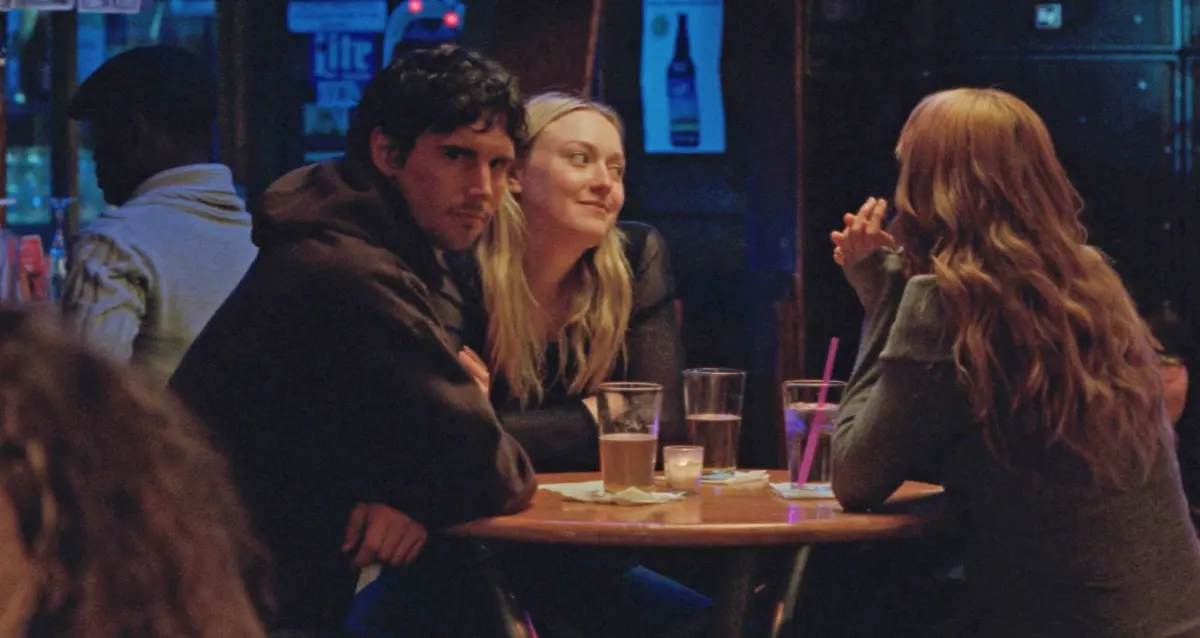
- The Unexpected Reconnection: At the bar with Brandon, Wendy makes eye contact with Chuck (Cory Michael Smith), a rough-mannered backcountry pilot and ex-boyfriend who broke up with her three years prior. The romantic spark between Wendy and Chuck reignites instantly, forcing Jack into a frantic, desperate attempt to undo the very terms he imposed.
Supporting Context & Technical Metrics
To fully understand The Sun Never Sets, it is necessary to compare its stylistic choices, structural methodologies, and technical execution against Swanberg’s earlier work.
Comparative Framework: Mumblecore Era vs. Formalist Era
| Metric / Dimension | Early Career (2005–2012) | The Sun Never Sets (Present) |
|---|---|---|
| Typical Budget | Micro-budget ($5,000–$50,000) | Mid-tier Independent |
| Primary Narrative Focus | Identity, youth anxiety, artistic struggle | Abstract structures of love & commitment |
| Characterization | Dense, psychological, detail-oriented | Elliptical, action-driven, archetype-adjacent |
| Cinematography Style | Handheld, expressive, personal (Swanberg) | Fixed, neutral, bright, open (Eon Mora) |
| Dialogue Construction | Unscripted, sprawling, conversational | Outline-driven, structurally precise |
| Socio-Political Context | Explicit contemporary references | Atemporal, isolated narrative environment |
The Mechanics of Structural Improv
Swanberg’s signature technique involves outlining a precise narrative architecture for every scene while granting actors wide latitude in inventing dialogue and blocking. In The Sun Never Sets, this method yields unique results:
[SCENE FUNCTION DEFINED]
Swanberg establishes clear plot mechanics & dramatic boundaries.
       │
       ▼
[ACTOR FREEDOM]
Cast improvises dialogue within strict situational constraints.
       │
       ▼
[RESULT]
Performances align tightly with character types, pushing structural ideas to the forefront.
By removing extraneous background detail, Swanberg ensures that every scene advances the underlying narrative mechanism. Characters do not deliberate on abstract ideas or discuss historical context; instead, their traits are revealed entirely through action.
Visual Neutrality: The Cinematography of Eon Mora
A major element in this shift is the work of director of photography Eon Mora, who has collaborated with Swanberg since 2015.
In Swanberg’s early self-shot features, the camera operated with raw, subjective energy. In contrast, Mora’s visual strategy in The Sun Never Sets achieves what could be described as a visual "degree zero." The lighting is bright, open, and evenly balanced, and the framing remains observational and objective. This visual neutrality prevents the audience from identifying too strongly with any single character’s perspective. Instead, the viewer is invited to analyze the romantic landscape with clinical objectivity.
Critical Commentary & Analytical Perspectives
The dramatic machinery of The Sun Never Sets generates significant emotional resonance from modest premises. For the broader world, the stakes of Jack and Wendy’s relationship are small; for the individuals involved, they are life-altering.
Characterization by Type
Unlike conventional romantic dramas that build empathy through detailed backstories, The Sun Never Sets intentionally limits deep character history:
"The movie elides traditional characterization. It rarely suggests what might be happening in the inner lives of its characters; it gives few clues about their interests, tendencies, or principles, granting them only those traits that fit the logic of the drama like pegs in slots."
Rather than weakening the film, this design choice transforms the characters into functional types that reflect their core temperaments. Fanning’s Wendy embodies openness and action, Johnson’s Jack represents analytical anxiety and control, and Smith’s Chuck introduces unpredictable instinct.
       [JACK]                [WENDY]                [CHUCK]
  Analytical Anxiety    Grounded Pragmatism    Unpredictable Instinct
  (Control & Logic)      (Openness & Action)      (Wild Outdoor Impulse)
The Allegorical Shift
By stripping away narrative fluff, Swanberg moves from observational realism toward romantic allegory. The film asks fundamental questions about human connection:
- Are people drawn together by shared surface traits and lifestyle preferences?
- Or are they bound by an underlying, essential identity that transcends day-to-day compatibility?
While earlier films like Hannah Takes the Stairs found truth in the messiness of youth, The Sun Never Sets suggests that core human connections are defined by fundamental personal traits rather than superficial lifestyle alignments.
Future Outlook: The Maturation of Independent Cinema
Swanberg’s return after a six-year break offers valuable insight into the maturation of American independent filmmakers who emerged in the digital boom of the mid-2000s.
[YOUTH FILMMAKING: 2005-2012]              [MATURE FORMALISM: PRESENT]
• Exploration of self                      • Distillation of core principles
• Tangled personal observations            • Clean narrative lines
• Real-time uncertainty                    • Conceptual clarity & emotional healing
The Sun Never Sets demonstrates that artistic growth does not require larger budgets or grander visual effects. Instead, it can emerge from dramatic distillation—a process of stripping away non-essential elements until only the core themes remain.
By stepping away from the open-ended uncertainty of his early work, Swanberg has embraced a precise, highly structured approach to storytelling. The Sun Never Sets stands as a compelling mid-career statement from a filmmaker who has moved past youth’s restless searching to offer a clear, thoughtful perspective on love, control, and human connection.




Comments
Facebook App ID not configured. Please add it in the Customizer.