
Executive Overview
For decades, the bedrock of transformative character-arc theory has relied on a singular, pithy premise: The Lie the Character Believes. Popularized by writing instructors, script consultants, and theorists—most notably K.M. Weiland in her seminal guide Creating Character Arcs—this framework posits that characters harbor a limited, mistaken perspective that prevents them from embracing a broader thematic Truth until external narrative pressures force them to evolve.
In a Positive Change Arc, the character successfully confronts and dismantles this falsehood to adopt a more expansive worldview. Conversely, in a Negative Change Arc, the failure to outgrow the limitation causes the character to devolve into a warped, constricted reality.

However, a radical re-evaluation of this foundational screenwriting and novel-writing dogma is underway. A closer examination of transformational fiction reveals that the "Lie" is rarely an outright falsehood from its inception. Instead, it frequently begins as a functional truth—a survival mechanism that served the character well in their backstory until changing circumstances rendered it obsolete.
Read Also
This conceptual shift moves the understanding of character arcs away from simple moral correction and toward a profound psychological continuum. Rather than fixing a "wrong" belief, characters are undergoing a process of individuation, shedding ego identities, and aligning their conscious awareness with the unconscious self. This investigative deep-dive explores the three evolving models of the "Lie," how childhood coping mechanisms form the narrative "Ghost," and why storytelling is ultimately an exercise in inner alignment rather than external transformation.

Detailed Chronology: The Evolution of Story Architecture
To understand how writing theory has arrived at this psychological juncture, it is helpful to trace the evolution of how creators view character development.
- Phase 1: The Mechanical Era of Storytelling (The Mistaken Belief Model). Historically, character arcs were viewed transactionally. Protagonists held an incorrect premise about the world or themselves (e.g., "I am unlovable" or "Money is the only safety"). The narrative acted as a stress test, proving through conflict that the premise was mathematically or morally incorrect, forcing a sudden paradigm shift at the Climax.
- Phase 2: The Continuum Model (Perspective Shift). As narrative theory matured, writers realized that a "Lie" and a "Truth" are rarely binary opposites. Instead, they exist on a continuum. What works as a protective truth in one stage of life—such as Feyre’s hyper-focused survival skills in A Court of Thorns and Roses—becomes a limiting liability when the protagonist enters a larger, more complex world. Yesterday’s truth naturally evolves into tomorrow’s lie as the horizon of experience expands.
- Phase 3: The Consciousness & Ego Model (Current Paradigms). Today, advanced narrative theory merges Jungian psychology with structural writing. The "Lie" is no longer viewed as an isolated cognitive error, but as a fissure in human consciousness. It represents the ego’s desperate attempt to hold onto a limited identity, creating a painful separation between the surface-level persona and the deeper, unified Self.
Supporting Context & Psychology: Three Models of the "Lie"
Modern narrative philosophy categorizes the "Lie the Character Believes" into three tiers of increasing psychological complexity:

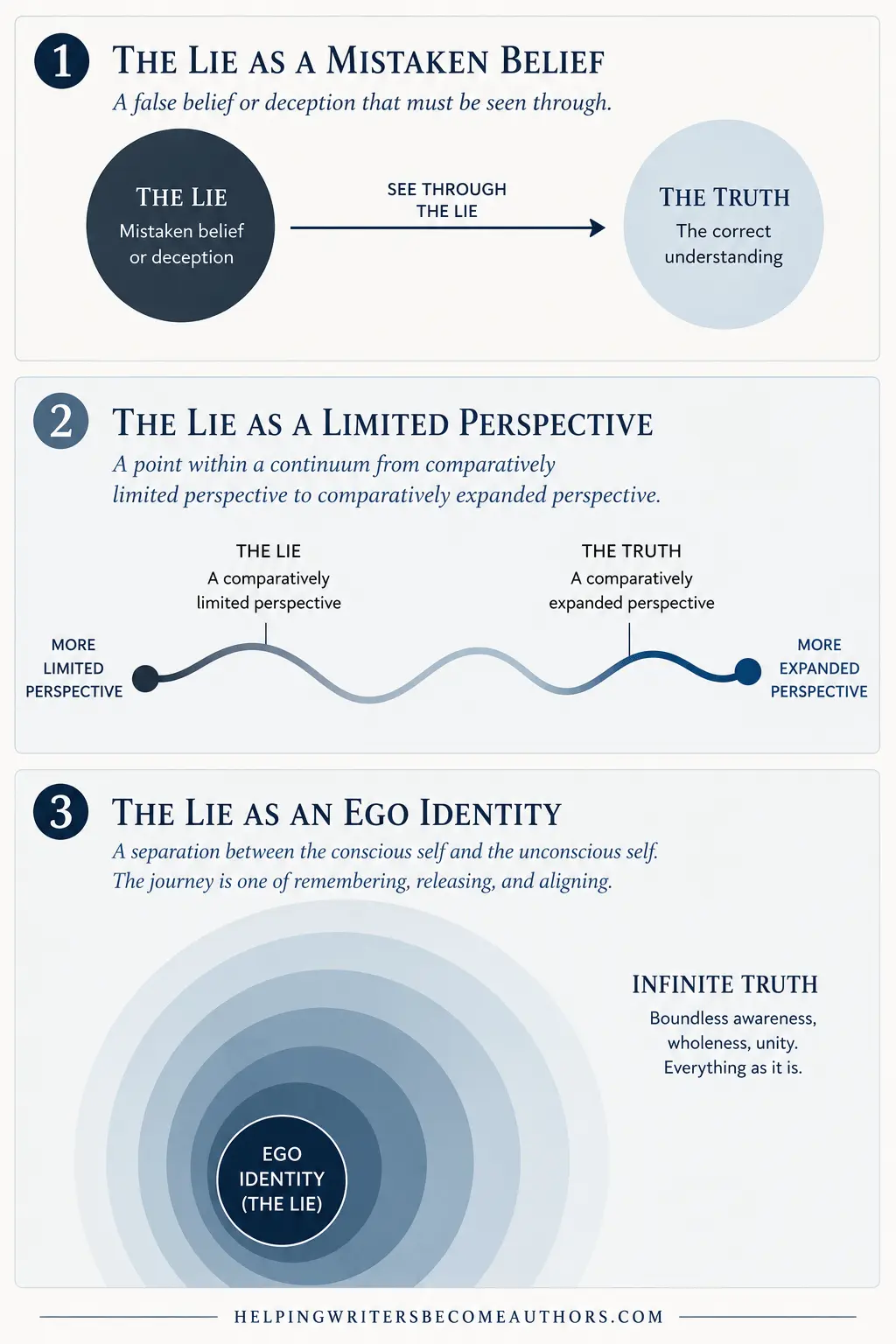
1. The Lie as a Mistaken Belief
At its most basic structural level, the Lie functions as an outright deception or factual error. The character believes something empirically or narratively false about their environment, their capabilities, or other people. The resolution requires gathering new data and accepting reality.
2. The Lie as a Limited Perspective
Moving up the ladder of complexity, the Lie is recognized not as a falsehood, but as a comparatively limited perspective. Both the Lie and the Truth are reference points on an endless continuum of growth. There is no absolute good or bad; rather, the character simply outgrows a viewpoint that is too small for their current stage of development.

3. The Lie as an Ego Identity and Separation
At its deepest psychological tier, the Lie is an ego defense. The ego constructs a fragile identity around external markers—name, profession, trauma, social roles, or perceived failures. To protect this identity, the mind creates a division between the conscious self and the deeper unconscious truth. The suffering experienced by the character is not caused by the harshness of the world, but by their rigid identification with a limited perspective.
[Level 1: Mistaken Belief]  --> Correcting bad data / factual error.
[Level 2: Limited Horizon]  --> Expanding perspective along a continuum.
[Level 3: Ego Identity]     --> Releasing false self-separations for inner alignment.
Official Insights & Theoretical Perspectives
Writing authorities and depth psychologists alike point to the intersection between narrative structure and human physiology to explain why this psychological approach to character arcs resonates so deeply with audiences.

The Backstory "Ghost" as a Biological Coping Mechanism
In storyform theory, the root of the Lie is traditionally found in the "Ghost"—a traumatic backstory wound that catalyzes the character’s defensive worldview. Viewed through a modern neurobiological lens, this Ghost is simply an early childhood coping mechanism.
As researchers like Loretta Graziano Breuning note in Habits of a Happy Brain, early experiences wire our neurochemistry (dopamine, serotonin, endorphins, and cortisol), shaping our personalities and the stories we tell about ourselves. Just as a physical coping mechanism goes unquestioned until it begins causing chronic physical pain, a psychological coping mechanism goes unquestioned until it stops serving the character’s survival and instead generates profound internal friction.

The Ego-Driven vs. Soul-Driven Arc
In advanced masterclasses on narrative psychology, a distinction is drawn between karmic (ego-driven) arcs and dharmic (soul-driven) arcs:
- Ego-Driven Arcs: Characters violently resist change. Their ego identities feel threatened by the unfolding narrative, leading to high plot conflict, defensive reactions, and immense psychological suffering as the status quo collapses.
- Soul-Driven Arcs: Advanced archetypal characters (such as the Mage archetype) engage in minimal plot conflict because they understand that resistance is futile. They practice non-reactivity, embodying the principles outlined by Jungian scholar Marie-Louise von Franz: the ego relinquishes its arbitrary wishes to allow a deeper, more fundamental form of existence to emerge.
Future Outlook: Storytelling as an Act of Alignment
As we look toward the future of novel writing and screenwriting pedagogy, the definition of a successful character arc is undergoing a subtle yet profound semantic pivot.

We are moving away from viewing character arcs strictly as transformation (adding something new to the protagonist) and moving toward viewing them as alignment (stripping away the false self so the character can see clearly).
This philosophical pivot elevates storytelling from mere entertainment to a mythic mirror of the human condition. As Richard Rudd observes in The Gene Keys, the natural program of all life force is to grow and evolve. When readers engage with a masterfully crafted Positive Change Arc, they are not just watching a fictional character solve a plot problem; they are witnessing a universal, instinctual shedding of fear, defenses, and accumulated ego identities.

Ultimately, the Lie the Character Believes is the cage we all build to feel safe against the chaos of the world. And the Truth is the realization that true freedom—both on the page and in life—begins the moment we are willing to step outside it.




Comments
Facebook App ID not configured. Please add it in the Customizer.