
Executive Overview
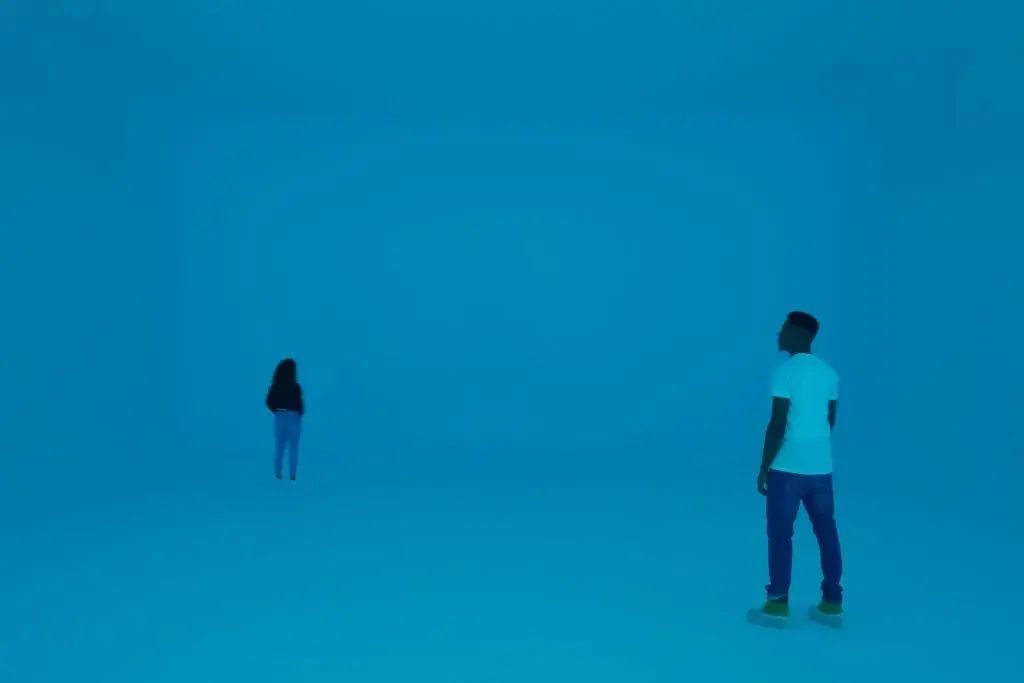
Superblue Miami, the groundbreaking experiential art hub nestled in the heart of the city’s industrial Allapattah neighborhood, is officially celebrating its milestone five-year anniversary. To mark half a decade of redefining how audiences interact with large-scale, immersive contemporary art, the institution has unveiled a major permanent acquisition: Blue Sea Sky (2026), a mesmerizing new installation by legendary Light and Space artist James Turrell.
As the latest addition to Turrell’s celebrated, ongoing Ganzfeld series—which he began developing in 1976—Blue Sea Sky transforms perception, enveloping viewers in an uninterrupted field of shifting, saturated color. The piece draws direct chromatic inspiration from Miami’s unique tropical environment, echoing the luminous blue of the Atlantic Ocean, the vibrant green of native palm fronds, the brilliant blaze of coastal sunsets, and the iconic pink neon facades of the city’s historic Art Deco architecture.
The installation replaces AKHU (2021), a foundational Turrell piece from the same series that was originally on loan to the museum when Superblue first opened its doors in May 2021. With the acquisition of Blue Sea Sky, Superblue cements its ongoing commitment to permanent, museum-quality public art, positioning Blue Sea Sky as the fifth major newly acquired work to join its core collection since inception.
Read Also
The unveiling arrives during a banner year for the octogenarian artist, hot on the heels of the summer unveiling of As Seen Below (2026) in Denmark, which stands as Turrell’s largest-ever museum skyspace. For Superblue, the debut of Blue Sea Sky is both a retrospective nod to the institution’s foundational roots and a bold declaration of its future as a premier global destination for boundary-pushing, perceptual contemporary art.
Detailed Chronology: From Opening Roots to the Five-Year Milestone
May 2021: The Genesis of Superblue Miami
When Superblue Miami opened its cavernous, 50,000-square-foot former industrial facility in Allapattah in May 2021, it arrived with a radical mission: to champion experiential art forms that break free from traditional gallery walls. Co-founded by Mollie Dent-Brocklehurst, Superblue was designed not just as an exhibition space, but as an enterprise supporting artists who work on a massive, architectural scale, inviting active audience participation rather than passive viewing.
From day one, James Turrell was central to that vision. As a pioneer of the West Coast Light and Space movement of the 1960s and ’70s, Turrell’s career-long exploration of light, space, and human consciousness aligned perfectly with Superblue’s core ethos. For the inaugural opening, Turrell loaned AKHU (2021), a striking entry in his Ganzfeld series. For nearly five years, AKHU served as a spiritual anchor for the Miami hub, drawing hundreds of thousands of visitors into its disorienting, luminous chambers and establishing Superblue as an essential stop on the global contemporary art map.
The Evolution of the Collection: 2021–2025
Over the subsequent four and a half years, Superblue Miami steadily expanded its footprint beyond temporary loans, building an ambitious permanent collection of major scale installations.
A notable milestone in this collection strategy occurred in 2023 with the permanent installation of Rafael Lozano-Hemmer’s Pulse Topology (2021). In this interactive, large-scale biometric sculpture, thousands of suspended lightbulbs illuminate in real-time response to the heartbeats of visitors, creating a luminous, undulating landscape driven by collective human biology.
As Superblue approached its five-year anniversary, leadership recognized that the departure of Turrell’s AKHU—which was scheduled to return to its private collection or rotate to a new venue—required an intervention worthy of the institution’s legacy. Rather than seeking a temporary replacement, Superblue moved to permanently commission and acquire a brand-new, site-sensitive work by Turrell himself: Blue Sea Sky.
2026: The Five-Year Anniversary and Blue Sea Sky
Unveiled in early 2026 to coincide with Superblue’s fifth anniversary celebrations, Blue Sea Sky represents the culmination of Turrell’s decades-long technical and aesthetic evolution. Designed specifically to dialogue with its South Florida home, the installation takes the immersive parameters of the Ganzfeld phenomenon and filters them through the chromatic vernacular of Miami.
The debut of Blue Sea Sky also neatly bookends a landmark year for the artist internationally. Earlier in the summer of 2026, Turrell made global headlines with the opening of As Seen Below in Denmark—his largest museum skyspace to date. Together, these two monumental unveilings underscore the incredible, enduring vitality of an artist who, well into his eighties, continues to push the absolute outer limits of spatial architecture and perceptual psychology.
Supporting Context & Metrics: The Science and Art of the Ganzfeld
Understanding the Ganzfeld Effect
To fully appreciate the impact of Blue Sea Sky, one must understand the perceptual phenomenon that inspired it: the ganzfeld effect. Derived from the German word for "complete field," the ganzfeld refers to the neurological phenomenon that occurs when an individual’s visual field is subjected to an unstructured, uniform stimulation field.
In a natural setting, the human brain relies heavily on visual cues—such as edges, shadows, textures, and depth markers—to make sense of three-dimensional space. When these cues are systematically removed through a seamless, softly lit environment where boundaries dissolve into a wash of pure, borderless color, the brain loses its capacity for depth perception.
For Turrell, this creates a state of sensory deprivation and simultaneous hyper-awareness. Viewers stepping into a Ganzfeld installation often experience a profound sense of floating, losing all orientation of scale, distance, and direction. Walls appear to advance and retreat; the air itself seems to take on a tangible, physical density.
The Pilot’s Perspective and Perceptual Psychology
Turrell’s fascination with light and perception is deeply rooted in his biography. A licensed pilot since the age of 16, Turrell spent countless hours navigating the skies, where he frequently encountered atmospheric optical illusions. He experienced firsthand how light behaves at high altitudes—how the sky can transform from a dome of blue to a solid, impenetrable ceiling, and how pilots can lose their horizon line entirely in dense cloud cover or at twilight (a phenomenon known as the "the tilt" or spatial disorientation).
Furthermore, Turrell’s academic background in perceptual psychology at Pomona College provided him with the theoretical framework to translate these aviation experiences into fine art. By manipulating architectural boundaries, ambient lighting, and specialized fluorescent and LED spectrums, Turrell engineers environments where viewers become acutely conscious of the mechanics of their own seeing. As he famously noted: "We are eating light."
Superblue Miami by the Numbers
- Total Exhibition Space: 50,000 square feet of converted industrial warehouse space in Allapattah.
- Anniversary Milestone: Celebrating 5 years of operation since opening in May 2021.
- Permanent Collection Growth: Blue Sea Sky marks the fifth major newly acquired permanent work secured by Superblue since its founding.
- Turrell’s Global Footprint: Follows closely behind the summer 2026 unveiling of As Seen Below, Turrell’s largest-ever museum skyspace, located in Denmark.
Official Statements & Critical Perspectives
The unveiling of Blue Sea Sky has drawn widespread acclaim from curators, critics, and museum leadership, who view the installation as a masterclass in experiential curation.
Mollie Dent-Brocklehurst, co-founder and chief curator of Superblue, emphasized the profound emotional and psychological resonance of the new work in an official institutional statement:
"Blue Sea Sky brings people together in a shared experience of immersion in pure color, pushing the limits of human perception," said Dent-Brocklehurst. "It’s difficult to speak about Turrell without including one of his own wonderful quotes. […] ‘In an age of consumerism and materialism, I traffic in blue sky and colored air.’"
Art historians and critics have similarly praised the installation for its ability to anchor Superblue’s diverse programming in the rigorous history of the Light and Space movement. While many contemporary experiential art spaces rely heavily on high-tech digital projections and ephemeral digital tricks, Turrell’s work relies entirely on the precise physics of light, architecture, and human neurology. By omitting digital screens in favor of architectural manipulation and pure chromatic illumination, Blue Sea Sky offers a contemplative, almost meditative counterpoint to the fast-paced visual culture of the 21st century.
Furthermore, cultural analysts note that the acquisition of Blue Sea Sky signals Superblue’s maturation from an ambitious startup into a permanent fixture of the global museum landscape. By securing blue-chip, permanent acquisitions by foundational artists like Turrell and Rafael Lozano-Hemmer, Superblue is curating a permanent art historical canon for the experiential art movement.
Future Outlook: The Next Era of Experiential Art
As Superblue Miami looks beyond its five-year anniversary, the institution stands at a fascinating crossroads in the evolution of contemporary culture. The line between entertainment, technology, and high art has never been more porous, with audiences increasingly hungry for physical, embodied experiences in an era dominated by digital screens and virtual reality.
Yet, as Blue Sea Sky demonstrates, the most powerful immersive experiences often rely on timeless, elemental mediums: light, space, color, and human presence. By investing in permanent masterworks that challenge perception and foster collective contemplation, Superblue is setting a high benchmark for the future of experiential institutions worldwide.
Looking ahead, Superblue plans to expand its commissioning framework, supporting a new generation of artists who continue to push the boundaries of spatial design and interactivity. Meanwhile, James Turrell continues to work on his monumental, lifelong magnum opus—Roden Crater, an extinct volcanic cinder cone in the Painted Desert of Arizona that he has spent decades transforming into a massive naked-eye observatory for celestial light.
As visitors step inside Blue Sea Sky at Superblue Miami today, they are not merely viewing an artwork; they are participating in a living experiment in human consciousness. In the words of Mollie Dent-Brocklehurst, Turrell remains the ultimate architect of "blue sky and colored air"—reminding us, five years into Superblue’s journey and decades into Turrell’s career, of the radical, transformative power of simply stopping to look at light.

Comments
Facebook App ID not configured. Please add it in the Customizer.