
Executive Overview
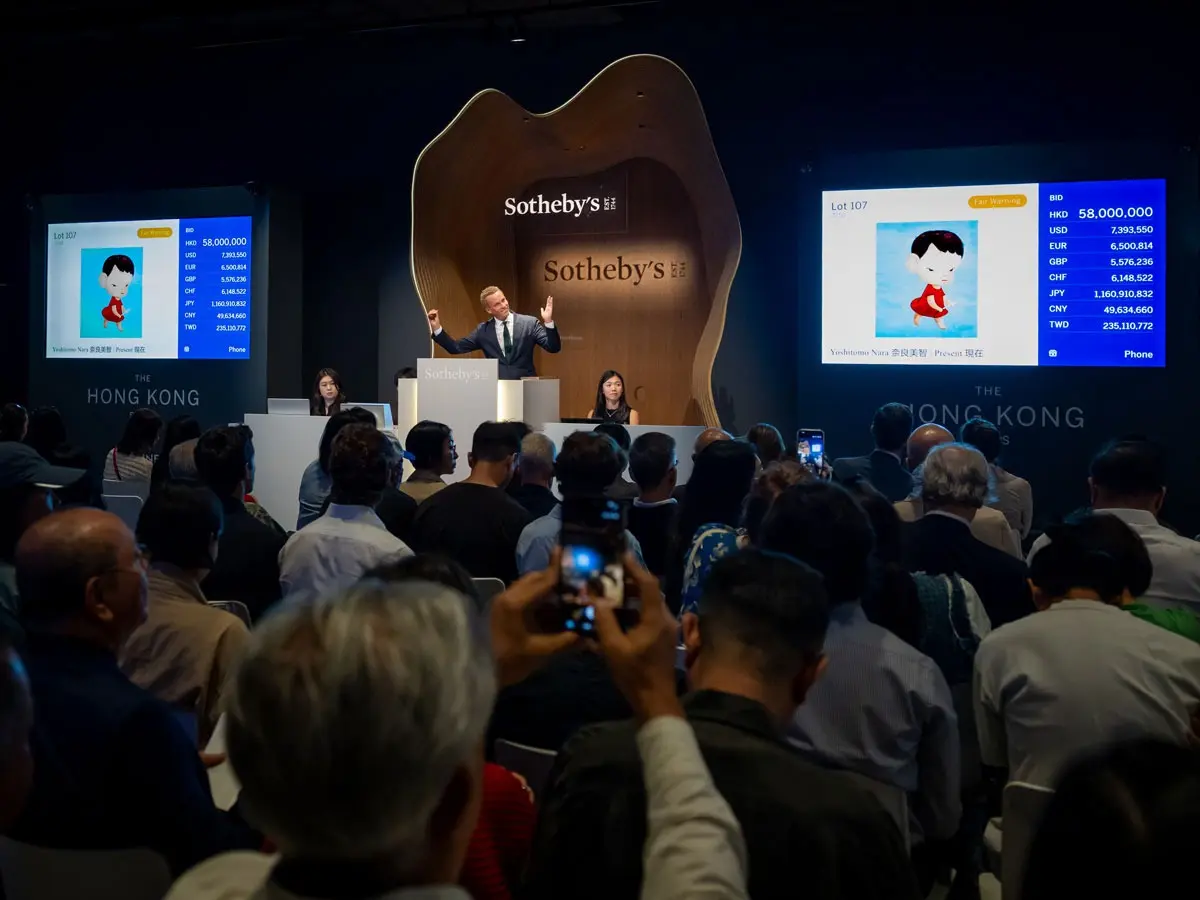
The Hong Kong art market’s protracted and uneven recovery was laid bare during the autumn auction season, reflecting a delicate interplay between regional macroeconomic turbulence and a recalibrated collector base. Staged across a high-stakes three-day window, the modern and contemporary art evening sales hosted by international powerhouses Christie’s, Sotheby’s, and Phillips generated a combined $184.6 million.
While this figure represents a steady, if modest, increase from the $164.9 million realized during the spring season, the topline figures mask deep-seated anxieties within the trade. Beneath the surface of multimillion-dollar hammer prices lies a market characterized by pronounced risk aversion, shrinking eight-figure buyer pools, and the heavy shadow of regional economic headwinds—from mainland Chinese equities plunging to 13-month lows to the dramatic multi-decade depreciation of the Japanese yen.
Commercial galleries are already bearing the brunt of these pressures. The abrupt shuttering of Tang Contemporary’s Wong Chuk Hang space in Hong Kong earlier this month, driven by months of accumulated rent arrears and a severe contraction in retail sales, sent shockwaves through the regional ecosystem. At the top tier, auction houses navigated these choppy waters by adopting hyper-cautious consignment strategies, selective lot withdrawals, and a heavy reliance on single-owner collections to stimulate demand.
Read Also
As the dust settles on another pivotal chapter for the special administrative region, the overarching narrative is clear: while a resilient core of collectors remains eager to transact in the sub-million-to-five-million-dollar bracket, the ultra-high-end market is facing structural bottlenecks that require fresh capital injection rather than recycled regional liquidity.
Detailed Chronology: A Three-Day Window of Cautious Bidding
Sotheby’s Opening Night: High-Flying Foujita and Strategic Withdrawals
Firing the first major shot of the autumn season on Monday evening, Sotheby’s sought to establish early momentum with a single-owner collection sale dedicated to the paintings and works on paper of Léonard Tsuguharu Foujita, sourced from the holdings of billionaire Joe Lewis. Building on the success of a similar Lewis-focused sale in London earlier this year, the Hong Kong Foujita session grossed $8.7 million, with an astounding 80 percent of the 15 offered works surging past their high estimates. The crown jewel of this introductory segment was Foujita’s 1949 oil-and-ink masterwork, Le rêve (Hommage à La Fontaine), which obliterated its $510,000–$765,000 estimate to fetch $3.38 million.
However, as the evening transitioned to the main marquee sale, the mood shifted decisively toward caution. The night’s opening lot—Chinese artist Hu Xiaoyuan’s Wood – Rift I—shattered expectations, soaring 160 percent above its high estimate to net $212,080 and set a new auction record for the artist. Yet, this early triumph was immediately undercut when the second and third lots failed to secure buyers.

The most telling moment of the night arrived with the withdrawal of the auction’s presumptive top lot: Mark Rothko’s 1965 Chapel-series masterpiece, Untitled (Plum and Dark Brown). Estimated between $9.94 million and $16.3 million, the canvas was quietly pulled prior to the sale, signaling a reluctance among consignors to test a hesitant market at the ten-million-dollar threshold.
Without the Lewis collection contribution, Sotheby’s core evening sale closed at $87.3 million with an 88.5 percent sell-through rate. Inclusive of the Foujita lots, the house reported a 91 percent sell-through rate and a total haul of $124.3 million—its strongest showing since the fall of 2023. The main auction’s ultimate top lot became Yoshitomo Nara’s 1994 canvas Present, which returned to the public block for the first time since 2004, commanding $9.13 million.
Christie’s Tuesday Showcase: Old Masters and Fierce Underbidding
On Tuesday night, Christie’s carved out a distinct identity for its marquee 20th- and 21st-century evening sale by leaning into robust underbidder activity across European Old Masters and established contemporary Asian luminaries. The session was propelled by a 28 percent year-on-year increase, bringing in $92.6 million, though this growth was supported by an inventory expansion of 14 additional lots compared to the previous year.
A major highlight of the evening unfolded during the Old Master segment. A fierce bidding war broke out over Peter Paul Rubens’s Landscape with Willows (1577–1640) between two phone adversaries, culminating when Christie’s China chairman Rebecca Yang brought down the hammer at $1.5 million—representing a staggering 150 percent premium over its low estimate and triggering spontaneous applause in the saleroom.
Contemporary offerings also sparked international cross-currents. A work by Liu Ye ignited a head-to-head duel between a Hong Kong-based collector and an aggressive Western buyer. Yet, other marquee lots revealed signs of price fatigue. Yayoi Kusama’s 2011 canvas A-Pumpkin (YHP) hammered at $5.99 million—slipping 2.08 percent below its low estimate and realizing roughly $300,000 less than a comparable painting sold at Sotheby’s just 24 hours prior.
Similarly, Gerhard Richter’s Abstraktes Bild (1991) hammered at $3.568 million, falling 26 percent short of its low estimate before closing at $4.47 million with buyer’s premium included. Despite the shortfall relative to expectations, Christie’s executives defended the result, noting that the consignor had originally acquired the piece at Christie’s London in 2006 for a fraction of its realized sum.

Phillips’s Wednesday Night: Navigating Leadership Transitions
On Wednesday, Phillips closed out the high-profile auction cycle with its first Hong Kong evening sale since the abrupt exit of Asia chairman Jonathan Crockett earlier in the month, an event that formed part of a broader global exodus of senior leadership. Stepping into the breach as interim lead, Dina Zhang, head of modern and contemporary art for China, moved swiftly to quell market rumors of a potential regional contraction.
Operating with a lean, highly selective catalog of just 16 lots, Phillips generated over $6.4 million with a healthy 87.5 percent sell-through rate. The evening’s premier lot was another Richter masterwork—1983’s Abstraktes Bild (522-1)—which fetched $2.93 million, underscoring the enduring, if tiered, appetite for blue-chip abstract paintings at lower price points than those commanded by its larger competitors.
Supporting Context & Metrics: Macroeconomic Realities and Market Mechanics
The bifurcated performance of the Hong Kong auction houses cannot be divorced from the complex macroeconomic matrix currently governing the Asia-Pacific region. While South Korea’s economy has demonstrated robust momentum fueled by surging semiconductor exports, and capital inflows from the Middle East continue to bolster financial hubs like Hong Kong and Singapore amid prolonged geopolitical friction, domestic China remains mired in economic headwinds. Mainland equities slumped to 13-month lows this month, while the Japanese yen dipped to multi-decade lows in June, directly impacting the purchasing power and liquidity reserves of core collector demographics.
Furthermore, structural changes in the global art calendar have exacerbated the pressures on secondary market sales. Yuki Terase, co-founder of advisory firm Art Intelligence Global, noted that an over-saturated calendar packed tightly with international fairs, major gallery exhibitions, and private secondary market inventory means that collectors returning from summer holidays are immediately confronted with a dizzying array of choices.
+--------------------------------------------------------------------------+
|                 HONG KONG AUTUMN 2026 AUCTION METRICS                    |
+------------------------------+-------------------+-----------------------+
| Auction House                | Total Sales (USD) | Sell-Through Rate     |
+------------------------------+-------------------+-----------------------+
| Sotheby's (Inc. Lewis Sale)  | $124.3 Million    | 91.0%                 |
| Christie's                   | $92.6 Million     | ~90% (Est.)           |
| Phillips                     | >$6.4 Million     | 87.5%                 |
+------------------------------+-------------------+-----------------------+
| COMBINED TOTAL               | $184.6 Million*   | --                    |
+------------------------------+-------------------+-----------------------+
*Note: Combined evening sale totals reflect aggregated market capitalization.
Terase highlighted a structural bottleneck that defines the contemporary art market: while there exists a vast, liquid pool of collectors who can comfortably and intuitively commit sums up to a few million dollars, the demographic boundary shifts dramatically once bids cross into the eight-figure threshold.
This dynamic was crystallized by the sale of Jean-Michel Basquiat’s Ancient Scientist (1984) at Christie’s, which sold for $9.81 million to claim the title of the most expensive work auctioned in Asia this season. Though it led the regional market, its hammer price of $7.97 million landed a modest 11.61 percent above its low estimate. Having last traded hands in Hong Kong at a joint Phillips-Poly Auction sale in December 2020, the work serves as a case study demonstrating how premier eight-figure trophies increasingly require the cultivation of fresh, external capital rather than relying on the recirculated liquidity of existing regional participants.

Official Statements and Industry Perspectives
Leadership across the major auction houses offered candid assessments of the season’s results, acknowledging the tactical shifts required to maintain momentum in a recalibrating market.
Discussing the experimental inclusion of Richter’s oil-on-wood painting in an Asian evening sale, Cristian Albu, head of auction and private sales for Christie’s Asia Pacific, admitted to calculated risk-taking.
"We took a bit of a risk by bringing this particular Richter work to the evening sale," Albu told ARTnews. He noted that while Richter’s prolific output spanned diverse media, this marked the first time Christie’s had presented a panel painting of this type in Asia, suggesting that a dedicated institutional exhibition providing greater contextual depth might have better primed regional collectors.
Addressing the below-estimate performance of Yayoi Kusama’s pumpkin canvas—which nevertheless grossed over $7 million with buyer’s premium—Ada Tsui, vice president for Christie’s Asia Pacific, defended the valuation.
"The artist’s passing was priced in a long time ago because of her age, and we think this is a very respectable price with the buyer’s premium—over $7 million," Tsui remarked. "With sales of very comparable works scheduled back-to-back with our competitor, having multiple clients bidding at that level is encouraging."
Tsui further emphasized that performance is increasingly dictated by specific material qualities and granular collector tastes rather than broad market sweeps. She pointed to the successful dispersal of the Marian Goodman collection in New York earlier this year, where Asian buyers actively acquired or underbit more than half of the abstract paintings on offer, proving that regional fluency in complex Western contemporary idioms remains high.

At Phillips, interim lead Dina Zhang addressed the institutional turbulence head-on, dismissing concerns over the firm’s regional viability following recent high-profile departures. Instead, Zhang outlined an aggressive strategy focused on client retention, bespoke service integration, and agile consignment policies.
"I think we remain very competitive in certain categories and within specific price ranges," Zhang asserted. "Whenever we are competing for a major consignment against other houses, I always ask clients to give us a fair shot. Even if we lose the bid, I ask them for transparent feedback so we know the real reason."
Future Outlook
As the Hong Kong art market looks toward the upcoming spring planning cycles, the consensus among dealers, advisors, and auctioneers points toward a prolonged period of realistic pricing and conservative estimates. The era of unchecked speculative inflation characterized by the pandemic-era boom has definitively yielded to a buyer’s market defined by rigorous selectivity and due diligence.
For commercial galleries, the cautionary tale of Tang Contemporary’s abrupt closure underscores the operational perils of carrying high overheads against a backdrop of sluggish retail and primary market turnover. Galleries will likely be forced to downsize physical footprints, embrace shared-space models, or pivot heavily toward digital-first client engagement to insulate themselves from persistent macroeconomic headwinds in mainland China.
For the major auction houses, future success will hinge on their ability to attract fresh, untapped pools of high-net-worth wealth—particularly from emerging financial corridors in the Middle East and Southeast Asia—while reassuring consignors that lower, more realistic pre-sale estimates are essential to sparking competitive bidding wars. Until macroeconomic stabilization takes hold across broader Asian equity and currency markets, Hong Kong’s art trade will continue to tread carefully, prioritizing strategic consolidation over flashy expansion.




Comments
Facebook App ID not configured. Please add it in the Customizer.