
Date: September 14, 2026
Author: Culture & Politics Desk
Location: London, United Kingdom
Executive Overview
The grand, light-filled spaces of the British Museum’s iconic Great Hall became the epicenter of high-stakes cultural activism on Saturday afternoon. Just days after the institution launched its blockbuster, highly anticipated exhibition of the Bayeux Tapestry—a historic artifact on rare loan from France—activist coalition Energy Embargo for Palestine staged a prominent demonstration inside the venue.
The protest targeted a dual set of grievances: the museum’s enduring corporate partnership with fossil fuel giant British Petroleum (BP) and newly uncovered controversies surrounding the funding of the Tapestry’s UK journey. Investigative reports published last week revealed that Belarusian billionaire Igor Tulchinsky contributed a staggering $6.8 million to facilitate the transport and display of the historic artifact. However, public scrutiny quickly mounted when it was disclosed that Tulchinsky has also channeled financial support into Efrat, an illegal Israeli settlement located in the occupied West Bank that currently faces UK government sanctions.
Read Also
The demonstration underscores a rapidly escalating tension within the global arts and cultural sector. As museums increasingly grapple with the ethics of their philanthropic portfolios, grassroots organizations are intensifying pressure on elite institutions to sever financial tethers to companies implicated in environmental degradation and human rights abuses. While other major London cultural institutions—such as the National Portrait Gallery and the Royal Opera House—have successfully phased out fossil fuel sponsorships, the British Museum remains a prominent holdout, drawing fierce condemnation from labor groups, local Camden communities, and international solidarity campaigns alike.
Detailed Chronology: From Revelations to the Great Hall Demonstration
The events that culminated in Saturday’s protest unfolded at a breakneck pace over a single week, setting off shockwaves across the British cultural landscape.
Early September 2026: The Bayeux Tapestry Opening
The controversy began against the backdrop of one of the museum’s most significant curatorial coups in recent memory. The British Museum successfully secured a loan of the legendary Bayeux Tapestry, an 11th-century masterwork chronicling the Norman conquest of England. Touted as a major diplomatic and cultural achievement, the exhibition opened to packed crowds and immense media fanfare. However, the triumph was swiftly overshadowed by investigative reporting that peeled back the layers of the exhibition’s financial architecture.
Mid-September 2026: The Middle East Eye Exposé
Last week, investigative journalists at Middle East Eye published a damaging report detailing the private funding streams behind the Tapestry’s transport and installation. The report revealed that Belarusian billionaire Igor Tulchinsky had injected $6.8 million into the project. Crucially, the exposé went further, linking Tulchinsky to financial contributions supporting a communal yurt project in Efrat—an Israeli settlement in the occupied West Bank built on land recognized as illegal under international law and recently subjected to official United Kingdom sanctions.
The revelation transformed what was initially celebrated as a triumph of international cultural diplomacy into an ethical lightning rod. Critics pointed out the jarring hypocrisy of an esteemed public museum accepting millions from a donor linked to sanctioned colonial enterprises in occupied territories.
Saturday, September 10, 2026: The Protest in the Great Hall
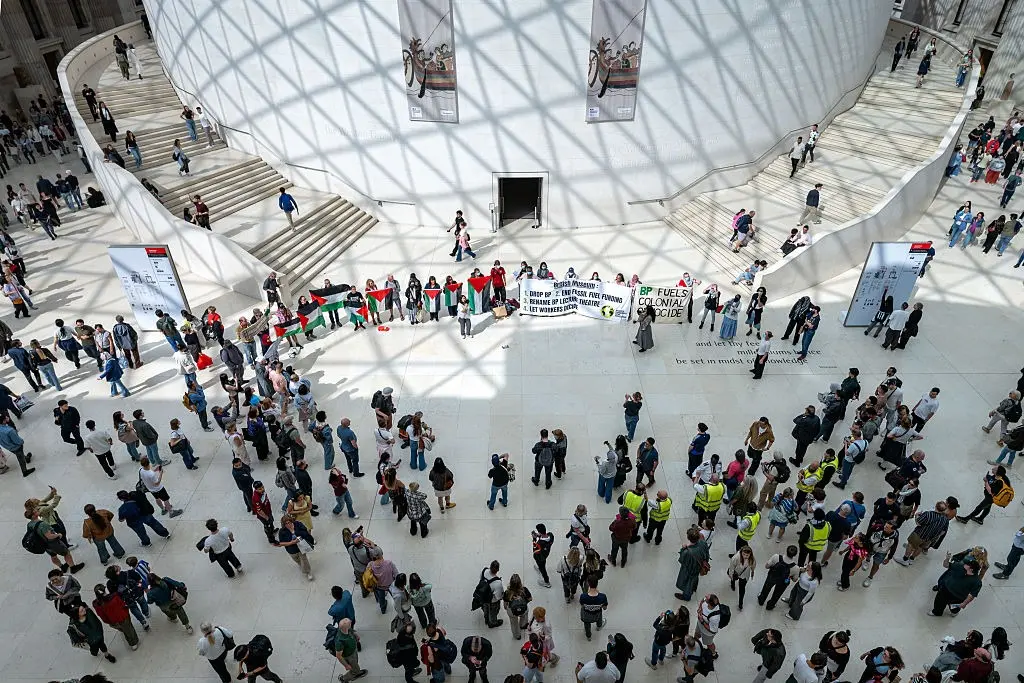
Capitalizing on the public outrage generated by the Middle East Eye revelations, the activist coalition Energy Embargo for Palestine—acting in collaboration with grassroots organizations A Space for Us Now and Camden Friends of Palestine—mobilized a direct action inside the British Museum.
Bypassing security thresholds into the museum’s cavernous Great Hall, demonstrators unfurled a massive, handcrafted textile they dubbed “the people’s tapestry.” The artwork, meticulously stitched together from panels created by local community members, featured explicit anti-war and anti-colonial slogans, including "Stop fueling genocide" and "Welfare not warfare."
Visitors milling through the light-filled public atrium were met with chants, flyers, and speeches condemning museum leadership. Security personnel monitored the demonstration closely, but the action proceeded peacefully, drawing significant attention from international media outlets and digital platforms.
Supporting Context & Metrics: The Anatomy of Museum Activism
To fully understand the weight of Saturday’s demonstration, one must examine the broader financial and political landscape surrounding the British Museum and its ongoing controversies.
The BP Sponsorship Legacy
For decades, the British Museum has relied on corporate sponsorships from fossil fuel majors, most notably British Petroleum (BP). Despite mounting climate crises and fierce campaigns led by groups such as BP or Not BP?, the museum has been remarkably slow to divest from oil and gas money compared to its institutional peers.
While institutions like the Tate galleries, the National Portrait Gallery, the Royal Shakespeare Company, and the National Gallery have all officially severed ties with fossil fuel companies in the wake of public pressure and staff walkouts, the British Museum has lagged behind. Although the institution previously renamed its BP Lecture Theater, it has repeatedly renewed overarching partnerships, making it the last major cultural landmark in London maintaining a formal relationship with the energy conglomerate.
The Demands of Energy Embargo for Palestine
The coalition behind Saturday’s action has issued a clear, uncompromising manifesto directed at the museum’s Board of Trustees and executive management. Their core demands include:
- Total Divestment from Fossil Fuels: The complete termination of all financial and institutional ties with BP and any other fossil fuel extraction companies.
- Rejection of Sanctioned and Controversial Philanthropy: A strict vetting process that bars donations from individuals or entities linked to illegal settlements, human rights abuses, or companies listed by the Boycott, Divestment, Sanctions (BDS) movement.
- Staff Empowerment via Ethics Committees: The establishment of an independent, staff-empowered ethics committee with binding authority over all future corporate sponsorships, high-value donations, and public events.
Localized Discontent and Worker Solidarity
The protest was not merely an international solidarity action; it was deeply rooted in local community grievances. Camden residents, local activists, and museum staff have increasingly voiced frustration over a perceived chasm between executive leadership and the museum’s workforce. Critics argue that museum directors operate in a vacuum, ignoring the values of the local population and the cultural sector at large.
"The interests of the British Museum management are in stark opposition to its workers, people across the culture sector, people in Camden, and to the general public," Energy Embargo for Palestine stated in a sharply worded post on Instagram following the action.
Official Statements and Institutional Responses
As of Monday, official statements from the British Museum’s leadership have remained guarded. Representatives for the museum issued a brief statement reiterating the institution’s commitment to public access, cultural education, and the preservation of world heritage.
"The British Museum is a platform for debate and a home to millions of years of human history," a museum spokesperson told reporters. "We respect the right of peaceful protest and freedom of expression, but we must also ensure that our galleries remain safe and accessible for all visitors who come to view our collections."
However, the museum has thus far declined to comment specifically on the $6.8 million donation from Igor Tulchinsky or the geopolitical implications of funding tied to West Bank settlements. Observers note that the silence reflects a deepening defensive posture within cultural institutions caught in the crosshairs of geopolitical conflicts and ethical donor scrutiny.
Legal and philanthropic experts point out that the museum faces a difficult tightrope walk. Rejecting multimillion-dollar philanthropic gifts at a time when public sector funding remains tight can severely impact exhibition programming and structural maintenance. Conversely, accepting tainted funds risks catastrophic reputational damage, staff revolts, and protracted public relations crises.
Future Outlook: A Turning Point for Cultural Institutions
The protest at the British Museum marks a watershed moment for the intersection of art, ethics, and geopolitics. As cultural institutions increasingly look to private wealth to make up for shortfalls in government funding, they are discovering that high-net-worth philanthropy comes with profound reputational risks.
The Shrinking Pool of "Clean" Donors
The convergence of climate activism and anti-colonial solidarity movements means that wealthy donors are under unprecedented public microscopes. Investigative journalism networks, armed with open-source intelligence and financial transparency databases, are routinely uncovering the provenance of museum gifts. For the British Museum, the Tulchinsky controversy demonstrates that accepting foreign millions for blockbuster shows can backfire spectacularly if those funds trace back to contested geopolitical zones.
What Lies Ahead for the British Museum?
Pressure on the British Museum’s leadership is unlikely to abate anytime soon. Labor unions within the cultural sector are expected to table emergency motions demanding greater transparency regarding donor vetting processes. Furthermore, grassroots coalitions have promised further disruptions if management continues to ignore their demands for fossil fuel divestment and ethical partnership reviews.
Whether the British Museum will follow the path of its peers and finally sever its ties to BP remains to be seen. However, Saturday’s unfurling of "the people’s tapestry" in the Great Hall sends an unmistakable message to the cultural establishment: the era of no-questions-asked corporate and billionaire philanthropy is rapidly drawing to a close. Public trust, once squandered on the altar of expediency, is proving far harder to curate than any historical artifact.




Comments
Facebook App ID not configured. Please add it in the Customizer.