
Executive Overview
In the intricate and often shadowy world of international art trafficking, illicitly acquired antiquities and fine art objects frequently vanish into private collections, never to be seen again. Yet, every so often, a triumph of modern provenance research, international cooperation, and institutional vigilance pierces the gloom.
More than thirty years after it was brazenly stolen under the cover of night from a zoo in northern France, Alfred Lepère’s 19th-century bronze masterwork, Faune Chasseur (1864), has been successfully recovered. The sculpture crossed the Atlantic Ocean, surfaced in an American auction catalog more than 4,000 miles from its original home, and was ultimately identified through rigorous pre-sale due diligence.
Today, the monumental bronze has been officially repatriated to its rightful custodians. It is once again on public display at the prestigious Musée de Picardie in Amiens, offering a beacon of hope for cultural heritage protection agencies worldwide. The recovery was spearheaded by the London-based Art Loss Register (ALR), whose database exposed the hidden, illicit provenance of a piece that bore no outward, obvious signs of a compromised history.
Read Also
This dramatic return not only highlights the enduring resilience of public museum collections but also underscores the vital, frontline defense maintained by international art recovery databases during an era marked by a global resurgence in cultural property crimes.
Detailed Chronology: From State Commission to Midnight Heist and American Exile
The modern journey of Faune Chasseur spans well over a century, tracing a complex arc from official 19th-century French patronage to audacious criminality, clandestine international transport, and ultimate salvation.
1863–1864: Creation and Official State Ownership
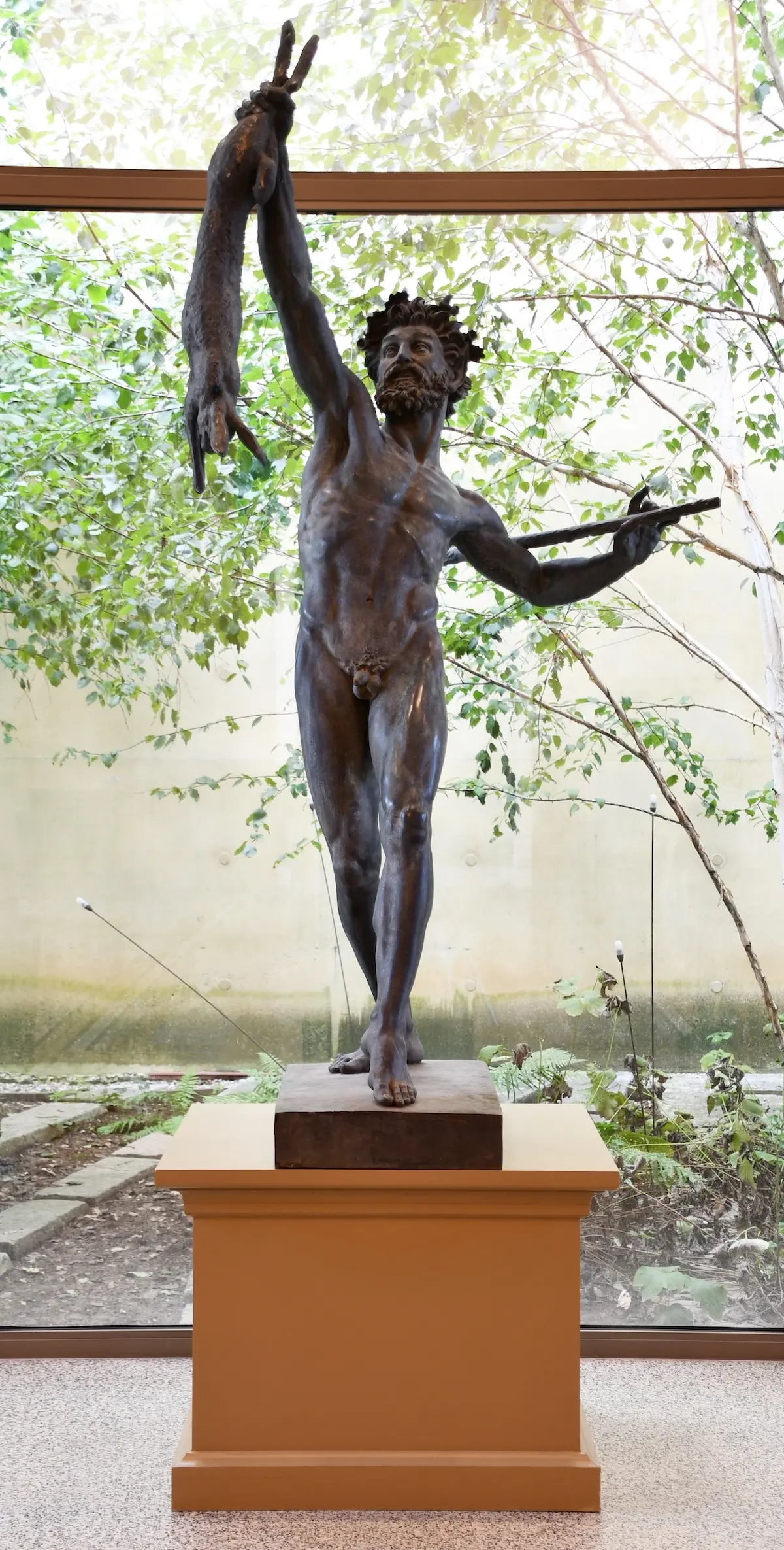
The genesis of the sculpture dates back to the height of the Second French Empire. In 1863, the French State commissioned sculptor Alfred Lepère to create a work that would embody classical motifs infused with the romanticism of the era. Completed in 1864, Faune Chasseur (Hunter Faun) captures a mythical faun—a woodland spirit associated with fertility and hunting—triumphantly holding a captured rabbit aloft.
Cast in heavy bronze, the piece stands as a testament to 19th-century metallurgical craftsmanship and academic sculpture. Because it was commissioned by the state, the artwork entered the French national cultural patrimony. It was subsequently placed under the management of the Centre National des Arts Plastiques (CNAP), the public establishment under the French Ministry of Culture charged with supporting, promoting, and inventorying the nation’s contemporary and historic visual art collection. For generations, works like Lepère’s were distributed on loan to regional museums, municipal institutions, and public spaces to enrich the cultural lives of citizens outside Paris.
1993: The Midnight Theft in Amiens
For a period of its modern life, Faune Chasseur was housed at the Amiens Zoo in northern France, serving as an aesthetic focal point for visitors blending natural history with fine art display. However, its prominent public placement also rendered it vulnerable.
In 1993, under the cover of darkness, thieves executed a calculated overnight raid on the zoo grounds. Despite the substantial physical dimensions and considerable weight of the monumental bronze sculpture, the perpetrators successfully detached, hoisted, and absconded with the artwork.
Local law enforcement and national heritage authorities launched investigations, but the trail quickly went cold. In the pre-digital era of the early 1990s, tracking stolen heavy metal sculpture proved exceedingly difficult. With no immediate ransom demands or leaks on the black market, authorities feared the worst: that the historic bronze had fallen victim to opportunistic metal thieves who would melt it down for its raw material scrap value—a grim fate that has claimed countless bronze and copper masterpieces worldwide. For more than thirty years, Faune Chasseur remained an official ghost in international police databases, its physical location entirely unknown to the French state.
2026: The American Discovery and Repatriation
The turning point arrived quietly in the late summer of 2026. An unnamed United States-based auction house, preparing a forthcoming fine art sale, consigned a large 19th-century bronze sculpture matching the description of Lepère’s lost work.
Adhering to industry best practices, the auction house submitted details of the consignment to the Art Loss Register for routine pre-sale clearance. ALR’s automated and manual cross-referencing systems immediately flagged the object against its global database of stolen cultural property. The database entry—logged decades prior following the Amiens Zoo theft—matched the consignment down to the artist, title, dimensions, and unique foundry characteristics.
With the illicit provenance unmasked before the hammer could fall, the auction house immediately halted the sale. Collaborative efforts involving international legal channels, cultural authorities, the CNAP, and ALR facilitated the swift, voluntary de-accessioning and return of the sculpture to France. By September 2026, Faune Chasseur was uncrated on European soil and formally transferred to the Musée de Picardie in Amiens, where it finally resumed its rightful place in the public trust.
Supporting Context & Metrics: The Mechanics of Modern Art Recovery
The recovery of Faune Chasseur is far more than a localized feel-good story; it serves as a masterclass in the technical and logistical realities of 21st-century art market regulation. To fully understand how a monumental sculpture can vanish for three decades only to be recovered intact, one must examine the metrics and methodologies governing cultural property protection.
The Role of Due Diligence in the Global Art Market
The international art market moves billions of dollars annually, operating largely on trust, discretion, and reputation. However, this high-value, fast-paced environment has historically been exploited by bad actors seeking to launder looted antiquities, Nazi-era plunder, and contemporary thefts.
Due diligence has thus evolved from an optional administrative afterthought into an essential legal and ethical compliance standard. Auction houses, galleries, and high-end dealers increasingly rely on comprehensive databases like the Art Loss Register—which maintains the world’s largest private database of lost and stolen art, antiques, and collectibles—to vet consignments before they enter public catalogues.

In the case of Faune Chasseur, the consignor in the United States may well have been an innocent downstream purchaser who acquired the piece through legitimate-seeming secondary channels over the preceding decades, completely unaware of its midnight heist in Amiens. This highlights a critical metric in art recovery: provenance laundering time. As art moves through multiple private hands, international borders, and unregulated estate sales, its suspicious origins are systematically scrubbed. Without institutional databases capturing historical police reports, these objects integrate seamlessly into legitimate commerce.
The Threat Matrix: Smuggling vs. Scrap Metal
Art crime analysts frequently divide thefts into two distinct categories: targeted intellectual/monetary heists (where thieves steal specific high-value items for private collectors or ransom) and opportunistic property crimes (where items are stolen for quick liquidity).
For monumental bronze sculptures, the threat matrix has historically skewed toward the latter. Heavy metal sculptures—particularly those displayed in open-air public spaces, parks, and zoos—are uniquely vulnerable to scrap metal theft. When copper and bronze commodity prices spike globally, public monuments face an elevated risk of being dismantled and fed into industrial smelters, turning irreplaceable centuries-old cultural heritage into anonymous metal ingots.
The recovery of Faune Chasseur provides a vital counter-narrative to this destructive trend. Despite weighing hundreds of pounds and spending thirty years in private, undocumented hands, the sculpture survived completely intact. It avoided the smelting furnace, proving that long-term disappearances do not automatically equate to total physical destruction.
Official Statements and Industry Perspectives
The successful repatriation of Alfred Lepère’s masterwork elicited strong reactions from cultural stewards, legal advocates, and art recovery specialists who view the case as a watershed moment for institutional security.
Speaking on the operational realities of the recovery, Charlotte Chambers-Farah, Business Development and Client Manager at the Art Loss Register, emphasized the fundamental importance of systemic vigilance within the trade:
"The recovery of this remarkable sculpture demonstrates why thorough due diligence is so important within the art market, where a stolen work can disappear for decades into private hands. Despite the considerable weight and size of this monumental sculpture, its whereabouts were unknown for more than 30 years before it appeared in a US auction catalogue more than 4,000 miles from where it was stolen. There were no obvious indications to the auction house that it had a problematic provenance, but by checking the work against our global database, its hidden past was established before it could be sold."
Chambers-Farah also framed the discovery within the broader, increasingly turbulent landscape of contemporary cultural heritage protection. In recent years, public institutions worldwide—most notably major national repositories like the Louvre—have faced a disturbing wave of high-profile thefts and security breaches targeting material and historic value. Addressing these modern vulnerabilities, she offered a note of cautious optimism:
"At a time when thefts in public institutions are once again targeting items for their material value, this recovery offers grounds for hope that their disappearance over a prolonged period does not necessarily mean that they have been melted down for scrap."
French cultural authorities, including representatives from the Centre National des Arts Plastiques and the Musée de Picardie, echoed these sentiments. In statements accompanying the unveiling of the restored exhibition, curators underscored the emotional and educational resonance of returning a state-owned masterpiece to the citizens of Amiens. For the Musée de Picardie, which houses one of regional France’s most distinguished collections of fine and decorative arts, the integration of Faune Chasseur bridges a painful historical gap left by the 1993 robbery.
Future Outlook: Challenges and Safeguards in Cultural Heritage Protection
While the return of Faune Chasseur is a definitive victory for international heritage preservation, museum directors, law enforcement agencies, and security experts warn that systemic vulnerabilities persist across the global art ecosystem. As illicit trafficking networks become increasingly sophisticated, safeguarding public and private collections requires a multi-layered, forward-looking defense strategy.
1. Technological Integration and Enhanced Tracking
One of the primary takeaways from the Amiens Zoo recovery is the indispensable value of centralized, digitized databases. Future security frameworks will likely mandate the widespread adoption of advanced object-tagging technologies—such as micro-chips, forensic DNA tagging, and high-resolution 3D laser scanning—for all major public art installations. When an object is digitally fingerprinted and cataloged from the moment of its creation or state acquisition, laundering its provenance through international borders becomes exponentially more difficult.
2. Cross-Border Regulatory Harmonization
Art theft is inherently transnational. Perpetrators frequently exploit jurisdictional gaps between countries with stringent export controls and those with lax secondary art market regulations. Strengthening international treaties, such as the UNESCO 1970 Convention on the Means of Prohibiting and Preventing the Illicit Import, Export and Transfer of Ownership of Cultural Property, will remain critical to ensuring that looted objects can be seized and repatriated without protracted, decades-long legal battles.
3. Raising Awareness Across the Secondary Market
Many auction houses and galleries still treat database checks as a secondary precaution rather than a mandatory prerequisite. Industry advocates are pushing for standardized compliance protocols across all tiers of the art market—from major multinational auction houses down to regional antique dealers. Educating private collectors about the legal and moral hazards of acquiring unverified antiquities remains essential to drying up the demand side of the illicit art economy.
Conclusion
The odyssey of Alfred Lepère’s Faune Chasseur—from a 19th-century French state commission to a midnight zoo heist, an American auction catalog, and finally a triumphant homecoming at the Musée de Picardie—stands as a powerful reminder of the endurance of art. It proves that vigilance pays off, databases save histories, and stolen cultural heritage can indeed find its way back into the light.



Comments
Facebook App ID not configured. Please add it in the Customizer.