
Executive Overview
In an era defined by geopolitical fractures, shrinking foreign aid budgets, and a historic resurgence in global child mortality rates, the world’s most influential global health philanthropy is making a high-stakes, multi-billion-dollar gamble. The Bill & Melinda Gates Foundation has officially ushered in a wholesale embrace of artificial intelligence, culminating in a sweeping announcement to distribute $1 billion over the next two years. This massive infusion of capital is designed to scale AI interventions across healthcare, education, and agriculture in some of the world’s most vulnerable regions.
This strategic pivot represents a profound philosophical and practical shift. Following a devastating cycle of international funding cuts that left thousands of rural medical clinics shuttered and hundreds of thousands of classrooms understaffed across sub-Saharan Africa and other developing zones, traditional foreign aid infrastructure has buckled. Rather than attempting to rebuild brick-and-mortar facilities on a depleted fiscal baseline, the Gates Foundation is betting that advanced artificial intelligence can act as a digital scaffold—compensating for systemic deficits, empowering overworked professionals, and democratizing access to critical services.
Yet, this vision is fraught with a paradox that even its chief architects openly acknowledge. Artificial intelligence, for all its computational power, requires physical infrastructure—reliable electrical grids, sustainable water supplies, broadband connectivity, and staffed outposts—to function effectively. When entire communities go dark due to funding rollbacks, downloading a weather forecasting app or deploying an AI math tutor becomes an insurmountable hurdle. Furthermore, this heavy tilt toward digital innovation arrives against a backdrop of deep personal ambivalence from Bill Gates himself, who has recently warned that artificial intelligence could easily become "the worst source of injustice" and usher in a deeply turbulent era.
Read Also
This investigative report examines the trajectory of the Gates Foundation’s AI rollout, exploring the friction between digital utopianism and physical austerity, the geopolitical realignments driving these technological partnerships, and the fundamental question facing the international community: Can we afford to invest in the digital infrastructure of the future at the expense of the basic human needs of today?
Detailed Chronology: From Davos to a Billion-Dollar Commitment
The evolution of the Gates Foundation’s artificial intelligence strategy did not happen in a vacuum; it has been an accelerating response to a rapidly deteriorating global aid landscape over the past two years.
The Opening Salvo at Davos
The pivot began in the Swiss Alps earlier this year at the World Economic Forum in Davos. Standing before an audience of global leaders and philanthropists, Bill Gates announced a modest yet symbolic $50 million partnership between his foundation and OpenAI. The objective was straightforward: leverage generative AI to improve healthcare outcomes in Rwanda.
The announcement carried acute irony. Just a month prior, the Gates Foundation had released a harrowing internal report documenting widespread global health funding cuts and the catastrophic collapse of foreign aid infrastructure. For the first time this century, the report recorded an alarming rise in global child deaths. Even as the United States and other Western donors hemorrhaged funding for critical vaccine rollbacks, maternal healthcare programs, and HIV treatment regimens, Gates struck an uncharacteristically optimistic tone. Speaking to Reuters, he argued that "using innovation, using AI, I think we can get back on track."
Scaling Up: Anthropic and the Billion-Dollar Pledge
What began as an experimental partnership with OpenAI quickly snowballed into an institutional mandate. Just a few months after the Davos gathering, the foundation announced a substantially larger $200 million partnership with AI lab Anthropic, focusing on advanced reasoning models for biomedical research and public health deployment.
The velocity of this shift culminated this Tuesday, when the Gates Foundation formally unveiled its most aggressive financial commitment to date: a $1 billion plan to be doled out over the next 24 months. The capital is earmarked specifically for integrating AI tools into grassroots public services—ranging from diagnostic assistance for rural clinicians to personalized agronomy guidance for smallholder farmers and interactive tutoring models for students in resource-constrained classrooms.
Supporting Context & Metrics: The Crisis of Austerity and the Promise of the Digital Fix
To understand why a global health foundation is pouring ten-digit figures into machine learning models, one must examine the apocalyptic state of traditional foreign aid.
The Fallout of Aid Reductions
Last year’s foreign aid cuts delivered a devastating blow to the developing world. According to data compiled by humanitarian agencies and UNICEF, sweeping reductions in bilateral aid forced the closure of thousands of frontline clinics and hundreds of thousands of classrooms. In regions where healthcare workers and educational supplies were already stretched to breaking points, these cuts transformed systemic strain into outright collapse. Satellite imagery analyzed by academic researchers revealed that entire rural communities in sub-Saharan Africa effectively "went dark" following the withdrawal of U.S. Agency for International Development (USAID) and allied funding streams, losing the electrical stability required to power basic community services.
The Logic of the Digital Band-Aid
In response to this physical retrenchment, global health strategists are turning to technological leaps reminiscent of the "leapfrogging" phenomenon seen during the telecommunications revolution. Just as much of the developing world bypassed traditional copper-wire landline telephony and went straight to mobile cellular networks, the current hypothesis is that AI can bypass the agonizingly slow process of building traditional physical infrastructure.
Mark Suzman, CEO of the Gates Foundation, frames this as a pragmatic necessity. "This is the most transformative technology of our lifetime," Suzman notes. While acknowledging the "very real risks and challenges" surrounding AI safety, bias, and corporate consolidation, Suzman insists that the technology presents tangible opportunities to improve lives immediately.
Early pilot programs lend empirical weight to this argument. In several Kenyan health clinics, an AI-assisted diagnostic tool funded by the foundation has reportedly improved the diagnostic accuracy of community health workers by 16 percent. In a country like Kenya, where doctor-to-patient ratios far exceed safe thresholds, a 16 percent increase in diagnostic precision translates directly to lives saved, treatments targeted, and complications averted.

+-----------------------------------------------------------------+
|               THE DIGITAL LEAPFROGGING PARADIGM                 |
+-----------------------------------------------------------------+
| TRADITIONAL MODEL (Slow & Costly)                               |
| Build Physical Infrastructure -> Train Specialists -> Scale Care  |
+-----------------------------------------------------------------+
| AI AUGMENTATION MODEL (Fast & Scalable)                         |
| Deploy AI Models -> Empower Existing Workers -> Optimize Yields   |
+-----------------------------------------------------------------+
The Geopolitical Alignment: The "America First" Tech Push
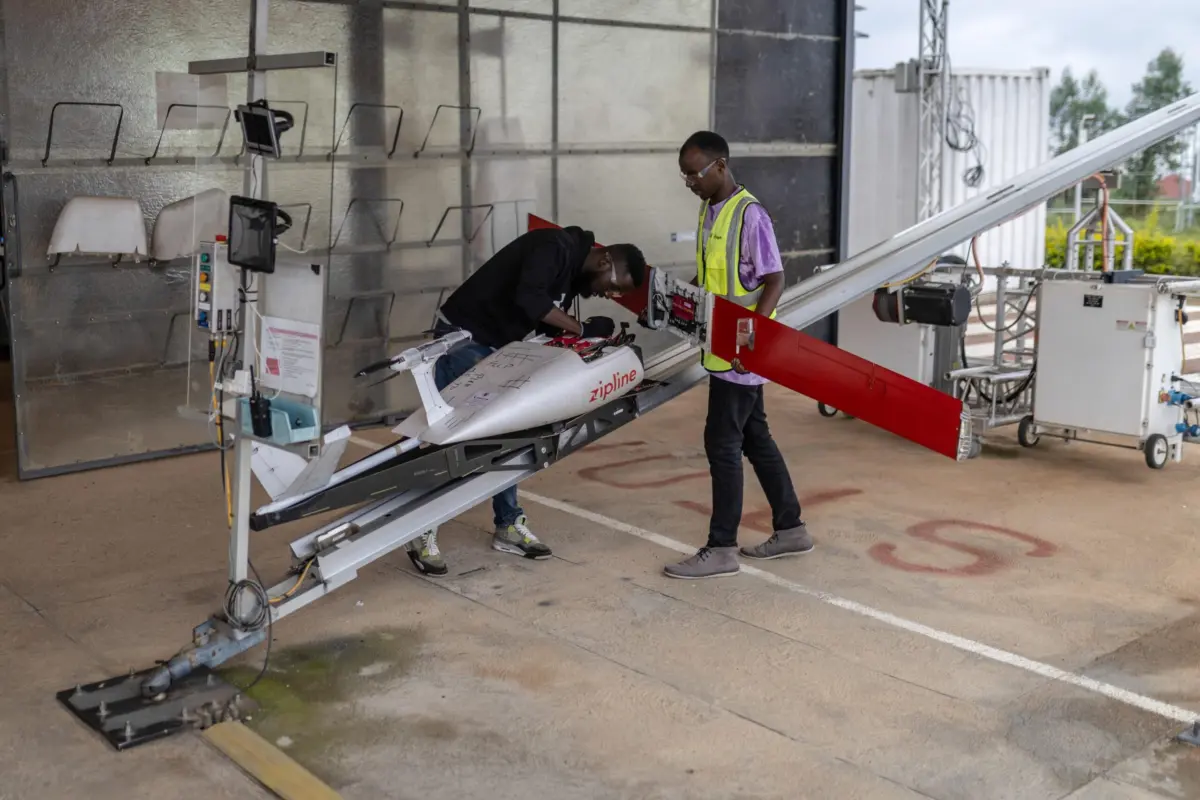
Intriguingly, the pivot toward technological solutions in global health is not isolated to private philanthropy; it enjoys strange-bedfellow alignment with geopolitical shifts, including the Trump administration. Recognizing that traditional foreign aid faces intense domestic political skepticism, the U.S. State Department announced a $150 million partnership with drone delivery pioneer Zipline to transport medical supplies across several developing nations.
Zipline’s operations in countries like Rwanda offer a clear proof-of-concept for high-tech intervention. In rugged rural corridors where driving to the nearest hospital can take hours over winding, unpaved terrain, Zipline’s autonomous drones deliver life-saving blood transfusions and vaccines within minutes.
However, this success story exposes the exact friction point troubling development experts: drones still need a landing pad, and AI diagnostic tools still need a physical clinic. Enoh Ebong, president of the global development department at the Center for Strategic and International Studies, highlighted this vulnerability in discussions with NPR, noting that "without the underlying infrastructure, like roads, energy and power and unless there is accessibility, rural and otherwise, then all of these solutions will stop short."
Official Statements & Institutional Perspectives
The internal debate within the philanthropic and global health community is characterized by profound tension between utopian possibilities and cautionary realism.
-
Bill Gates, Co-Chair of the Gates Foundation:
"In poorer countries with enormous health worker shortages and lack of health systems infrastructure, AI can be a game-changer in expanding access to quality care… [However, it] will either be the greatest equalizer ever invented, or the worst source of injustice, ushering in one of the most turbulent times in human history."
In recent interviews with mainstream publications, Gates has struck a surprisingly sober tone, admitting that the net societal impact of artificial intelligence remains an open and terrifying question. Yet, his organization’s financial actions demonstrate a belief that abstaining from the race is far more dangerous than participating in it.
-
Mark Suzman, CEO of the Gates Foundation:
"We’re seeing this very much as a both/and… Traditional funding for education and healthcare remains the bedrock for long-term economic growth, which AI is meant to supplement, not replace."
Suzman defends the foundation’s heavy tech investments by arguing that if philanthropic organizations do not actively shape and fund equitable AI deployment now, the transformative benefits of these technologies—such as breakthrough cancer therapies and personalized medicine—will accrue exclusively to wealthy nations and individuals who can pay commercial rates.
Future Outlook: The Great Global Health Gamble
As the Gates Foundation begins dispersing its historic $1 billion AI commitment over the coming two years, the global health sector stands at a historic crossroads. The fundamental question raised by this pivot extends far beyond the balance sheets of philanthropy: Do we spend our increasingly scarce resources on the digital infrastructure of the future at the peril of our immediate, physical survival needs?
There are historical precedents suggesting that digital tools can profoundly alter socioeconomic realities ahead of physical infrastructure. The explosive growth of mobile money platforms across East Africa—such as Kenya’s M-Pesa—allowed millions of "unbanked" citizens to securely store, transfer, and borrow money long before traditional brick-and-mortar bank branches ever reached their villages. If AI-driven health assistants and agricultural models can replicate that leap, bringing localized diagnostic and educational expertise to millions who would otherwise have zero access, the $1 billion bet will be remembered as a stroke of visionary genius.
Conversely, if the physical bedrock of society—electrical grids, schools, roads, and staffed local clinics—continues to crumble under the weight of sustained foreign aid cuts, the deployment of advanced software risks becoming an exercise in digital displacement. An AI math tutor is of little use to a child whose school has no roof, and a diagnostic algorithm cannot save a patient if the local clinic has been shuttered for lack of basic gauze and antibiotics.
Ultimately, the next two decades of global health will be defined by the guardrails and deployment strategies established right now. As Mark Suzman noted, these decisions shape the future. Whether artificial intelligence becomes the great equalizer that rescues a starved global aid system, or merely a high-tech veneer masking deep systemic abandonment, remains the defining question of our generation.




Comments
Facebook App ID not configured. Please add it in the Customizer.