
Executive Overview
As cultural institutions across the United States scramble to mark the nation’s 250th anniversary, the vast majority have defaulted to safe, anodyne programming. From coast to coast, museums have staged predictable collection shows centered on vague, feel-good notions of democracy, civic resilience, and historical pride. These exhibitions—often polite, sanitized, and deeply concerned with maintaining institutional equilibrium—risk flattening the turbulent contradictions of the American experiment into a neat, digestible narrative.
Enter Taryn Simon.
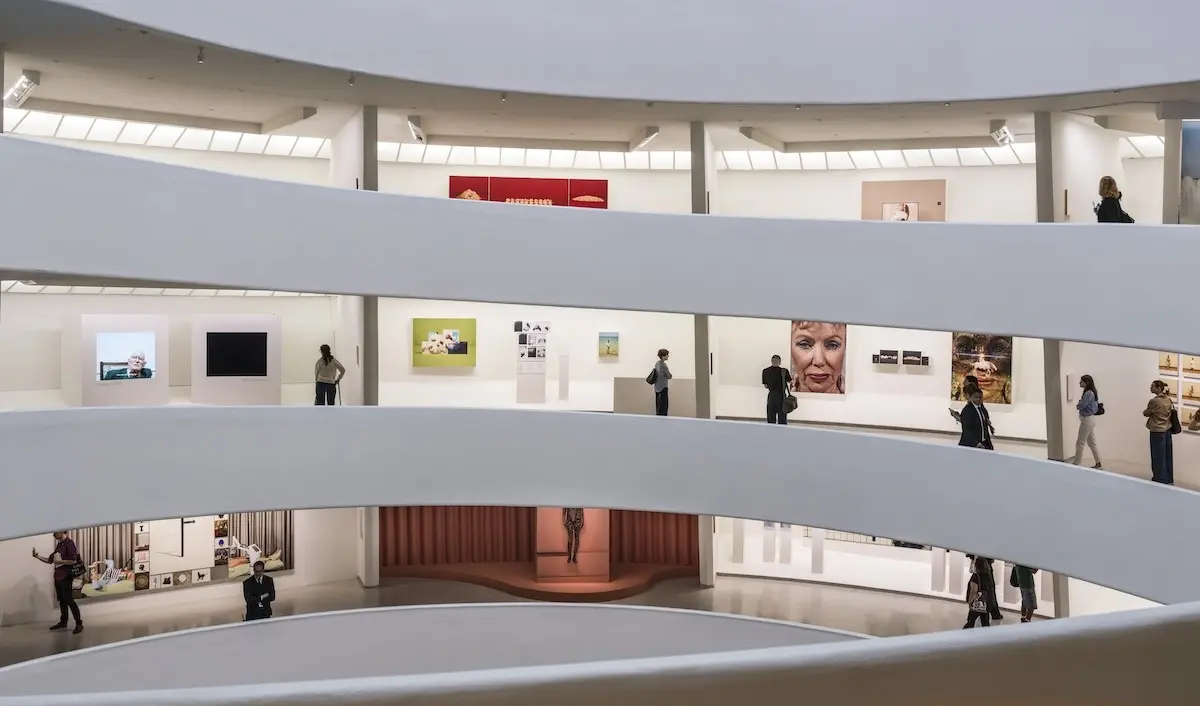
Opening to the public at the Solomon R. Guggenheim Museum in New York, Simon’s breathtaking new exhibition shatters this complacent consensus. Titled Father Country I Do Love You, the 42-part installation is a paranoid, high-stakes exploration of surveillance, state-sponsored violence, institutional deceit, and the most enduringly American of all geopolitical motifs: foreign intervention. Conceived by curator Nancy Spector and brought to fruition by Nat Trotman, the exhibition fills the Guggenheim’s iconic rotunda with a sprawling, dizzying mosaic of more than 1,000 photographs, accompanied by thousands of words of text.
Read Also
At once a hefty conceptual artwork and an unorthodox form of investigative reporting, the exhibition takes root in a chance encounter from 2017, when Simon discovered a former intelligence agent’s name in 1990s FBI files. Over the course of nearly a decade, Simon tracked the man down, forged a complex rapport, and conducted extensive interviews. The resulting installation resists linear history, forcing viewers to grapple with an edgeless, chaotic, and perpetually unstable American narrative. In doing so, Simon bypasses the sanitized pageantry of the nation’s semiquincentennial to hold a mirror up to an empire tangled in its own secrets.
Detailed Chronology: From a Maryland Diner to the Guggenheim Rotunda
The genesis of Father Country I Do Love You reads like the setup for a geopolitical thriller, yet its roots are firmly planted in the meticulous, multi-year methodologies that have defined Simon’s career for over two decades.
The 2017 Genesis
The project began quietly in 2017. While reviewing declassified and archived Federal Bureau of Investigation files dating back to the 1990s, Simon stumbled across a distinct operational name. Refusing to let the thread drop, she initiated a private investigation of her own, ultimately tracking the former operative down. Their initial face-to-face meeting took place in an unglamorous setting: a Mexican restaurant in Maryland.

Over bowls of chips and salsa, an unlikely rapport was established. Over the better part of the next decade, Simon and the anonymous agent met repeatedly. Throughout the interviews, Simon made a deliberate artistic choice: she has strictly concealed the agent’s true identity. By keeping him anonymous, Simon imbues him with an everyman quality—he could be your neighbor, a stranger on the subway, or a ghost in the machine.
A Decade of Investigative Art
As the interviews progressed, the scope of Simon’s project expanded far beyond a simple biographical sketch. The 42-part installation acts as a narrative mosaic, charting the agent’s life from his birth at an undisclosed hospital in Exeter, New Hampshire, through his deployment in overseas operations across sensitive global flashpoints, including China and Saudi Arabia.
Yet, reducing the show to a mere biography of a spook would fundamentally miss the point. Simon weaves an intricate web of seemingly disparate people, corporations, and locations into the agent’s orbit. Visitors to the Guggenheim are confronted with a breathtakingly dense constellation of imagery and text:
- A Beverly Hills beauty enterprise operated by an individual tied to the January 6 insurrection.
- A peaceful YMCA summer camp in New Hampshire, juxtaposed against the innocent children who attend it.
- Eyewitness accounts and aftermath imagery from the devastating 1998 U.S. embassy bombing in Nairobi, Kenya.
- The obscure manufacturer behind specialized compression garments known as MooreWraps.
During the press preview, critics and journalists noted that even a dedicated hour—the standard allotment for opening-day press tours—barely scratched the surface of the visual data. Truly digesting Father Country I Do Love You demands an investment of at least three hours of deep, contemplative looking and reading.
Supporting Context & Metrics: The Blurring of Fact, Fiction, and Memory
To understand the weight of Simon’s Guggenheim installation, one must examine her artistic lineage. Simon first rose to international prominence with The Innocents (2000–03), a searing photographic project documenting men who had been wrongfully convicted of crimes they did not commit, often captured standing at the very geographic sites where their false accusations originated. This was followed by monumental projects like A Living Man Declared Dead and Other Chapters I–XVIII (2008–11), which traced elaborate bloodlines and was named after four Indian men declared legally dead as part of corrupt inheritance plots.
In Father Country I Do Love You, Simon supercharges her signature formula—pairing massive grids of meticulously captured photographs with dense blocks of explanatory text—to dismantle the very concept of objective truth.

The Geography of Espionage
Simon often subverts the viewer’s expectations by presenting images that initially appear tranquil, only to reveal dark undercurrents through their captions. In one grid, subjects are shown standing near sun-dappled bridges in serene forests. One particular photograph features a woman standing beside a placid brook.
The accompanying wall text identifies her as Sakeena Majul, a Saudi immigrant living in the United States. A quote from Majul reflects on her new home: "I deeply appreciate how strange it is in the grand sweep of history… The ability to move earth at this scale would have seemed like magic when I was a kid."
However, an adjacent text reveals the true gravity of the location: the forest is Foxstone Park in Virginia—the exact dead-drop site where Robert Hanssen, the notorious American double agent working for the Soviet Union and Russian intelligence, once left classified documents for his KGB handlers. Through Simon’s connective tissue, Majul’s immigrant journey is intellectually tethered to Hanssen, who is in turn linked to her anonymous federal agent, who operated in the counterintelligence ecosystem that hunted men like Hanssen.
The Collapse of Authenticity
The veracity of these sweeping connections is frequently hazy, slippery, and deliberately difficult to authenticate. While the Foxstone Park dead drop is a matter of public FBI record, other threads in Simon’s web challenge the boundaries of proof.
Alongside photographs of the waters off Long Island where TWA Flight 800 mysteriously exploded in 1996 amid an unexplained streak of light, Simon features a blunt quote from her anonymous agent: "Some things can’t be proven."
This sentiment echoes throughout the exhibition. In one striking inclusion, Simon photographs actress Jodie Foster—who famously portrayed FBI trainee Clarice Starling in Jonathan Demme’s cinematic masterpiece The Silence of the Lambs—with ink-stained fingers at an FBI fingerprinting lab. According to the agent, he personally witnessed Foster training for her iconic role on-site. Whether this anecdote is absolute historical fact, an exaggerated war story, or an outright fabrication is almost irrelevant. The visual prompt immediately triggers the viewer’s collective cultural memory of Hollywood, cinema, and the mythical aura of federal law enforcement.

Institutional Resistance and Memory Failure
Simon’s exploration of memory and defensiveness is further highlighted in her interaction with a public affairs officer at the Defense Logistics Agency. According to wall texts, the official "repeatedly injured himself and threatened Taryn Simon and her crew" during a contentious four-hour photoshoot in 2021.
In a newly commissioned two-channel video installation, the man claims he has no recollection of the hostility, though he carefully avoids outright denying Simon’s version of events. Periodically, one of the two video screens plunges into absolute darkness—a stark, brilliant visual metaphor for the black holes, redactions, and unretrievable answers that plague government accountability.
Official Statements and Institutional Perspectives
The realization of an exhibition of this magnitude requires a delicate alignment between an uncompromising artist and a major cultural institution willing to weather controversy.
Nancy Spector, who initially conceived the project, along with curator Nat Trotman, provided the institutional scaffolding necessary to bring Simon’s sprawling vision into the Frank Lloyd Wright-designed rotunda. By handing over the museum’s primary architectural space to an installation that critiques state power, surveillance, and institutional opacity, the Guggenheim has positioned itself as a rare venue willing to forgo polite anniversary celebrations in favor of rigorous, politically charged inquiry.
While the federal agencies and corporations referenced in the exhibition have largely maintained silence regarding Simon’s provocative pairings, voices from the psychological and medical communities dealing with the fallout of state secrecy have begun to weigh in.
As one psychiatrist who regularly treats members of the American intelligence community remarked to Simon during her research:

"People come in with their story all tangled up inside of them."
Playing the role of an analyst to an addled, anxious American id, Simon’s exhibition provides the space—and the rope—for the nation to continue tying itself in knots as it attempts to process two and a half centuries of geopolitical trauma, unchecked power, and moral ambiguity.
Future Outlook: A New Benchmark for Historical Reflection
As Father Country I Do Love You settles into its six-month run at the Guggenheim—remaining on view through March 14, 2027—its ripple effects across the contemporary art and journalistic landscapes are already palpable.
By treating American history as edgeless, chaotic, and permanently malleable, Simon challenges the comfortable domestic mythologies promoted elsewhere during the country’s 250th-anniversary programming. She rejects the notion that the nation’s past was ever cleanly confined within its geographic borders, or that its actions can be summarized in a neat celebratory brochure.
For visitors willing to invest the requisite hours into navigating its labyrinthine galleries, the exhibition offers no easy answers. Instead, it leaves them stranded in a productive state of paranoia and critical inquiry. In an era defined by deepfakes, institutional distrust, and endless geopolitical entanglements, Taryn Simon has not only delivered the defining artwork of the year—she has provided an essential roadmap for how contemporary culture must confront the dark, unmapped corners of the American psyche.


Comments
Facebook App ID not configured. Please add it in the Customizer.