
Executive Overview
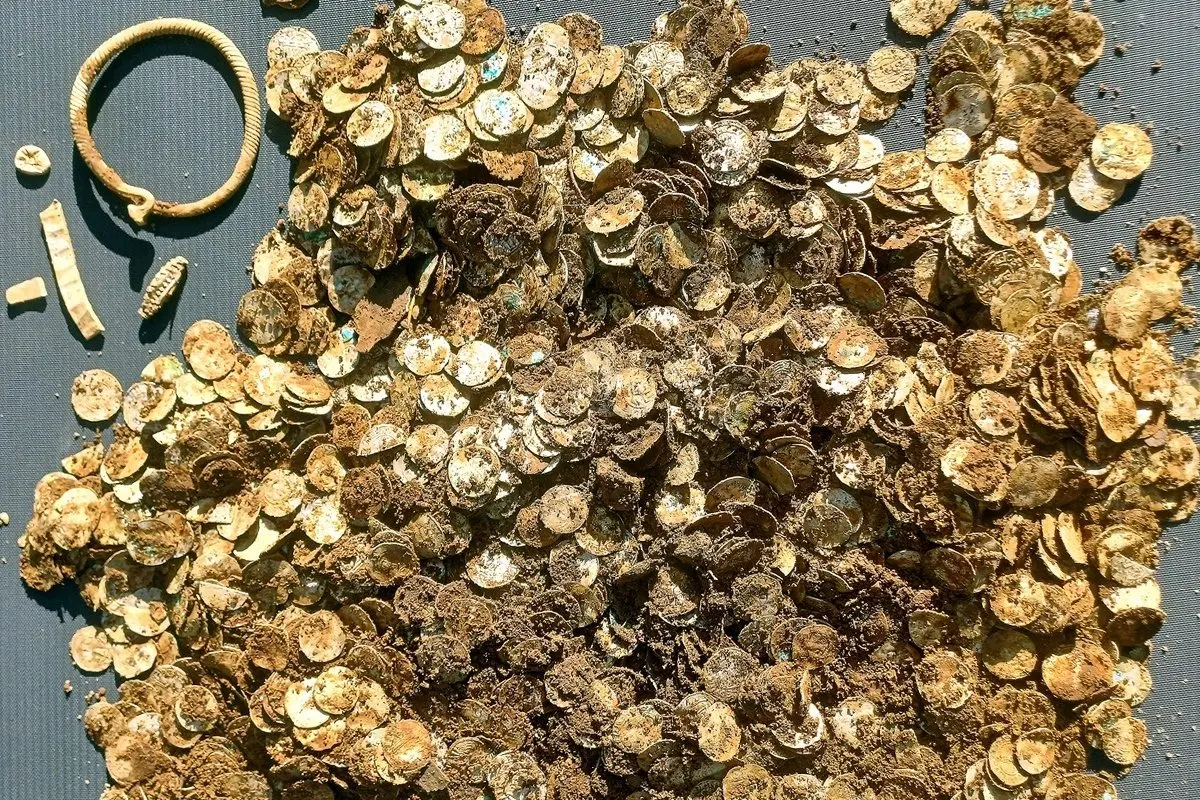
In what archaeological authorities are calling a once-in-a-generation discovery, an amateur metal detectorist has unearthed the largest Viking-era silver coin hoard ever found in Finland. Recovered near the historic church village of Sysmä in southern Finland, the massive trove weighs nearly 10 pounds and consists of thousands of individual silver coins, intricate jewelry fragments, and precious artifacts.
Experts at Lahti Museums have confirmed that the scale of the find eclipses any previous Viking Age discovery in the country, shattering records that have stood for more than a century. The previous benchmark—a cache discovered in Nousiainen in 1895—weighed slightly less than five pounds and contained roughly 1,700 coins.
What makes the Sysmä discovery uniquely significant is not just its sheer weight and monetary value during the medieval era, but the astonishing preservation of the organic vessels that held the treasure. Unearthed nearly 18 inches below the forest floor, the silver was contained within two straw receptacles buried approximately 40 feet apart. The survival of these fragile organic containers offers archaeologists a rare, pristine micro-environment to study ancient deposition practices, long-distance trade routes, and the socioeconomic landscape of Finland’s Late Iron Age.
Read Also
As conservators begin the painstaking process of cleaning, separating, and analyzing the thousands of artifacts, historians anticipate that the find will fundamentally rewrite our understanding of Norse-Finnic interactions, regional wealth distribution, and the security dynamics of the medieval northern world.
Detailed Chronology: From a Sunday Sweep to a National Discovery
The extraordinary series of events began on September 3, transforming an ordinary afternoon into a milestone moment for Scandinavian archaeology.
September 3: The Initial Signal
Kalle Lappinen, an experienced amateur metal detectorist operating in the rural expanses of southern Finland, was scanning a wooded area near the Sysmä church village. Metal detecting is governed by strict heritage protection laws in Finland, requiring hobbyists to report finds immediately and cooperate closely with regional museums.
Operating under these protocols, Lappinen received a strong, high-conductivity signal that hinted at a substantial mass of non-ferrous metal buried beneath the topsoil. Upon initial excavation, he realized he had not merely stumbled upon a stray agricultural tool or a solitary medieval coin, but a vast, densely packed accumulation of precious metal. Recognizing the historical sensitivity of the location, Lappinen immediately ceased unauthorized digging and alerted local heritage authorities, initiating a rapid response from professional archaeologists.
Mid-September: Archaeological Recovery and Extraction
Within days, a team of specialists from Lahti Museums arrived at the site to conduct a controlled, stratigraphic excavation. Working meticulously with trowels, brushes, and soil-sieving screens, the archaeologists mapped the exact spatial distribution of the find.
Their investigation revealed a sophisticated deposition strategy. The hoard was split between two distinct straw containers buried approximately 18 inches deep in the earth, spaced roughly 40 feet apart. This separation immediately raised profound questions for the research team: Were the vessels buried simultaneously by a single owner wishing to diversify the risk of loss, or were they deposited at different times by separate individuals responding to distinct regional crises?
The excavation team successfully lifted the delicate organic remnants along with their heavy metallic contents, transporting them under secure conditions to specialized conservation laboratories.
Current Phase: Laboratory Analysis and Conservation
As of late September, the artifacts are undergoing stabilization. Because the coins are fused together by centuries of corrosion and packed tightly within the degraded straw matrices, conservators cannot simply dump and count the contents. Each coin must be chemically and mechanically isolated, cleaned of soil and mineral crusts, and cataloged individually. While the exact final count is yet to be definitively established, preliminary weight metrics confirm the hoard scales in at nearly 10 pounds of solid silver—a royal ransom by medieval standards.
Supporting Context & Metrics: The Archaeological and Historical Significance
To truly grasp the magnitude of the Sysmä discovery, one must examine the broader historical landscape of Finland during the Late Iron Age and the Viking Period (roughly spanning from 800 AD to 1050 AD).
The Scale of the Sysmä Hoard in Context
For generations, the gold standard of Finnish numismatic discoveries was the Nousiainen hoard, unearthed in 1895 in Southwest Finland. That collection weighed just shy of five pounds and contained approximately 1,700 coins alongside various silver ornaments.
The Sysmä find more than doubles the weight of the Nousiainen discovery. While the final coin count is still pending full separation, preliminary estimates suggest it easily surpasses previous national records. To put this into perspective, silver hoards of this magnitude are exceptionally rare in Finland compared to neighboring Sweden, Gotland, or Denmark, where tens of thousands of Viking-age coins are routinely recovered. Finland was historically a peripheral zone in terms of centralized monetary economies, making major bullion deposits rare windows into the region’s economic life.
| Feature / Metric | The Sysmä Hoard (2026) | The Nousiainen Hoard (1895) |
|---|---|---|
| Discovery Date | September 3, 2026 | 1895 |
| Discoverer | Kalle Lappinen (Amateur Detectorist) | Local laborers / agricultural workers |
| Location | Sysmä church village, southern Finland | Nousiainen, Southwest Finland |
| Total Weight | Nearly 10 pounds (~4.5 kg) | Just under 5 pounds (~2.2 kg) |
| Estimated Coin Count | Several thousand (processing ongoing) | ~1,700 coins |
| Container Type | Two straw vessels buried 40 feet apart | Standard subsurface deposit |
| Associated Artifacts | Silver fragment, bracelet, clasp, bead | Assorted ornaments and jewelry |
Beyond Coins: The Accompanying Artifacts
While the sheer volume of silver coins dominates headlines, archaeologists emphasize that the non-numismatic items found within the Sysmä containers are equally critical for cultural interpretation. The hoard includes:
- A Silver Fragment: Indicative of Hacksilber (hack silver), a system where precious metal objects were routinely chopped into smaller pieces and weighed on balance scales to facilitate trade transactions of varying values.
- A Silver Bracelet: A common form of portable wealth and personal adornment across the Viking world, frequently used as bullion currency.
- A Silver Clasp: Demonstrating fine craftsmanship and offering stylistic clues regarding the cultural affiliations of the owner.
- A Rare Bead: Serving as an exotic trade marker, likely sourced from distant manufacturing centers in the Baltic, Middle East, or continental Europe.
The Mystery of the Straw Containers
The survival of organic materials like straw after more than a millennium underground is an extraordinary stroke of archaeological luck. Soil acidity, moisture fluctuations, and microbial activity typically consume plant fibers within decades. However, the antimicrobial properties of heavy concentrations of silver ions can sometimes inhibit bacterial growth in the immediate vicinity of a metal hoard, unintentionally creating a micro-preservation zone for organic packaging.
Researchers expect that laboratory analysis of the straw fragments will reveal the exact plant species used, weaving techniques employed by local craftspeople, and potentially environmental data about the local ecosystem at the time of burial.
Official Statements and Expert Perspectives
The discovery has sent ripples of excitement through the Nordic academic community, prompting statements from leading archaeologists, museum directors, and cultural heritage officials.
Dr. Elina Rantasalo, senior archaeologist at Lahti Museums, emphasized the rarity and methodological importance of the find during a regional press briefing:
"We are looking at a landmark discovery for Finnish archaeology. Hoards of the Viking Age are discovered on rare occasions, but finding a deposit weighing nearly 10 pounds—surpassing even the legendary Nousiainen find of the 19th century—is unprecedented in modern times. What excites us even more as scientists is the preservation of the straw containers. This gives us an unbroken physical context that standard treasure-hunting completely erases."
Kalle Lappinen, the amateur detectorist credited with the find, expressed his humility and awe regarding the historical weight of his afternoon excursion:
"When the signal rang out, I knew it was deep and strong, but nothing prepares you for the moment you realize you are touching history on this scale. My first instinct was to step back, ensure the site was undisturbed, and call the professionals. Knowing that this will help researchers understand our shared past makes the entire experience deeply rewarding."
Cultural heritage legal experts have also praised the collaborative dynamic between amateur detectorists and professional institutions in Finland. The framework ensures that while hobbyists can pursue their passions across the landscape, national treasures are systematically protected, scientifically excavated, and preserved in public museums rather than dispersed into the illicit antiquities black market.
Future Outlook: What Lies Ahead for the Sysmä Treasure?
As the initial excitement of the discovery transitions into methodical scientific investigation, researchers have outlined a multi-phase roadmap for the Sysmä hoard.
Numismatic and Metallurgical Mapping
Over the coming months, numismatists will analyze the individual coins as they emerge from conservation. Viking-age hoards in the Baltic region frequently include a cosmopolitan mix of currency: Islamic dirhams brought north via the Volga trade routes, Anglo-Saxon pennies acquired through raiding or trade (often known as Danegeld), and German denarii minted in the Holy Roman Empire.
Identifying the mint locations and chronological spread of the coins will provide a definitive terminus post quem—the earliest possible date for when the hoard could have been buried. Metallurgical testing using X-ray fluorescence (XRF) and mass spectrometry will also reveal the purity of the silver and trace elemental signatures, potentially pointing to the original mines or bullion pools from which the silver was smelted.
Reconstructing Trade and Security Networks
Historians are eager to contextualize why such a massive concentration of wealth was buried near Sysmä. During the Late Iron Age, southern Finland was an active crossroads of cultural exchange, situated between Scandinavian Norse populations, Baltic tribes, and inland Finnic groups.
The accumulation of 10 pounds of silver represented a staggering fortune—capable of purchasing large tracts of land, multiple livestock herds, or commissioning fleets of sea-faring vessels. The burial of such wealth typically correlates with periods of acute societal stress, conflict, shifting trade hegemonies, or personal misfortune where the owner was unable to return to reclaim their assets.
Exhibition and Public Access
Once conservation, cleaning, and cataloging are fully completed, Lahti Museums plans to curate a dedicated public exhibition showcasing the Sysmä hoard in its entirety. Cultural ministers have hinted that due to its national significance, portions of the find may eventually travel to the National Museum of Finland in Helsinki, allowing the public to witness firsthand the glittering legacy of the Viking Age.
For now, the thousands of silver coins rest safely in climate-controlled laboratory vaults, whispering secrets of medieval commerce, hidden fortunes, and the tumultuous borderlands of the ancient North.


Comments
Facebook App ID not configured. Please add it in the Customizer.