
Executive Overview
When the creative team behind Paramount+’s critically acclaimed Star Trek: Strange New Worlds first unveiled the episode titles for its upcoming fourth season earlier this year, a single entry sent immediate shockwaves through the global fandom. Positioned in the definitive, high-stakes anchor spot as the season finale was a title rich with franchise history and narrative peril: "Tomorrow’s Enterprise."
Even out of context, the title served as an unmistakable thematic nod to "Yesterday’s Enterprise," the legendary third-season episode of Star Trek: The Next Generation widely considered one of the greatest hours of television science fiction ever produced. However, astute fans immediately began speculating that the climactic placement of "Tomorrow’s Enterprise" pointed toward a much grander design. Could this finale be setting up a similar high-concept temporal distortion, offering a fateful, sideways glance into the The Original Series ("TOS") future that awaits the crew of the USS Enterprise? With the series chronologically creeping ever closer to the era of James T. Kirk, Captain Christopher Pike, and their respective destinies, the timing could not be more auspicious.
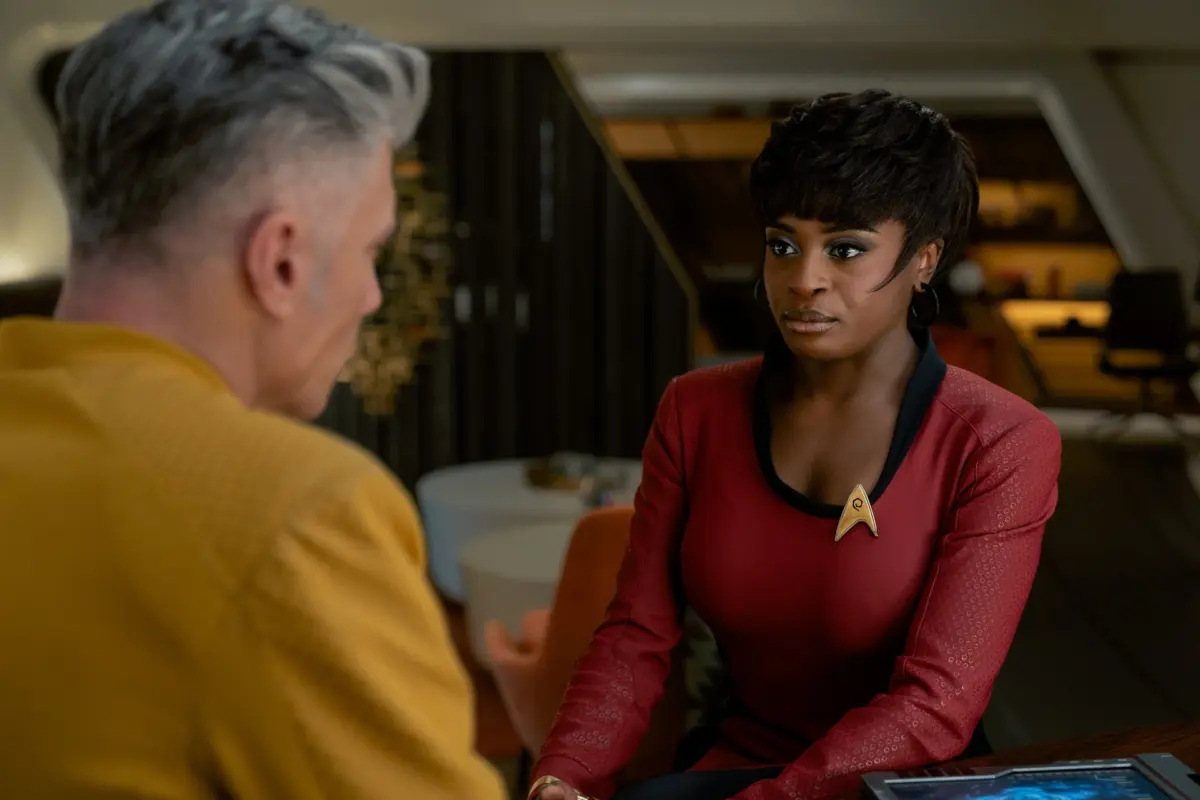
Now, with the release of the official Season 4 trailer, first-look production stills, and promotional loglines, those fan theories have shifted from hopeful speculation to confirmed reality. The upcoming finale will indeed wrench the Enterprise sideways through time, forcing its crew to navigate an unprecedented temporal crisis. At the center of this chronological chaos is a fascinating hook: a time ripple that forces a younger and an older Nyota Uhura to cooperate across the ages to repair the fractured timeline.
Read Also
As we dissect the promotional materials, character clues, and overarching structural implications for Strange New Worlds, it becomes increasingly clear that this episode is more than just a nostalgic gimmick. It may well be a pivotal narrative turning point that bridges the gap between Pike’s tenure and the classic TOS era while redefining the show’s approach to temporal mechanics.
Detailed Chronology: Unpacking the "Tomorrow’s Enterprise" Tease
To understand the weight of the upcoming Strange New Worlds season finale, one must first examine the official logline provided by Paramount:
"A time ripple damages the Enterprise, forcing young and old Uhura to cooperate and fix the timeline."
While the newly released trailer keeps its narrative cards close to its chest—offering sweeping shots of shipboard alarms, pulsing warp cores, and distorted spatial anomalies—the accompanying episodic photographs provide a goldmine of visual data for dedicated sleuths.
Visual Clues and Temporal Anomalies
Of primary note within the released imagery are subtle yet striking changes to character aesthetics and command structures:
- Uhura’s Evolving Look: Promotional stills highlight a markedly different visual presentation for Nyota Uhura (played by Celia Rose Gooding), featuring updated styling and a mature demeanor that strongly contrasts with her standard appearance in the earlier seasons of Strange New Worlds. This visual dichotomy supports the logline’s premise of a multi-generational team-up.
- Shifts in Uniform and Command: Sharp-eyed fans have also noted subtle alterations in the crew’s duty uniforms, alongside tantalizing frames that appear to position Captain James T. Kirk (Paul Wesley) in the center seat under extraordinary circumstances.
- Cross-Time Communication: The trailer heavily implies that the two versions of Uhura are not merely sharing the same deck through standard time-travel tropes, but are actively communicating or operating across a distinct temporal distortion. Whether this manifests as a physical crossover or a subspace rift bridging different eras of the Enterprise remains one of the season’s best-kept secrets.
Blending Timelines: A "What If?" Scenario
However, the narrative mechanics appear far more complex than a straightforward generational hand-off or a standard encounter with TOS counterparts. Major legacy characters traditionally associated with the TOS era are still notably absent from the immediate deckplates—though casting announcements have confirmed that icons like Dr. McCoy, Sulu, and others are slated to debut by the conclusion of the upcoming season.
Simultaneously, key Strange New Worlds original characters who have no established place in traditional TOS canon remain fully integrated into the mix. This juxtaposition implies that the narrative is not merely executing a clean time-jump into the future. Instead, it hints at a volatile, blended timeline—a structural choice that pays direct homage to "Yesterday’s Enterprise," which famously constructed an alternate, militarized "What If?" reality where the Federation was losing a brutal, decades-long war with the Klingon Empire.
Executive producer Henry Alonso Myers has previously teased a desire to subvert traditional Star Trek time-travel tropes, pushing the writers’ room to experiment with narrative structures that break the mold of classic temporal mechanics. If "Tomorrow’s Enterprise" leans into this ethos, viewers can expect an emotionally resonant, high-stakes puzzle box rather than a simple nostalgic playground.
Supporting Context & Metrics: The "Gimmick" Debate and Narrative Momentum
As Strange New Worlds presses toward its later seasons, the series occupies a unique space within the modern Star Trek television ecosystem. Praised for its episodic flexibility—allowing for everything from courtroom dramas and murder mysteries to full-scale musical episodes and animated crossovers—the show has nonetheless faced healthy debate among fans and critics alike regarding its reliance on high-concept "gimmick" episodes.
Balancing Standalone Flair with Serialized Stakes
To evaluate how "Tomorrow’s Enterprise" functions within the broader structural architecture of the series, we can analyze the distribution of episodic styles across recent seasons:
| Season Phase | Primary Narrative Focus | Structural Approach | Fan/Critic Reception |
|---|---|---|---|
| Early Seasons (1–2) | Character establishment, world-building, standalone adventures | Episodic with light serialized arcs | Universally praised for capturing classic TOS adventurous spirit |
| Mid-Run (Season 3) | Mythos expansion, Gorn conflicts, emotional depth | Hybrid (Episodic standalones + heavy serialization) | Applauded for high production values; occasional debates on pacing |
| Current Era (Season 4 Finale) | Temporal mechanics, legacy convergence, inevitable destinations | High-concept speculative fiction / Alternative timeline | High anticipation; viewed as a critical test of long-term narrative payoff |
Critics of the gimmick-heavy episodes argue that standalone adventures occasionally pull focus away from the overarching dread of the impending Gorn war and Pike’s tragic, canonically predetermined future (as seen in "The Menagerie"). Conversely, defenders point out that these creative excursions allow Strange New Worlds to honor the diverse storytelling traditions of 1990s-era Trek while giving individual ensemble members deep, character-defining spotlights.
The success of "Tomorrow’s Enterprise" will likely hinge on its ability to satisfy both camps. If the time ripple serves merely as a flashy, self-contained diversion before resetting neatly at the credits, it may risk narrative fatigue. However, if the events of the finale permanently alter the psychological landscape of the crew or offer concrete narrative momentum toward the show’s inevitable chronological destination, it will be remembered as a masterclass in modern franchise storytelling.
Official Statements and Industry Insights
While Paramount+ has maintained tight security around the exact plot twists of the season finale, statements from the creative team shed light on the ambition driving the production.
In recent press rounds, showrunners and executive producers have emphasized that approaching legacy material requires a delicate balance of reverence and bold innovation. When asked about comparisons to The Next Generation, the writing team noted that while "Yesterday’s Enterprise" set an impossibly high gold standard for emotional resonance in a temporal bottleneck, Strange New Worlds operates under a fundamentally different dramatic irony.
"We aren’t just looking backward at what came before; we are watching characters actively race toward futures they can only dimly perceive," noted a source close to the production. "When you introduce time anomalies into an ensemble that is already acutely aware of the historical weight resting on their shoulders, the psychological stakes multiply exponentially."
Furthermore, actress Celia Rose Gooding has teased that Uhura’s arc in Season 4 represents her most demanding physical and emotional work on the series to date. Navigating the duality of a character grappling with her younger self—while facing the stark, unyielding realities of Starfleet command responsibilities—provided unique acting challenges that pushed the boundaries of the ensemble’s dynamic chemistry.
Future Outlook: Paving the Way for What Comes Next
As television audiences prepare to stream the season finale this week, the implications of "Tomorrow’s Enterprise" stretch far beyond the immediate resolution of a damaged warp core or a localized chronological kerfuffle.
We are rapidly approaching the twilight years of Strange New Worlds. With the upcoming fifth season officially designated as the final chapter for Pike’s crew, the creative team faces the ultimate storytelling challenge: how to land a plane that has a historically fixed runway. Fans already know the broad strokes of where characters like Spock, Uhura, and Kirk must ultimately end up. The magic of the series has always lived in the unexplored spaces between those established milestones.
If "Tomorrow’s Enterprise" succeeds, it will act as a structural keystone. By offering a sideways glance into the future—or a fractured, alternate version of it—the episode can test-drive the emotional weight of the impending transition without cheapening the finality of the series’ ultimate conclusion. It forces the characters to confront the ghosts of their futures before they have even lived them, creating a poetic feedback loop that is quintessentially Star Trek.
Whether the time ripple is ultimately smoothed over by a brilliant engineering fix or leaves permanent fractures in the bedrock of the timeline, one thing is certain: the journey toward the final frontier has never looked more uncertain, or more thrilling.
Stay tuned to ReactorMag for our complete, spoiler-filled episodic breakdown and post-mortem analysis immediately following the broadcast of the Strange New Worlds Season 4 finale.


Comments
Facebook App ID not configured. Please add it in the Customizer.