
Date: September 21, 2026
Author: Global Arts & Culture Desk
Executive Overview
In a landmark acquisition that reshapes the landscape of modern Asian art representation in Western institutions, the Metropolitan Museum of Art (The Met) has announced the acquisition of 38 masterworks by Chang Dai-chien (1899–1983), widely celebrated as one of the towering figures of twentieth-century Chinese painting. The collection, secured through a hybrid arrangement of generous gifting and strategic acquisition directly from the artist’s daughter, Sing Sheng Chang, encompasses pivotal periods of Chang’s prolific career.
The newly acquired trove spans the artist’s formative, painstaking studies at the ancient Dunhuang Buddhist cave temples in the Gobi Desert during the 1940s, traverses his nomadic middle decades across South Asia and Latin America, and culminates in his breathtaking late-career abstractions from the 1960s and 1970s. This acquisition not only bridges historical gaps in The Met’s permanent collection but also provides scholars, historians, and the global public with an unprecedented window into the evolution of guóhuà (traditional Chinese ink painting) during an era of unprecedented geopolitical and aesthetic transformation.
Read Also

Selected highlights from this historic acquisition are slated to debut in an intimate rotation later this year, paving the way for a comprehensive, museum-wide retrospective dedicated to 20th-century Chinese ink painting scheduled for 2028. This move cements The Met’s ongoing commitment to contextualizing non-Western modernisms through rigorous scholarship and world-class curatorial stewardship.
Detailed Chronology: The Artistic Odyssey of Chang Dai-chien
To understand the immense cultural and historical value of The Met’s 38 newly acquired works, one must trace the extraordinary geopolitical and artistic trajectory of Chang Dai-chien. His life was defined by self-exile, relentless cross-cultural pollination, and a rare ability to synthesize classical Chinese mastery with the avant-garde currents of Western modernism.
The Dunhuang Years and Classical Mastery (1940–1949)
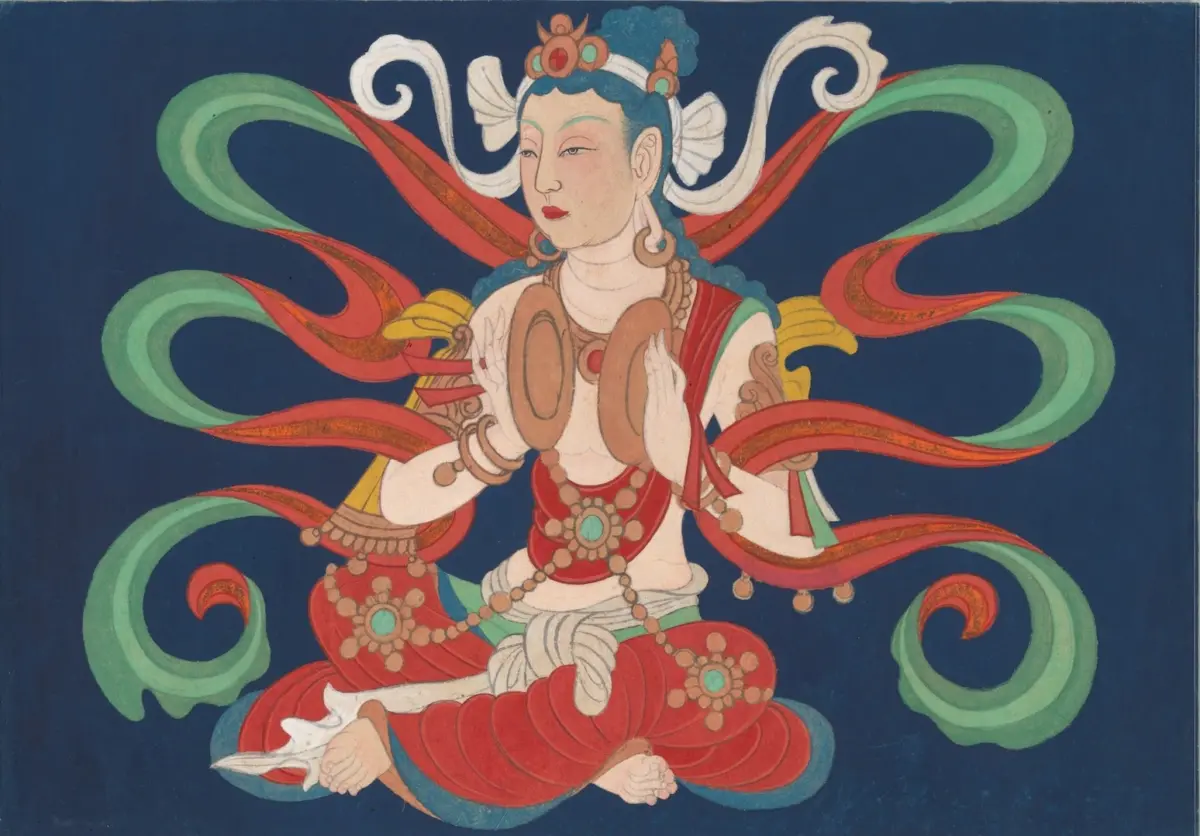
Before achieving global renown, Chang established his reputation in China as an unrivaled copyist and master of classical literati styles. However, his artistic worldview underwent a seismic shift between 1941 and 1943, when he undertook a grueling, self-funded expedition to the Mogao Caves at Dunhuang—an ancient Buddhist sanctuary located on the perilous fringes of the Gobi Desert.

Living in austere isolation for nearly three years, Chang and a team of hired Tibetan Buddhist lamas and scholars meticulously copied the crumbling murals dating from the Northern Wei through the Tang dynasties. This immersive engagement profoundly altered his visual vocabulary. The works in The Met’s acquisition originating from this period reveal Chang’s rare ability to capture the monumental scale, radiant mineral pigments, and spiritual depth of ancient Buddhist iconography. These studies served as the foundational bedrock for his technical prowess, preparing him for the tumultuous decades of displacement that lay ahead.
Following the establishment of the People’s Republic of China in 1949, Chang chose self-exile. He embarked on a nomadic existence that would take him across continents, earning him the moniker of a truly global artist.
The Nomadic Interlude and Transnational Vision (1950s–1960s)
Chang’s departure from mainland China marked the beginning of a decades-long international odyssey. He resided briefly in Hong Kong, India, Argentina, Brazil, and Japan, before eventually settling in Carmel, California, in the late 1970s.

Among the standout pieces in The Met’s acquisition is a rare self-portrait executed in Hong Kong in 1951. In this deeply psychological work, Chang depicts himself seated within a weightless, expansive void, gazing directly at the viewer. The piece captures the existential displacement and profound artistic introspection of an artist untethered from his homeland yet fiercely protective of his cultural identity.
During his years in South Asia and South America—particularly at his sprawling estate, "Ba Daoist Villa" (Granja Taoista), in São Paulo, Brazil—Chang cultivated expansive gardens that mirrored the landscape aesthetics of traditional Chinese scroll paintings. It was during this period that his brushwork began to loosen, absorbing the saturated palettes and expressive freedom of contemporary Western abstract expressionism, which was gaining international dominance.
The Late Abstractions and Monterey Solitude (1970s–1983)
In his final decades, living in Monterey, California, and later in Taipei, Taiwan—where he passed away in 1983 at the age of 83—Chang pioneered his signature pōmò (splash-ink) and pōcǎi (splash-color) techniques.

The late-period works included in The Met’s acquisition showcase this radical stylistic pivot. Moving away from the crisp, controlled lines of classical portraiture and landscape, Chang allowed water, heavy mineral pigments (such as malachite green and azurite blue), and dark ink to bleed organically across absorbent paper or silk. These works hover captivatingly on the precipice between representation and abstraction: misty mountain peaks, crashing waves, and quiet ravines emerge from chaotic fields of vibrant color. Through these works, Chang demonstrated that traditional Chinese ink media could rival, and even converse with, the most radical formal experiments of Western post-war art.
Supporting Context & Metrics: The Met’s Strategic Vision
The acquisition of 38 works by a single artist represents a significant logistical and financial undertaking for any encyclopedic museum. It reflects a broader institutional recalibration aimed at ensuring that modern and contemporary non-Western art is collected with the same depth and historical rigor historically reserved for Western European and American movements.
Curatorial Significance and Provenance
The provenance of the collection adds an extra layer of historical intimacy. Acquired directly from the artist’s daughter, Sing Sheng Chang, the grouping includes pieces that remained in the artist’s personal collection throughout his life. This direct lineage ensures that the works possess unimpeachable authenticity and offer rare insights into Chang’s private artistic process—displaying trial studies, unfinished compositions, and intimate portraits that were never intended for immediate commercial circulation.

Filling the 20th-Century Asian Art Gap
For decades, major Western art institutions suffered from a blind spot regarding 20th-century Asian art, often treating traditional Asian art as a historical artifact frozen in time, while viewing modern art exclusively through a Euro-American lens. Chang Dai-chien’s career dismantles this artificial dichotomy. By acquiring this comprehensive suite of works, The Met bridges its historical holdings of classical Chinese painting and calligraphy with its robust contemporary art programming.
Furthermore, the acquisition positions The Met as a premier global hub for the study of guóhuà in the modern era. Scholars will now have local access to a continuous chronological thread demonstrating how traditional techniques survived geopolitical upheaval and successfully transmuted into a global modern idiom.
Official Statements
The acquisition has generated widespread acclaim within the international museum community, highlighting the profound legacy of Chang Dai-chien and the forward-looking vision of The Met’s leadership.

In an official museum statement released last week, Max Hollein, the Marina Kellen French Director of The Met, articulated the historical gravity of the acquisition:
"Chang Dai-chien stands as one of the most important painters of the modern era. He combined a deep knowledge of classical Chinese culture with a transnational perspective to fashion a style of ink painting that was both locally rooted and connected to a wider global outlook."
Hollein further emphasized the artist’s geographical and stylistic journey, noting how Chang’s movement across China, South Asia, Japan, Taiwan, and finally California infused his traditional training with a distinctly global consciousness.

Sing Sheng Chang, speaking on behalf of the artist’s family regarding the placement of the works, expressed deep satisfaction that her father’s creative legacy has found a permanent home within one of the world’s most prestigious cultural institutions:
"My father’s heart always remained connected to the eternal spirit of Chinese ink, yet his eyes were wide open to the world. Knowing that these 38 works—from his arduous days at Dunhuang to his final serene landscapes in California—will now be studied, preserved, and cherished by millions at The Met is the greatest tribute to his lifelong dedication."
Future Outlook: Exhibitions and Public Engagement
The integration of these 38 works into The Met’s permanent holdings will unfold in careful, phased stages over the next two years, ensuring both rigorous conservation review and maximum public exposure.

Fall 2026 Preview Rotation
Art enthusiasts and scholars will not have to wait long to experience the collection firsthand. A curated selection of key works from the acquisition—highlighting the Dunhuang studies and the 1951 self-portrait—will go on public display in The Met’s Asian art galleries later this year. This initial rotation is designed to offer an enticing preview of the broader collection and to spark immediate academic dialogue surrounding Chang’s transnational migration and stylistic evolution.
The 2028 Landmark Retrospective
The crowning milestone for this acquisition will arrive in 2028, when the entirety of the newly acquired trove takes center stage in a major, museum-wide exhibition dedicated to 20th-century Chinese ink painting (guóhuà).
Curated by The Met’s Department of Asian Art, the 2028 exhibition aims to contextualize Chang Dai-chien alongside his prominent contemporaries—such as Qi Baishi, Xu Beihong, and Pan Tianshou—while boldly asserting Chang’s unique position as a master who successfully negotiated the tensions between tradition and modernity, nationalism and globalism, representation and pure abstraction.

As museums worldwide grapple with the imperatives of decolonizing their narratives and expanding their historical canons, The Met’s acquisition of Chang Dai-chien’s masterworks serves as a gold standard. It proves that the history of modern art is not a monolith centered solely in Paris or New York, but a polyphonic chorus of global visionaries whose brushstrokes continue to map the contours of our shared human experience.


Comments
Facebook App ID not configured. Please add it in the Customizer.