
Executive Overview
As the international art world prepares to commemorate the centenary of Claude Monet’s passing in 1926, Paris is hosting a sweeping dual-institution tribute. The Musée de l’Orangerie and the Musée d’Orsay have launched major, concurrent exhibitions—titled Claude Monet, Painting Time and I Spend My Life Painting, respectively. Together, these exhibitions offer a sweeping retrospective of the pioneering artist’s career.
Yet, beyond the visual splendor of iconic landscapes and light-drenched water lilies, the Musée d’Orsay’s presentation introduces a groundbreaking dimension: the results of rigorous, state-of-the-art technical examinations performed on five foundational masterworks. Led by conservation scientists at the Center for Research and Restoration of the Museums of France (C2RMF), these analyses have fundamentally challenged long-held assumptions regarding the father of Impressionism.
Far from being the purely spontaneous, en plein air painter who effortlessly captured fleeting atmospheric effects in a single burst of inspiration, Monet emerges from these technical revelations as an intensely deliberate, highly experimental architect of form. Through sophisticated X-ray imaging and transmitted infrared photography, researchers have uncovered discarded figures, radically altered spatial dynamics, and complex compositional revisions hidden just beneath the pigment of some of his most celebrated canvases.
Read Also
Most notably, a technical deep dive into Monet’s monumental 1873 canvas The Luncheon has revealed a web of erased characters, shifting domestic objects, and a tantalizing potential self-portrait. These discoveries not only reshape our understanding of individual masterworks but also cast new light on the socio-economic pressures, artistic ambitions, and working methods that propelled Monet during the turbulent formative years of the Impressionist movement.
Detailed Chronology & Forensic Discoveries: Inside The Luncheon
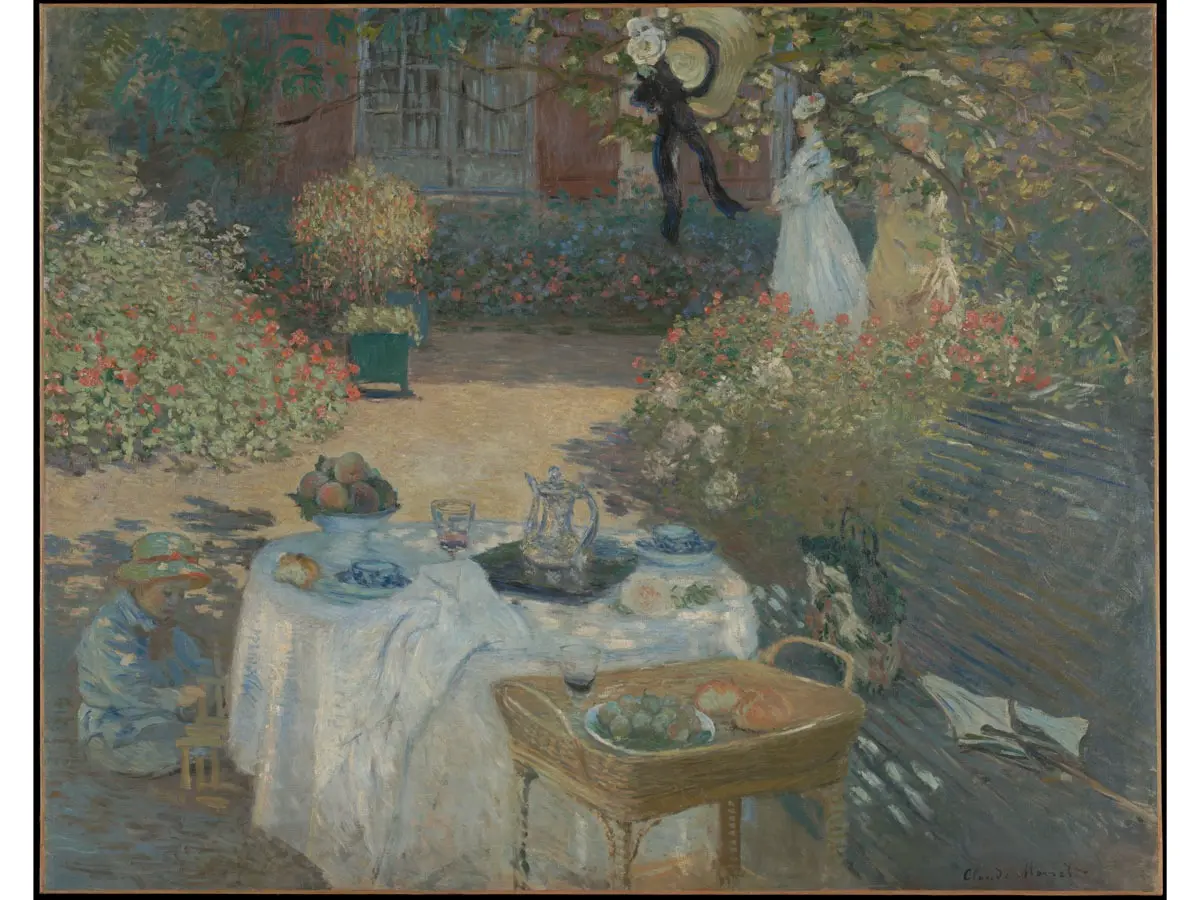
The crown jewel of these new technical insights centers on The Luncheon (Le Déjeuner), painted in 1873 while Monet and his young family were renting a home in Argenteuil, a picturesque commune situated roughly 7.5 miles northwest of Paris. Measuring an impressive 5 feet 3 inches by 6 feet 7 inches, the final composition captures the quiet, melancholic aftermath of an outdoor meal. The guests have departed, leaving behind only scattered traces of their presence: a table bearing plates, a wine glass, and a serving trolley. Monet’s young son, Jean, is positioned on the left side of the canvas, while his first wife, Camille, walks through the distant background alongside a neighbor or friend.
Historically, art historians interpreted the painting’s powerful spatial structure—anchored by a strong diagonal bench and a deliberate, empty center that emphasizes a profound sense of absence—as a direct, unedited translation of the Argenteuil garden scene.
However, recent pre-restoration technical analyses conducted by C2RMF conservation scientists have shattered this neat narrative.

Layers of Erasure and Revision
Ahead of a scheduled, comprehensive conservation treatment slated to begin in late 2027, the C2RMF team subjected The Luncheon to advanced X-ray radiography. The resulting digital scans unveiled a surprisingly chaotic under-construction.
"The table itself was altered," explains Johanna Salvant, a conservation scientist and PhD researcher at C2RMF who played an integral role in analyzing the painting. "As for the trolley in front of it, with some bread and a wine glass, it was shifted to the right; and the fruit plate moved accordingly."
Intrigued by these structural shifts, the researchers deployed transmitted infrared photography—a technique involving the illumination of the canvas from behind to peer through opaque layers of lead-white and oil paint. This secondary scan confirmed that Monet had drastically edited the human presence within the garden.
Originally, two women were depicted seated prominently on the wooden bench that now dominates the foreground. Monet subsequently painted over them, replacing their figures with a simple domestic basket and a folded parasol. Furthermore, minor details underwent metamorphosis: what now reads as a blooming rose was initially rounded, potentially conceived as a piece of fruit. Even young Jean was re-posed; in an earlier iteration, his back was turned almost entirely toward the viewer, whereas the final composition renders him in a more direct, engaging three-quarter view.
The Looming Enigma: A Monet Self-Portrait?
Perhaps the most astonishing revelation hidden beneath The Luncheon is the presence of two additional figures previously unknown to art history. Infrared scans exposed a shadowy figure looming in a distant window and, more strikingly, a bearded man wearing a hat, standing in profile on the far left of the composition.
Gilles Bastian, a heritage curator at C2RMF, notes that Monet subsequently expanded the surrounding flower beds, blanketing this mysterious male figure almost entirely beneath cascading foliage. The execution of this floral extension, Bastian observes, was handled in a looser, more conventional manner than the crisp, precise marks characteristic of Monet’s early Impressionist style.
This discovery has ignited fierce speculation among curators. Could this obscured, bearded figure be a rare self-portrait of the artist?

A compelling comparative piece exists across the Atlantic: Pierre-Auguste Renoir’s 1873 canvas Monet Painting in His Garden at Argenteuil, housed in the collection of the Wadsworth Atheneum Museum of Art in Hartford, Connecticut. Renoir’s portrait depicts Monet wearing a soft-brimmed hat, though turned in the opposite direction.
"Monet scarcely ever painted himself, so if this is indeed a self-representation, it would be a major discovery," remarks Anne Robbins, curator of paintings at the Musée d’Orsay.
Sylvie Patry, chief curator at the Orsay, echoes this excitement. "The possible presence of Monet himself would place the work within a long tradition of artists inserting themselves into their compositions, often discreetly and at the periphery of the scene."
Despite the tantalizing visual overlap with Renoir’s portrait, museum officials maintain a posture of rigorous scientific caution. "At this stage, however, the identification remains a hypothesis," Robbins notes, emphasizing that comprehensive analytical work requires time. "We will need time to get to the bottom of these discoveries."
Supporting Context, Metrics, and Market Realities
To fully appreciate why Monet systematically excised figures from The Luncheon, one must examine the economic and social climate of the mid-1870s. During this period, the Impressionists were social outcasts struggling against the rigid gatekeeping of the official Paris Salon. Monet was facing acute financial distress, burdened by debt and desperately seeking affluent patrons to sustain his young family.
Anne Robbins suggests that the strategic decision to paint out the human subjects may have been driven by commercial pragmatism. When Monet submitted the canvas to the Second Impressionist Exhibition in 1876, he deliberately exhibited it under the neutral, non-narrative title Decorative Panel.
"Covering the figures may have contributed to making the painting more neutral and adaptable as a decorative object," Robbins explains.

This calculated pivot paid off handsomely. Ernest Hoschedé—the wealthy department store magnate and pioneering collector who famously owned Impression, Sunrise (1872), the very canvas that christened the Impressionist movement—viewed The Luncheon at the 1876 exhibition. The painting’s depopulated, harmonious scale likely captured Hoschedé’s imagination, directly inspiring him to commission Monet shortly thereafter to create an ambitious four-panel decorative cycle for his country estate, the Château de Montgeron.
Beyond The Luncheon: Technical Revisions Across the Oeuvre
The Luncheon is not an isolated anomaly in Monet’s early catalog. C2RMF’s technical campaign analyzed two other masterworks from the same era, proving that heavy editorial revision was a structural pillar of Monet’s creative process.
- The Magpie (1868–69): This celebrated winter landscape, featuring a solitary black bird perched upon a wooden fence against a blanket of snow, originally incorporated a row of three distinct houses in the background. Infrared analysis revealed that Monet deliberately painted out one of the houses to quiet the background and elevate the solitary magpie to the precise focal center of the composition.
- Women in the Garden (1866): This monumental outdoor canvas underwent a different kind of physical ordeal. Conservation analysis revealed that Monet was forced to repair the massive canvas by stitching it back together following a severe physical accident. According to historical accounts, the physical scale of the work presented such a logistical challenge that Monet had to dig a trench in his garden, lowering himself into the earth so he could physically reach the upper reaches of the canvas.
These revelations dismantle the romanticized myth of the Impressionist who merely dashed off impressions in real-time. Instead, they reveal an artist engaged in a rigorous, highly physical wrestling match with his materials, constantly building, scraping down, stitching, and refining compositions to achieve optical harmony.
Official Statements and Institutional Vision
The ongoing technical revelations are the crown jewel of the current Parisian museum season. Speaking on the unique character of the Musée d’Orsay’s holdings relative to other institutions, Sylvie Patry emphasized the unmatched scope of the museum’s collection.
"While the Musée Marmottan Monet holds the largest collection of Monet’s works in numbers," Patry stated, "the Musée d’Orsay houses the most comprehensive ensemble, in the sense that it covers the different stages of his career and his changes in technique."
The current exhibitions are designed precisely to showcase these evolutionary leaps, tracing Monet’s trajectory from the structured, heavily revised compositions of the 1860s and 1870s to the dissolving, light-saturated abstractions of his later decades.
Future Outlook
For art historians, conservation scientists, and the general public, the current exhibitions are merely the opening chapter of a much larger, ongoing investigation.

The three newly analyzed works—The Luncheon, The Magpie, and Women in the Garden—alongside The Thaw at Vétheuil (ca. 1880s) and Cathedral (1892–93), currently anchor the narrative arc of the Musée d’Orsay’s I Spend My Life Painting.
However, the definitive chapter for The Luncheon remains on the horizon. The painting is scheduled to undergo a full, invasive conservation restoration beginning in late 2027. Conservators anticipate that physical intervention during the restoration process will yield even clearer microscopic data regarding pigment stratigraphy, medium composition, and the exact chronological sequence of Monet’s erasures.
Until then, visitors to Paris can witness the intersection of art history and advanced forensic science firsthand. As museums increasingly utilize non-invasive imaging technologies to read beneath the skin of iconic paintings, masterpieces once thought to be fully understood are revealing hidden lives, proving that even a century after his death, Claude Monet still holds profound secrets waiting to be brought to light.


Comments
Facebook App ID not configured. Please add it in the Customizer.