
Executive Overview
Following last year’s blockbuster auction of Napoleon Bonaparte’s worn stockings, camp bed, and iconic bicorne hat, Sotheby’s is pivoting from the French emperor to his greatest maritime nemesis: Admiral Horatio Nelson. In a major single-lot, sealed-bid sale slated for late autumn, the auction house will offer an unprecedented archive of 415 letters, documents, and manuscripts connected to the legendary British naval commander. Carrying a high estimate of £6 million ($8 million), this collection represents the largest trove of Nelson’s personal correspondence still remaining in private hands.
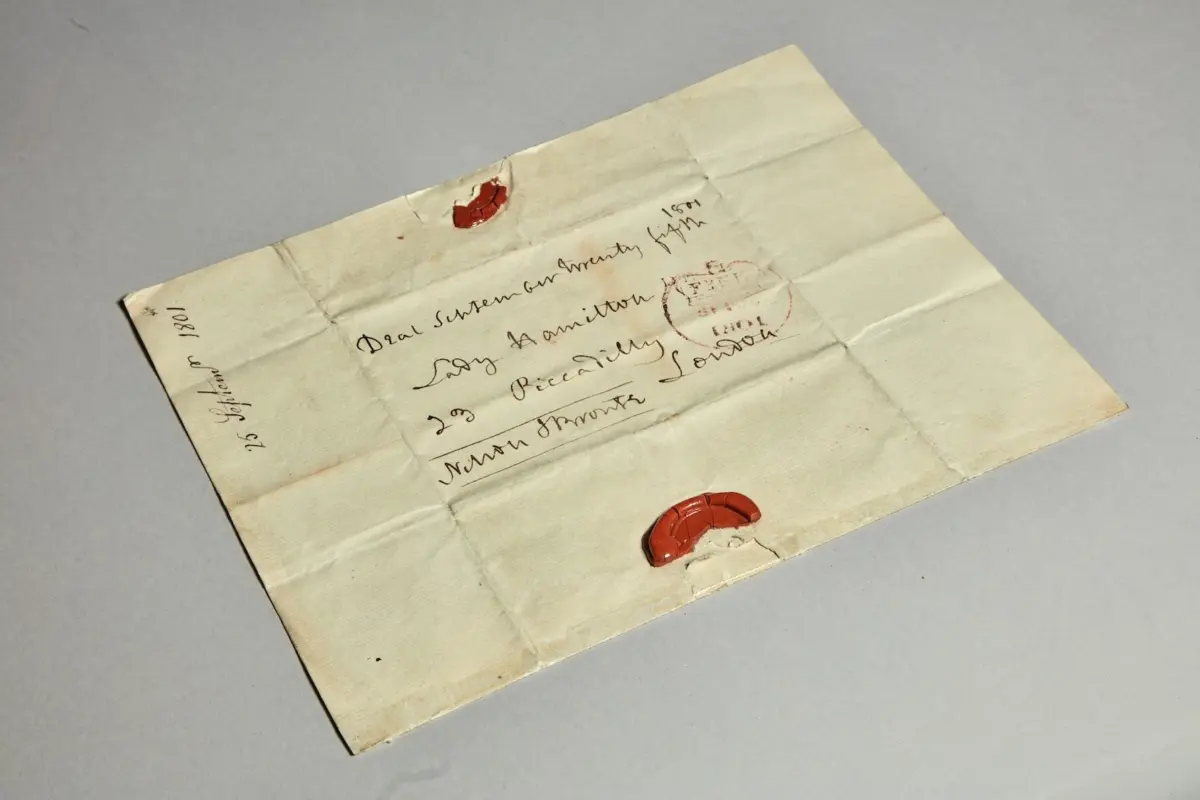
The archive spans 168 autograph letters penned by Nelson himself, alongside vital battle papers, family documents, historic naval logs, and rare volumes pulled directly from the personal libraries of Nelson and his famous mistress, Emma Hamilton. Meticulously assembled over four decades by the late British businessman and collector Clive Richards—who passed away in 2021—the collection offers an extraordinarily intimate window into the psyche, vulnerabilities, and complex personal relationships of one of the United Kingdom’s most mythologized historical figures.
Bidding for this monumental single-lot offering is scheduled to open online on October 21 to purposefully coincide with Trafalgar Day, running through November 18. To mark the launch, key highlights will go on public display for a week at Sotheby’s prestigious New Bond Street headquarters in London. While the steep £6 million price tag ensures that interest will come from institutional heavyweights and ultra-high-net-worth collectors worldwide, the sale also raises pressing questions regarding the preservation of British national heritage and whether this invaluable historical record will ultimately remain in the UK.
Read Also
Detailed Chronology: The Life, Battles, and Letters of Admiral Nelson
To fully understand the weight of the Sotheby’s archive, one must trace the arc of Admiral Horatio Nelson’s storied naval career—a trajectory chronicled intimately across the 415 documents heading to the auction block.
Rise of a Naval Icon and the Price of Duty
Born in Norfolk, England, in 1758, Nelson entered the Royal Navy at the tender age of twelve. Through sheer tenacity, strategic brilliance, and fearless leadership, he steadily climbed the ranks, earning a reputation as an aggressive tactician who preferred decisive engagement over cautious maneuvering. However, this relentless pursuit of victory came at a profound physical cost.
The archive preserves the tangible, physical toll of Nelson’s decades at sea. Among the documents are poignant letters written after he lost the sight in his right eye during the siege of Calvi in 1794, and subsequent dispatches penned following the catastrophic amputation of his right arm after a disastrous assault at the Battle of Santa Cruz de Tenerife in 1797. Left-handed writing samples within the collection showcase Nelson’s painstaking efforts to retrain his hand, featuring his self-deprecating admission that he no longer possessed "the hand of a ready writer." These papers transform the stoic naval hero into a deeply human figure grappling with permanent disability.
Triumph at Trafalgar and the Threat to Napoleon
Nelson’s career reached its zenith during the Napoleonic Wars. As commander of the British fleet, his crowning achievement occurred on October 21, 1805, at the Battle of Trafalgar. Outnumbered and outmaneuvered on paper, Nelson utilized unorthodox tactics to shatter the combined French and Spanish fleets, effectively dismantling Napoleon Bonaparte’s designs to launch an amphibious invasion of the British Isles.
Though Nelson was mortally wounded during the engagement—dying moments after securing a historic victory—his legacy was instantly cemented into the bedrock of British national identity. The archive captures this pivotal era through handwritten operational reports detailing the battles of the Nile and Copenhagen, alongside his original, highly confidential battle plans for Trafalgar. Prominent historian and broadcaster Dominic Sandbrook has noted that these operational blueprints rank "alongside the most sacred texts of our national history."
The Emma Hamilton Affair: A Scandalous Romance
Beyond military strategy and geopolitical maneuvers, the archive lays bare the deeply human dimensions of Nelson’s personal life, most notably his roaring, highly publicized romance with Emma Hamilton. At the time their affair commenced, Nelson was married to Frances Nisbet, while Emma was married to Sir William Hamilton, the British ambassador stationed in Naples.
Far from a quiet indiscretion, the affair evolved into a notorious ménage à trois, with Nelson, Emma, and Sir William eventually living together under the same roof. The letters addressed to Emma reveal a side of Nelson entirely divorced from the public image of the unyielding naval commander. They capture emotional vulnerability, domesticity, and the unvarnished unfolding of one of history’s most compelling and controversial love stories.
Supporting Context & Metrics: The Market for Imperial Relics
The upcoming sale of the Nelson archive arrives on the heels of a booming market for artifacts tied to the Napoleonic Wars. Last summer, Sotheby’s Paris orchestrated a high-profile auction featuring 112 lots from the collection of French antiques connoisseur Pierre-Jean Chalençon. That sale netted a staggering €8.7 million ($9.6 million), propelled by items such as Napoleon’s iconic bicorne hat, a heraldic sword from his 1804 coronation, a camp bed, his personal seal, and his worn silk stockings.
By pivoting to Nelson, Sotheby’s is essentially offering the British counterpart to the French emperor’s memorabilia, capitalizing on deep-seated collector appetites for imperial-era ephemera. However, there is a distinct structural difference in how Sotheby’s is packaging the Nelson collection: rather than scattering individual pieces to the wind, the house has elected to offer the entire trove as a single lot.
The Rise of the Single-Lot Historical Archive
According to Gabriel Heaton, Sotheby’s senior specialist in books and manuscripts, this decision stems from the intrinsic strength of the collection as a cohesive whole. "There are many wonderful highlights in the collection, but it is even more potent when considered as an entire collection," Heaton remarked.
This strategy reflects a broader structural shift within the high-end manuscript market. Rather than catering solely to speculators seeking isolated "trophy" letters or signatures, major auction houses increasingly favor keeping exhaustive archival libraries intact. By offering major institutional-grade troves—such as the historic Honresfield Library and now the Richards Nelson archive—Sotheby’s is banking on buyers who view themselves as custodians of complete historical narratives rather than accumulators of decorative curiosities.
Historical Auction Precedents for Nelson Memorabilia
Artifacts and documents connected to Admiral Nelson have consistently outperformed expectations when coming to auction. Key milestones include:
- The Alexander Davison Collection (Sotheby’s, 2002): A landmark sale of 93 lots brought a combined £1.84 million ($2.5 million). Highlights included a jeweled sword gifted to Nelson by the Ottoman Sultan Selim III, which fetched £300,000 ($410,000), and a bloodstained purse reportedly carried in his pocket when he was fatally shot at Trafalgar, which realized £240,000 ($330,000).
- Trafalgar Order of Battle (Christie’s, 2024): A rare operational document detailing fleet positions for Trafalgar handily smashed expectations, selling for £32,760 ($45,000) against a conservative high estimate of £20,000 ($27,500).
The £6 million ($8 million) high estimate for the Richards archive dwarfs these single-item successes, reflecting both the sheer volume of material (415 items) and forty years of focused, uncompromising collecting.
Official Statements & Collector Intentions
The assembly of this magnificent collection was the life’s work of the late Clive Richards, a successful British businessman who passed away in 2021. According to his widow, Sylvia Richards, her husband’s drive to collect Nelson material stemmed from a profound, lifelong fascination with British industrial and military history, sharing space in his intellectual pantheon alongside engineering titans like Isambard Kingdom Brunel.
"For some forty years, success in business enabled him to seek and purchase the very best and rarest letters of Nelson in his desire to ensure they were preserved and treasured in the future," Sylvia Richards explained. Crucially, however, Richards never viewed himself as the ultimate owner of the paper trail he so carefully amassed. "Clive truly believed he was only the custodian, and that they should be shared and studied by historians."
In alignment with this philosophy, Richards structured his estate so that the proceeds from the sale of the archive would directly benefit the Clive Richards Foundation—a charitable organization he established alongside Sylvia to fund initiatives in education, healthcare, local heritage, and the visual arts.
Gabriel Heaton emphasized the complex, multifaceted portrait of the commander that emerges from the documents:
"We see a man who has a grand sense of his own importance, we see emotion expressed without fear, we see exactly how he inspired his ‘band of brothers,’ and we have an intimate and privileged view as one of the great love stories unfolds through letters. In his own pen, we follow his career from beginning to end. This collection provides an extraordinarily rich and complex portrait of one of the most compelling figures in British history."
Future Outlook: Will the Archive Remain in Britain?
As the autumn bidding window approaches, a critical question looms over the sale: Will the archive stay in the United Kingdom, or will it cross international borders?
Clive Richards was, by all accounts, "proudly British," and those close to him acknowledge that he would have deeply appreciated the collection remaining on British soil to serve local scholars and institutions. At the same time, Richards possessed a pragmatic appreciation for global heritage preservation, recognizing that international museums and wealthy overseas collectors were equally capable of giving the papers the secure institutional home they deserve.
Given the £6 million high estimate, the pool of potential buyers is necessarily restricted. Major national institutions, such as the British Library, the National Maritime Museum in Greenwich, or university special collections, would likely require substantial grants from bodies like the National Heritage Memorial Fund or private philanthropic intervention to mount a competitive bid. Conversely, deep-pocketed private collectors in the United States, Asia, or the Middle East could easily clear the financial hurdle without external assistance.
If the single-lot sealed-bid format successfully attracts a private buyer who chooses to keep the archive intact, it will secure the integrity of Richards’s lifelong project. Whether those documents reside in a London archive or a private vault abroad, the upcoming Sotheby’s auction promises to cast a brilliant, revealing light on the man behind the naval legend—transforming a bronze-and-stone monument of British history back into a living, breathing human being.





Comments
Facebook App ID not configured. Please add it in the Customizer.