
Executive Overview
In a landmark decision that signals a profound shift in the country’s cinematic landscape, Pakistan has officially selected Mo Naqvi’s high-stakes documentary thriller, Hanging By a Wire, as its official submission for the Best International Feature Film category at the 99th Academy Awards. This selection shoves open a previously impenetrable door, marking the historic first time a documentary has been chosen by the Pakistan Academy Selection Committee to represent the nation in this specific Oscar race.
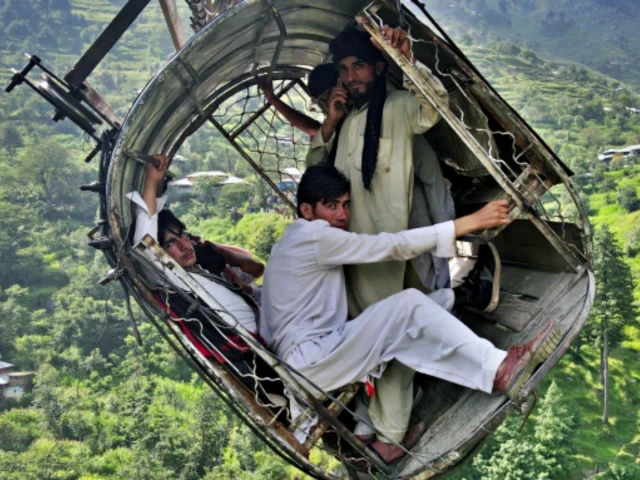
Clocking in as both a harrowing survival narrative and a masterclass in modern documentary filmmaking, Hanging By a Wire transports viewers directly to the rugged, breathtaking, yet unforgiving terrain of northern Pakistan. The film revisits the collective national anxiety of the August 2023 Battagram cable car crisis—an event that held the world captive as six young schoolchildren and two adults dangled precariously over a dizzying 900-foot abyss after a mechanical failure severed their primary line of transit.
By deftly combining raw, unvarnished eyewitness footage, harrowing survivor testimonies, and meticulously crafted cinematic reconstructions featuring the actual protagonists of the rescue effort, director Mo Naqvi and writer-producer Bilal Sami have constructed a cinematic experience that blurs the line between fiction and terrifying reality. Backed by a powerhouse production coalition including EverWonder Studio, Universal Pictures Content Group, Mindhouse Productions, and 64th Street Media, the documentary has already carved a formidable festival path, premiering in the World Cinema Documentary competition at the prestigious Sundance Film Festival before captivating audiences at Tribeca, Seattle, and Sydney.
Read Also
As Hanging By a Wire prepares to take its place on the global stage for the 99th Academy Awards, its selection is not merely a triumph for Pakistani cinema; it is a testament to the power of grassroots storytelling, community resilience, and the unyielding human spirit in the face of absolute catastrophe.
Detailed Chronology: The Battagram Cable Car Crisis
To truly understand the visceral impact of Mo Naqvi’s film, one must return to the scorching late-summer afternoon of August 22, 2023, in the remote mountainous district of Battagram, nestled within Pakistan’s Khyber Pakhtunkhwa province.
The Snap in the Sky
For the residents of Jamberi, a remote, mountainous hamlet, traversing the local geography is an exercise in daily peril. To cross the deep gorge carved by a rushing river below, locals relied on privately operated cable cars—makeshift wire ropeways improvised to bridge economic isolation and rugged topography. On that fateful morning, eight individuals—six schoolboys aged between 10 and 15, accompanied by two local adults—boarded one such car to make the routine journey across the valley to get to school.
At approximately 7:00 AM local time, disaster struck. Midway through the crossing, high overhead and isolated from immediate help, one of the primary steel cables snapped with a resounding crack. The car instantly lurched, plunging violently before dangling helplessly by a single, fraying strand of wire, suspended roughly 900 feet (274 meters) in the air above a rocky ravine.
The 16-Hour Ordeal
What followed was a nerve-wracking, 16-hour race against daylight, gravity, and encroaching darkness. As news of the disaster trickled down to mobile-signal-deprived valleys and subsequently exploded across international news networks, a massive rescue mobilization began.
The initial hours were marked by agonizing helplessness. The sheer altitude and turbulent wind currents rendered traditional helicopter approaches perilous; a miscalculated downdraft from rotor blades threatened to destabilize the remaining cable and send the car plummeting into the abyss. Below, desperate villagers gathered, creating a makeshift command center, using megaphones to communicate with the terrified children trapped hundreds of feet above them.
As daylight waned, the Pakistani military’s elite Special Services Group (SSG), alongside seasoned local zipline experts, formulated a daring, high-risk operation. Utilizing a small cable-riding rig and extraordinary physical courage, rescuers executed a sequence of perilous zip-line extractions. In the pitch-black of night, illuminated only by searchlights and handheld mobile phones, the final survivors were pulled to safety just moments before total darkness would have rendered the rescue impossible. The operation was universally hailed as a miracle of modern emergency response and indigenous resourcefulness.
Supporting Context & Metrics: The Making of a Cinematic Thriller
Hanging By a Wire elevates the documentary genre by rejecting traditional, detached academic analysis in favor of an immersive, pulse-pounding thriller aesthetic.
Co-Authored by the Community
One of the most defining aspects of the film’s production is its democratic approach to visual documentation. Rather than relying solely on archival news broadcasts or retrospective interviews, Naqvi incorporated raw footage captured dynamically by the villagers themselves as the crisis unfolded.
"It’s a straight-up disaster film, except it really happened, and you’re watching real footage of it unfolding live," Mo Naqvi noted in an interview with Deadline. "The community on the ground filmed it themselves and trusted me with that footage, so in a real sense they co-authored this film with me."
This collaborative ethos grants the film an uncompromising authenticity. The shaky mobile-phone recordings, the frantic audio of villagers coordinating rescue paths, and the tearful reunions on the cliffside infuse the narrative with an emotional gravity that professional Hollywood disaster thrillers struggle to artificially replicate.
Festival Circuit and Global Reception
Before making history as an Oscar contender, Hanging By a Wire built a formidable reputation on the international film festival circuit.
- Sundance Film Festival: The film made its high-profile world premiere in the competitive World Cinema Documentary section, where it drew praise from critics for its unrelenting tension and empathetic framing of rural isolation.
- Tribeca, Seattle, and Sydney: Subsequent screenings solidified its status as an international crowd-pleaser and critical darling, bridging the gap between localized human-interest reporting and universal cinematic art.
The film’s formidable financial and creative backing—pooled through EverWonder Studio, Universal Pictures Content Group, Mindhouse Productions, and 64th Street Media—further underscores the global appetite for high-caliber, character-driven non-fiction storytelling originating from South Asia.
Official Statements and Industry Impact
The announcement has sent shockwaves of pride and validation throughout Pakistan’s burgeoning film industry, which has steadily fought for international recognition amid infrastructural challenges and institutional hurdles.
The Pakistan Academy Selection Committee’s Perspective
Sana Zahra Jafri, deputy chairperson of the Pakistan Academy Selection Committee, illuminated the cultural and historic weight of the decision:
"The selection marks a historic milestone for Pakistani documentary filmmaking and brings an extraordinary story from northern Pakistan to the International Feature Film Oscar race."
This decision breaks a long-standing industry precedent wherein the committee has traditionally favored narrative feature films. By selecting a documentary, the committee is signaling that the boundaries of cinematic storytelling in Pakistan have evolved, and that non-fiction projects can carry the cultural weight, technical polish, and emotional resonance required to compete on the global stage.
Director Mo Naqvi’s Gratitude
Reflecting on the honor, director Mo Naqvi expressed deep appreciation for both the nominating committee and the resilient community whose lived trauma forms the heartbeat of the project:
"I’m honored that Hanging by a Wire has been selected to represent Pakistan in the International Feature Film category at the 99th Academy Awards, and grateful to the Pakistan Academy Selection Committee."
Naqvi has consistently focused his lens on complex socio-political and human-interest narratives within Pakistan. With Hanging By a Wire, he shifts focus from systemic critique to a profound exploration of human endurance, communal solidarity, and the triumph of ingenuity over structural adversity.
Future Outlook: Navigating the Oscar Landscape
As Hanging By a Wire formally enters the grueling, highly competitive gauntlet of the 99th Academy Awards, its journey holds implications that stretch far beyond a single statuette.
Breaking the Documentary Glass Ceiling at the Oscars
While documentaries are frequently submitted by various countries to the International Feature Film category (formerly Best Foreign Language Film), very few manage to secure official nominations, let alone victories—though historical exceptions like Denmark’s Flee (2021) proved that animated and documentary hybrids can transcend category boundaries. By entering this race, Hanging By a Wire opens new conversational avenues among Academy voters regarding how non-fiction storytelling is categorized, valued, and judged.
A Catalyst for Pakistani Non-Fiction
For Pakistan’s domestic film industry, this milestone serves as a vital economic and creative catalyst. Documentarians across the country have historically struggled with localized funding, distribution bottlenecks, and limited institutional support. The international prestige and commercial backing of studios like Universal and EverWonder behind Hanging By a Wire demonstrate that stories rooted in the everyday realities of Pakistani communities possess global commercial viability and universal artistic merit.
As the Academy’s voting members begin screening submissions from across the globe, Hanging By a Wire stands ready to remind international audiences that the most terrifying, awe-inspiring, and life-affirming stories are often those forged not in the writer’s room, but in the crucible of real-world survival.




Comments
Facebook App ID not configured. Please add it in the Customizer.