
The landscape of children’s and young adult biographical literature has been profoundly enriched by recent critical acclaim for Postcards From Malcolm X: How Yuri Kochiyama Became a Human Rights Activist. Written by acclaimed author Mia Wenjen, illustrated with striking visual depth by Keith Henry Brown, and published by Red Comet Press, the work has recently earned a stellar 5.0 overall rating from YA and Kids Books Central, alongside critical praise from outlets such as the School Library Journal.
At its core, the book explores an extraordinary, historical alliance between two monumental figures of 20th-century American history: Yuri Kochiyama, a tireless Japanese American civil rights activist, and Malcolm X, the prominent African American revolutionary and Muslim minister. Spanning concise yet potent narrative text, the book details how Kochiyama’s formative incarceration at the Jerome War Relocation Center in Arkansas during World War II catalyzed her lifelong commitment to social justice. Furthermore, it illuminates how her unyielding drive for equity converged with the philosophies of Malcolm X, resulting in a profound cross-cultural mentorship and friendship.
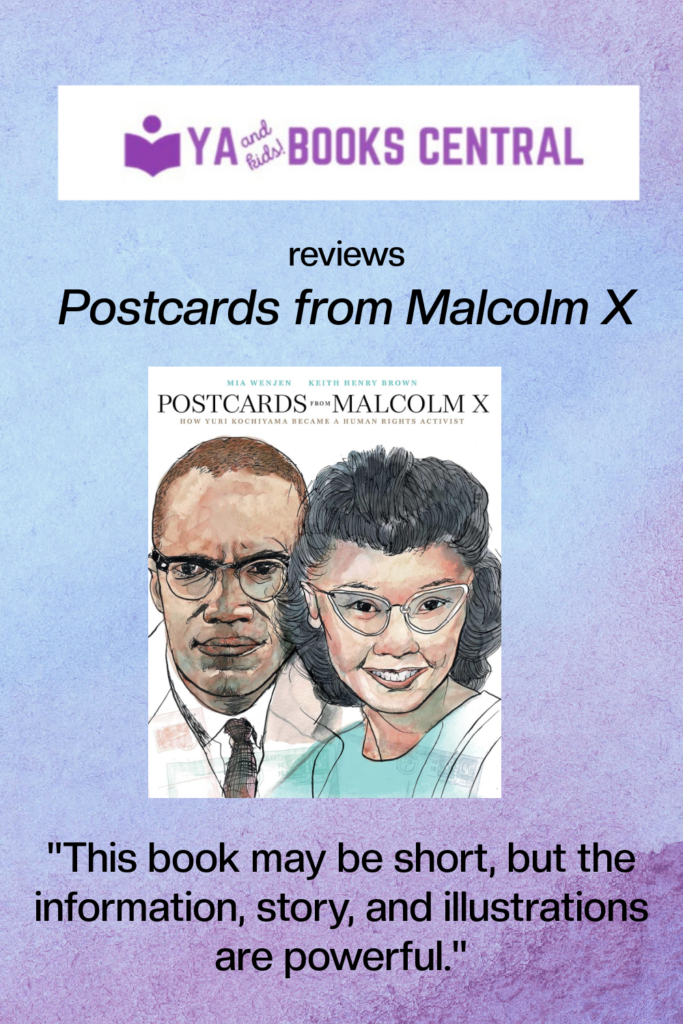
Beyond its historical recounting, Postcards From Malcolm X serves as a poignant reminder of the enduring power of written correspondence—specifically snail mail—highlighting the intimate postcards exchanged between the two activists. This article provides a comprehensive examination of the book’s thematic resonance, historical context, critical reception, and its broader implications for contemporary civil rights education.
Read Also
Detailed Chronology: Formative Years and the Birth of a Movement
To fully understand the narrative arc presented in Mia Wenjen’s work, one must trace the distinct yet converging paths of Yuri Kochiyama and Malcolm X. Their eventual partnership was not a random historical coincidence; rather, it was forged through years of personal hardship, ideological evolution, and a shared dedication to dismantling systemic oppression.

Yuri Kochiyama’s Early Life and World War II Incarceration
Born in San Pedro, California, in 1921, Yuri Kochiyama lived a relatively typical American middle-class life until the geopolitical shockwaves of the attack on Pearl Harbor in December 1941. In the wake of Executive Order 9066, signed by President Franklin D. Roosevelt, Kochiyama—alongside more than 120,000 individuals of Japanese descent—was forcibly removed from her home and incarcerated.
She spent years detained behind barbed wire, first at the Santa Anita assembly center and subsequently at the Jerome War Relocation Center in Arkansas. As depicted in Wenjen’s narrative and reinforced by companion works like Barbed Wire Between Us, this period of state-sanctioned incarceration was a critical turning point. Witnessing firsthand the systemic racism, denial of constitutional rights, and institutionalized prejudice inflicted upon Japanese Americans opened Kochiyama’s eyes to the broader matrix of racial injustice in the United States. It planted the seeds of an activist framework that would define the rest of her life.

The Rise of Malcolm X
Concurrently, Malcolm X—born Malcolm Little in Omaha, Nebraska, in 1925—navigated a youth marred by racial terror, displacement, and the tragic murder of his father by white supremacists. His journey through the foster care system, encounters with the criminal justice system, and subsequent conversion to the Nation of Islam while incarcerated transformed him into one of the most electrifying and uncompromising voices of the civil rights and Black liberation movements.
Malcolm X advocated for Black self-determination, self-defense, and human rights on an international scale, challenging the prevailing integrationist paradigms of the mainstream civil rights movement. His sharp intellect, moral clarity, and evolving global perspective made him a magnet for organizers, thinkers, and seekers of radical social change.

Intersection and Alliance in Harlem
In the early 1960s, Kochiyama relocated to Harlem, New York, where she immersed herself in the local community and engaged directly with the civil rights movement. It was here that her path crossed with Malcolm X. Defying the racial, gender, and social norms of an era where Asian American women rarely held prominent roles in radical Black liberation spaces, Kochiyama integrated herself into Malcolm’s inner circle.
Their friendship transcended traditional political alliances. They engaged in deep intellectual exchanges, challenging each other’s worldviews and expanding the scope of their activism. Kochiyama was famously present at the Audubon Ballroom in Manhattan on February 21, 1965, when Malcolm X was assassinated, and historical photographs capture her cradling his head in her final, tragic moments with him.

Supporting Context & Metrics: Evaluating the Literary and Educational Impact
Postcards From Malcolm X has achieved rare unanimous acclaim across major educational and literary review boards. Review metrics from YA and Kids Books Central reflect the book’s uncompromising quality across multiple evaluation vectors:
| Evaluation Metric | Score (Out of 5.0) | Critical Notes |
|---|---|---|
| Overall Rating | 5.0 | Celebrated for its unique fusion of history, emotional depth, and accessibility. |
| Writing Style | 5.0 | Praised for concise, powerful prose that navigates complex historical timelines seamlessly. |
| Illustrations | 5.0 | Highlighted for Keith Henry Brown’s evocative watercolor artwork capturing warmth and ferocity. |
| Learning Value | 5.0 | Recognized as an empowering introductory resource for young readers engaging with social justice history. |
The Power of Epistolary History
A defining element of Wenjen’s storytelling is its focus on the tangible artifacts of communication between Kochiyama and Malcolm X. In an age dominated by digital ephemera, the inclusion of postcard snippets in the book serves as a vital pedagogical tool. These physical dispatches remind modern readers of the deliberate, thoughtful nature of mid-century activism. Snail mail was not merely a medium for logistical coordination; it was a sanctuary for intellectual intimacy, mutual encouragement, and the exchange of radical political philosophy. Through these postcards, young readers witness the profound humanity behind historical icons.

Artistic Resonance and Visual Storytelling
Illustrator Keith Henry Brown plays a critical role in bringing this historical narrative to life. Utilizing a fluid, expressive watercolor medium, Brown captures both the warmth of the personal bond shared by Kochiyama and Malcolm X and the fierce urgency of their political convictions. The artwork avoids sterile historical depiction, opting instead for vibrant palettes and emotional resonance that captivates young readers, making complex themes of resistance and solidarity visually digestible.
Official Statements and Critical Reception
Literary critics and educators have roundly praised the publication for bridging gaps in historical education. In its review, YA and Kids Books Central emphasized the empowering nature of the work, noting:
"Yuri and Malcolm X’s friendship was not only a special connection, but they helped each other to open their eyes to new perspectives and ways to continue the fight for justice. Learning about Yuri’s work was empowering especially for speaking up in a time where it was unusual for a woman like her to be an activist. She never let things deter her and her tenacity led her to forge new bonds between various civil rights movements."
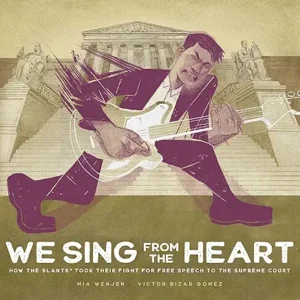
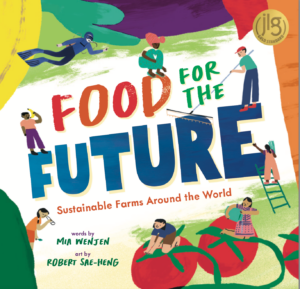
Furthermore, the School Library Journal underscored the book’s efficacy as an educational anchor, pointing out how seamlessly Wenjen weaves personal history with broader socio-political milestones. The book has also found a prominent place in broader literary discussions concerning the intersection of art, civil rights, and multicultural education—themes heavily championed by author Mia Wenjen in her complementary works, such as Barbed Wire Between Us, We Sing from the Heart, and her broader multicultural booklists featured on platforms like PragmaticMom.
Future Outlook: The Legacy of Coalition Building in Modern Education
As educational curricula increasingly seek to incorporate intersectional histories, Postcards From Malcolm X arrives as a timely and essential resource. The narrative offers a blueprint for modern coalition-building, demonstrating how solidarity across racial, cultural, and gender lines is essential in the ongoing fight for equity and civil rights.
Bridging Generational Divides
For young readers, the book demystifies the process of becoming an activist. By focusing on Yuri Kochiyama’s journey from a confined teenager in Arkansas to a globally minded revolutionary, the text teaches that civic engagement is not reserved for the extraordinary elite, but is accessible to anyone willing to question injustice and stand in solidarity with marginalized communities.
Expanding the Canon of Civil Rights Literature
The critical success of Wenjen’s work—reflected in its 5.0 rating and inclusion in prominent book fairs such as the Greater Roxbury Book Fair—signals a shifting appetite in children’s publishing. Publishers like Red Comet Press, alongside authors committed to diverse storytelling, are proving that young audiences are fully capable of engaging with nuanced, sophisticated historical narratives.
Moving forward, books like Postcards From Malcolm X will undoubtedly remain foundational texts in classrooms and libraries, ensuring that the remarkable legacies of Yuri Kochiyama and Malcolm X continue to inspire future generations of changemakers, equity advocates, and defenders of human rights.

Comments
Facebook App ID not configured. Please add it in the Customizer.