

First Contact narratives occupy a singular, resonant space within the broader architecture of speculative fiction. As a sentient species, humanity has perpetually looked toward the cosmos, pondering our place within the dark expanse, wrestling with the existential dread and incandescent wonder of whether we are alone. When we imagine encountering extraterrestrial intelligence, we are ultimately engaging in a grand, generational thought experiment.
Rooted historically in the anthropological study of disparate human cultures colliding for the first time—often under the heavy, asymmetrical shadows of colonialism and exploration—First Contact stories transcend mere hardware science fiction. Whether examining the rigorous hard sci-fi approaches of Carl Sagan’s Contact, Arthur C. Clarke’s Rendezvous with Rama, and Cixin Liu’s The Three-Body Problem; the sociological critiques of H.G. Wells’s The War of the Worlds, Sue Burke’s Semiosis, and Mary Doria Russell’s The Sparrow; or the multifaceted philosophical inquiries of Stanisław Lem’s Solaris and Tade Thompson’s successors, these narratives interrogate the mechanics of communication, language, culture, power, identity, and the fragile boundaries of human understanding.
Yet, despite their interstellar trappings, First Contact stories are rarely about literal alien bodies. They are about us. They serve as a cosmic prism through which humanity reflects its own anxieties, hypocrisies, and aspirations. This thematic introspection serves as the bedrock of my own novel, The Fist of Memory, which tackles a classic first-contact premise through the philosophical lenses of Sankofa—a West African concept emphasizing the imperative to learn from the past to secure the future—and Ubuntu, the Southern African philosophy positing that human identity is fundamentally communal and interconnected. Naturally, it also features assassins.
Read Also
Infusing these foundational African philosophies into the soul of a First Contact narrative invites a rigorous examination of the history and evolution of the subgenre within African speculative and fantastic fiction (SFF). Over the past century, African SFF has blossomed along a dynamic continuum. In my previous structural analyses of African speculative works published between 1931 and 2021, I proposed that this literary history can be neatly categorized into four distinct eras:
- The Early Period: 1930s to 1960s
- The Post-Independence Flourish: 1960s to the early 2000s
- The Internet Age and Genre Boundary Expansion: early 2000s to 2011
- The Current Period of Increasing Global Recognition: 2011 to the present
The Early Period remains deeply fascinating, partly characterized by nascent works functioning as colonial-encounter metaphors. These early texts represent the earliest African First Contact novels, offering a distinct anthropological lens shaped by the lived experience of Africans confronting European imperial expansion, subjugation, and systemic displacement. Yet, African SFF has evolved exponentially since those early foundations. Below is an exploration of five defining African books from the rich, diverse history of speculative fiction that operate masterfully as First Contact narratives.

Detailed Chronology: Five Landmark African First Contact Narratives
1. Nnanga Kon by Jean-Louis Njemba Medou (1932)
To trace the lineage of African First Contact narratives, we must look to the very beginning. Nnanga Kon holds the historic distinction of being the first entry in the comprehensive African speculative fiction database compiled and maintained for the African Speculative Fiction Society between 2015 and 2021. Originally published in the native Bulu language of Cameroon before being translated into French—with English editions following as translations of that French text—the title translates literally to "white ghosts."
The narrative chronicles a profound cultural and physical collision between the Bulu people and European missionaries and colonists. In a brilliant inversion of traditional sci-fi tropes, these colonizers are cast as technologically advanced supernatural beings, seamlessly fusing the anthropological and science-fictional roots of First Contact.
However, Nnanga Kon is also an unvarnished product of its geopolitical era. Medou was a self-declared "loyal servant to the French Empire," and portions of the text undeniably read as colonial propaganda—depicting hapless native populations being rescued by superhuman, benevolent white interlopers armed with incomprehensible technology. Colonization, as history shows, warps cultural perspectives in complex ways. (For a less science-fictional yet far more critically incisive exploration of a similar dynamic, readers should look to Buchi Emecheta’s 1983 masterpiece, The Rape of Shavi.)
Regardless of its ideological baggage, Nnanga Kon functions as an undeniably effective First Contact story. It reportedly birthed new folktales across Cameroon and stands as the inaugural published work of African speculative fiction. Its willingness to blend supernatural mysticism with overtly technological elements prefigures a stylistic hallmark that continues to define modern African speculative storytelling today.
2. Jazz and Palm Wine by Emmanuel Dongala (1982)
While technically a collection of short stories rather than a novel, Emmanuel Dongala’s The Rape of Shavi companion piece, Jazz and Palm Wine, is fundamentally obsessed with the violent and generative intersection points of disparate worldviews. Throughout the collection, traditional Congolese beliefs clash head-on with imported scientific paradigms; postcolonial aspirations for industrial progress rub raw against authoritarian desires for total state control; and primal witchcraft dances with formal diplomacy.

Yet, it is the titular story—a razor-sharp satirical and allegorical First Contact tale that anchors the collection—that secures its place in speculative history. When a fleet of extraterrestrial craft touches down in the Congo, terrified local populations instinctively attack the newcomers. In retaliation, the alien civilization initiates a devastating global invasion, prompting an emergency summit of Earth’s governments.
While various superpowers propose predictable, militaristic escalations, a Kenyan delegate offers a radical diplomatic alternative: dispatching human village elders to meet their alien counterparts and negotiate as equals. Ultimately, the crisis is resolved not through atomic fire or kinetic strike, but via "black secret technologies"—pacifying the alien intelligence by playing John Coltrane and Sun Ra jazz records while drinking palm wine. Dongala uses the rhythmic metaphors of jazz to brilliantly critique twentieth-century geopolitics and history, championing coexistence through cross-cultural artistic creation.
3. Lagoon by Nnedi Okorafor (2014)
As one of two contemporary novels on this list widely recognized by international genre readers, Nnedi Okorafor’s Lagoon shares a thematic DNA with my own The Fist of Memory, despite diverging wildly in plot mechanics. When an anomalous extraterrestrial object plummets into the Atlantic Ocean just off the coast of Lagos, a shapeshifting alien entity emerges from the watery depths. Soon, a down-on-her-luck street rapper, a pragmatic marine biologist, and a conflicted soldier find themselves inextricably drawn to the entity, thrust into a chaotic adventure as a city-wide transformation looms.
By her own admission, Okorafor initially conceived Lagoon as a direct creative pushback against the tropes she disliked in Neill Blomkamp’s film District 9 (itself a foundational African cinematic First Contact narrative). As she wrote, however, the story mutated into something entirely unprecedented.
Lagoon crackles with postmodern flair, delirious prose, and the frenetic energy of Lagos itself. It presents initially as a conventional First Contact biological and communicative puzzle, dissecting the megacity as a living character. True to Africanfuturist philosophy, the narrative rapidly expands to encompass traditional deities and spiritual forces that are just as tangible, demanding, and real as the extraterrestrials. The arrival of the alien—who assumes a human female form and is named Ayodele by Adaora, the marine biologist—activates indigenous Nigerian cosmologies. In a society where the spiritual and the physical are seamlessly interwoven, excluding the supernatural would have felt profoundly unnatural.

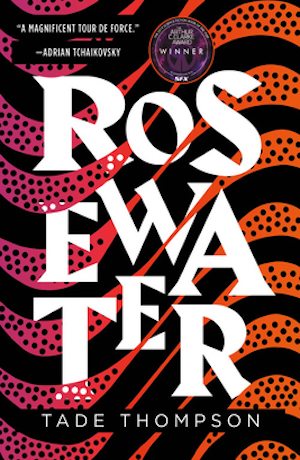
4. Rosewater by Tade Thompson (2016)
Tade Thompson’s Rosewater is an intoxicating collision of cyberpunk and biopunk aesthetics, delivered through a non-linear narrative driven by an amoral narrator and an utterly unorthodox extraterrestrial invasion. In Thompson’s universe, a mysterious alien organism lands on Earth, surfacing quietly in a small town in southwestern Nigeria and encasing itself within a massive biodome. Around its perimeter, a chaotic, opportunistic shantytown flourishes, populated by the curious, the desperate, and the chronically ill.
The alien entity releases microscopic spores that generate a psychic "xenosphere," granting a select group of human "sensitives" the ability to connect telepathically. Enter Karoo—a government bio-agent and sensitive with a murky criminal history—who discovers that his fellow operatives are dying under mysterious circumstances. Within the xenosphere, he encounters a spectral woman and a nomadic activist known only as "Bicycle Girl."
Rosewater is a dense, deeply immersive narrative built on shifting timelines. Thompson approaches the classic alien encounter from an unexpected, oblique angle that rewards attentive reading. Furthermore, its sequels—The Rosewater Insurrection and The Rosewater Redemption—accelerate the momentum, leaning heavily into traditional global invasion tropes. One could argue that The Rosewater Insurrection operates as the truest First Contact novel of the trilogy due to its direct human-alien dialogue, but experiencing its geopolitical complexity requires diving headfirst into this initial volume.
5. Triangulum by Masande Ntshanga (2019)
Masande Ntshanga’s Triangulum is an unconventional entry into the First Contact canon, deliberately sidestepping standard genre expectations to forge a wholly distinct path. Framed as a "found manuscript" narrative set in the year 2040, the story follows Dr. Naomi Buthelezi—a former science fiction author and decorated laureate—as she decodes classified transmissions sent to the South African National Space Agency (SANSA). These documents bear a grim warning: global ecological and civilizational collapse will occur by 2050 unless systemic trajectories are fundamentally altered.
The core narrative shifts to follow an anonymous narrator, a brilliant mathematical prodigy coming of age in post-apartheid South Africa while grappling with the lingering trauma of her mother’s mysterious disappearance. Haunted by recurring visions of an anomalous triangular machine, she drifts through dysfunctional educational institutions, familial breakdown, and strange subcultures, eventually entering a near-future South Africa wholly transformed by corporate surveillance and techno-colonial exploitation.
Constructed through fragmented documents and epistolary fragments, Triangulum is a cerebral puzzle box. The recurring machine ultimately bridges the protagonist to a distant extraterrestrial intelligence originating from the very real Triangulum Galaxy, echoing the cosmic scope of Carl Sagan’s Contact fused with the philosophical weight of The Day the Earth Stood Still. Ntshanga fuses coming-of-age fiction, political thriller, historical reckoning, and dystopian speculation, utilizing the alien encounter to interrogate the enduring, toxic legacies of colonization and resource exploitation—themes that heavily inform works like The Fist of Memory.
Supporting Context & Metrics: The Evolution of African Speculative Fiction
To fully contextualize these First Contact narratives, we must examine the broader socio-cultural and economic metrics governing the African SFF publishing ecosystem. Over the past fifteen years, the landscape has experienced exponential growth, transitioning from localized, independent press initiatives to mainstream global prominence.
- Publication Velocity: Between 1930 and 2000, formal African speculative fiction novels with international distribution were sparse, numbering in the dozens. Today, the output has surged by over 400%, driven by digital publishing platforms, dedicated anthologies, and specialized imprints.
- Linguistic Diversity: Early African speculative texts were largely confined to colonial languages (French and English) or specific regional tongues (such as Bulu and Yoruba). Contemporary African SFF increasingly embraces multilingualism, code-switching, and indigenous philosophical framing directly within English-language narratives.
- Thematic Shifts: As tracked by literary databases, early narratives heavily utilized the "superior alien/missionary" trope as a mirror for European imperialism. Post-independence works shifted toward satirical allegories of state bureaucracy and foreign intervention. Modern Africanfuturism completely deconstructs these paradigms, placing indigenous worldviews, spiritualities, and post-colonial identities at the center of cosmic interaction.
Official Statements & Authorial Perspectives
Reflecting on the psychological and political weight of First Contact stories, contemporary creators emphasize that the genre remains our most potent tool for examining terrestrial power dynamics.
"When we write about humanity meeting an intelligence fundamentally alien to our own, we are not mapping out a future star map; we are holding up a cracked mirror to our own history on Earth. Every debate over communication protocols, resource sharing, and existential threat projection is an echo of how empires have treated the unfamiliar across human history."
— Wole Talabi, Author of The Fist of Memory
Scholars of African speculative literature similarly note that the integration of indigenous cosmologies into science fiction is a radical reclamation of narrative space. By refusing to segregate "science" from "spirituality," African SFF authors bridge the artificial dichotomies imposed by Western literary traditions, creating a more holistic framework for evaluating humanity’s place in the universe.

Future Outlook: The Horizon of African Speculative Fiction
As we look toward the future of First Contact narratives within African speculative fiction, the trajectory points toward radical expansion and stylistic diversification. The barriers that once kept regional speculative traditions isolated from the global mainstream have largely dissolved, thanks to a generation of boundary-pushing authors, translators, and independent publishers dedicated to amplifying diverse voices.
The subgenre is moving beyond simple allegories of colonial trauma toward complex explorations of post-anthropocentric futures, ecological stewardship, and trans-dimensional communication. By grounding cosmic encounters in frameworks like Sankofa and Ubuntu, African speculative fiction offers the entire global literary community a vital reminder: our survival among the stars depends entirely on how we remember our past, honor our communities, and recognize our shared humanity down here on Earth.





Comments
Facebook App ID not configured. Please add it in the Customizer.