
Executive Overview
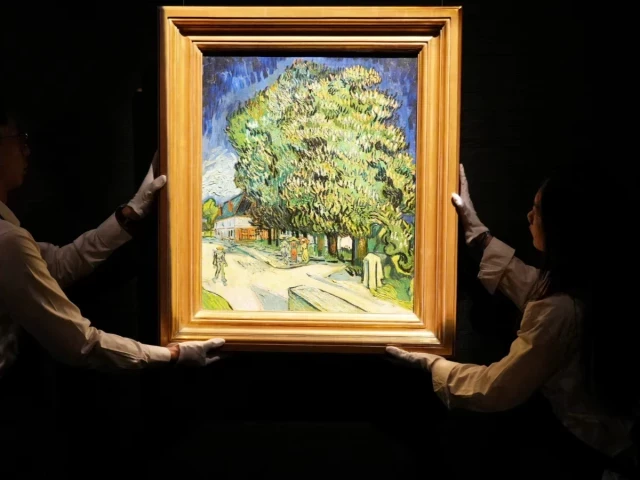
In a rare convergence of art history, high finance, and public spectacle, hundreds of art enthusiasts, collectors, and curious onlookers formed sprawling queues in Hong Kong on a brisk Tuesday morning. Their objective: a fleeting glimpse of Vincent van Gogh’s "Châtaigniers en fleurs" (Chestnut Trees in Blossom)—a breathtaking, museum-grade masterpiece that has remained entirely hidden from public view for more than six decades.
The exhibition in Hong Kong marks a critical international stop on a global preview tour orchestrated by Sotheby’s. The canvas is slated to headline a high-stakes, bellwether auction in New York on November 18, where industry insiders project it will shatter previous valuation benchmarks for the legendary Dutch post-Impressionist, commanding an astronomical sum estimated at approximately $180 million.
This impending sale serves as a definitive stress-test for the upper echelons of the global fine art market. In recent years, macroeconomic headwinds, inflationary pressures, and geopolitical volatility have tempered speculative spending across several sectors. Yet, the ultra-high-net-worth collector base has demonstrated an insatiable appetite for scarce "trophy assets"—museum-quality works with immaculate provenance and historical gravity. Should Châtaigniers en fleurs realize its lofty pre-sale estimate, it will not only reset the financial ceiling for Van Gogh’s oeuvre but also signal robust, unyielding confidence among global elite investors.
Read Also
Painted in May 1890 during the final, tumultuous, yet intensely productive months of the artist’s life in the sleepy French village of Auvers-sur-Oise, the painting encapsulates the raw emotional intensity and chromatic brilliance that define Van Gogh’s ultimate artistic statement. Its journey from private collections and decades of obscurity to the glaring lights of the auction room represents one of the most significant art market events of the decade.
Detailed Chronology: The Provenance and Journey of Châtaigniers en fleurs
To fully grasp the cultural and financial magnitude of the upcoming Sotheby’s auction, one must trace the extraordinary lineage of Châtaigniers en fleurs. The canvas carries a storied provenance that mirrors the turbulent history of modern art collecting over the past 135 years.
The Auvers-sur-Oise Genesis (May 1890)
Completed in May 1890, Châtaigniers en fleurs was executed during a poignant window of Van Gogh’s life. Just weeks prior, the artist had checked himself out of the asylum in Saint-Rémy-de-Provence, seeking solace, professional guidance, and creative stimulation in the pastoral tranquility of Auvers-sur-Oise, located north of Paris. Under the watchful eye of Dr. Paul Gachet, Van Gogh entered a period of frantic artistic productivity. Châtaigniers en fleurs captures the explosive vitality of spring, dominated by a massive, blossoming chestnut tree whose vibrant canopy commands the pictorial plane with thick, expressive impasto brushstrokes. Tragically, this burst of optimism was short-lived; Van Gogh would die by suicide in the same village just two months later, in July 1890, at the age of 37.
Early Descendants and the Family Archive
Following the artist’s tragic death, the immediate stewardship of his body of work fell to his devoted younger brother and confidant, Theo van Gogh. However, Theo’s own health deteriorated rapidly, and he passed away just six months after Vincent. The monumental task of preserving, cataloging, and promoting the artist’s legacy then fell to Theo’s widow, Johanna van Gogh-Bonger, and subsequently to their young son, Vincent Willem van Gogh. During this foundational period, Châtaigniers en fleurs was securely held within the family’s inner circle as they laid the groundwork for Van Gogh’s posthumous global recognition.
Entering the Hands of Visionary Collectors
As the 20th century progressed, the painting transitioned out of the Van Gogh family estate and entered the international commercial art market and private collections:
- Samuel Fischer: The painting was acquired by the prominent German publisher Samuel Fischer, the founder of S. Fischer Verlag, a seminal Berlin-based publishing house that championed modern literary and artistic movements in pre-WWII Europe.
- George "Buddy" DeSylva: The canvas subsequently crossed the Atlantic, entering the collection of George "Buddy" DeSylva. A legendary American songwriter, film producer, and co-founder of Capitol Records, DeSylva amassed an exceptional collection of modern European art, blending Hollywood glamour with elite connoisseurship.
- Harriet Harris-Jonas: In 1953, the painting was acquired by distinguished collector Harriet Harris-Jonas. Her private holdings were so renowned and historically significant that New York’s Metropolitan Museum of Art frequently organized exclusive visits for its most elite patrons and trustees to view masterpieces within her opulent Fifth Avenue apartment.
- The Blaquier Family: In 1975, the painting was acquired from the prestigious Wildenstein gallery by the Blaquier family, under whose private stewardship the painting remained largely hidden from public exhibitions and scholarly view for the subsequent fifty years.
Supporting Context & Metrics: The High-End Art Market Landscape
The decision by Sotheby’s to launch a global tour for Châtaigniers en fleurs—kicking off in London with companion pieces before drawing massive crowds in Hong Kong—highlights the shifting geography of wealth and power in the international fine art ecosystem.
The Asian Collector Base Takes Center Stage
The overwhelming public turnout in Hong Kong, exemplified by attendees like 50-year-old art lover Li Shanshan—who traveled two and a half hours from the southern tech hub of Shenzhen purely to witness the canvas firsthand—underscores the critical importance of Asian collectors in the modern contemporary market. Hong Kong has firmly established itself as a primary global hub for secondary market art sales, rivalling traditional capitals like New York, London, and Paris. Wealth preservation, luxury asset diversification, and a burgeoning class of ultra-high-net-worth collectors across Greater China and Southeast Asia have transformed regional previews into major media and financial events.
A Curated Collection of 12 Long-Unseen Masterworks
Châtaigniers en fleurs is not traveling in isolation. It forms the crown jewel of a curated collection comprising 12 long-unseen masterworks that have languished in private vaults for decades. This blockbuster consignment includes museum-caliber pieces by other foundational pillars of modern art, notably Paul Cézanne and Claude Monet.
In late September, Sotheby’s unveiled the first tranche of this remarkable collection in London, introducing works such as Cézanne’s vibrant Arlequin and Monet’s luminous Le Jardin des Tuileries. By bundling these legendary assets together, Sotheby’s is engineering a rare market phenomenon: injecting a massive supply of fresh, uncirculated blue-chip inventory into an ecosystem that has frequently suffered from supply constraints.
Testing Market Resilience Amid Economic Uncertainty
The November 18 New York auction will serve as an invaluable barometer for the health of the broader luxury economy. While broader macroeconomic indicators—including persistent interest rate adjustments, inflationary pressures, and localized recessions—have caused cautious behavior in mid-tier art markets, the ultra-luxury segment operates on a different plane. Trophy works by universally recognized masters function as alternative asset classes, offering wealthy buyers a tangible, historically resilient store of value. Industry analysts will monitor the auction closely to determine whether institutional and private capital is prepared to absorb a $180 million price tag in the current climate.
Official Statements and Curatorial Perspectives
The rare convergence of historical scholarship and aggressive market positioning has elicited profound commentary from the curators and specialists spearheading the sale.
Scott Niichel, a senior leader within Sotheby’s Modern and Contemporary Art department in New York, emphasized the unique psychological and emotional resonance embedded within the canvas. Speaking to the press during the Hong Kong preview, Niichel noted:
"This is a moment of extraordinary optimism, frenetic energy, enthusiasm, passion, and colour in the artist’s body of work. Paintings from Van Gogh’s final Auvers-sur-Oise period, just after his release from a psychiatric asylum in Saint-Rémy-de-Provence, rarely come to market. The sheer vitality captured in the brushwork defies the tragic narrative often erroneously projected onto his final months."
Niichel further elaborated on the rarity of the offering, explaining that works originating from the artist’s final, intensely creative months carry a mythical status among institutional curators and private collectors alike. Because the vast majority of these late-period masterpieces are permanently locked inside major international museums—such as the Van Gogh Museum in Amsterdam and the Musée d’Orsay in Paris—the opportunity to acquire a canvas of this caliber is a once-in-a-generation occurrence.
Art historians have similarly rallied around the exhibition, praising Sotheby’s for engineering a public preview tour that allows scholars and everyday enthusiasts alike to engage with a pivotal piece of art history that has been absent from public discourse for over half a century.
Future Outlook: Implications for the Global Art Market
As the clock ticks down to the pivotal November 18 auction in New York, the ripples of the Châtaigniers en fleurs phenomenon are already being felt across the international cultural landscape.
Setting New Valuation Benchmarks
Should the painting achieve or exceed its ambitious $180 million estimate, it will establish a watershed moment for Van Gogh’s market value, eclipsing past auction highs and recalibrating the financial ceilings for 19th-century post-Impressionism as a whole. This potential milestone could trigger a chain reaction, encouraging other private collectors and estate executors to bring long-sequestered masterworks out of private vaults and into the public eye.
The Evolution of Global Exhibition Models
The overwhelming public and media response in Hong Kong validates Sotheby’s multi-city touring strategy. By democratizing access to these elite artworks through public exhibitions in financial capitals across Europe and Asia before the gavel drops in New York, auction houses are successfully bridging the gap between exclusive wealth and public cultural engagement. This hybrid model not only drives massive pre-sale marketing value but also cements these auction houses as premier cultural institutions in their own right.
Preserving Artistic Legacy
Beyond the soaring financial figures and the glittering fanfare of the New York salesroom, the ultimate legacy of Châtaigniers en fleurs lies in its enduring capacity to captivate the human imagination. Whether the canvas is acquired by a private billionaire or secured by a philanthropic foundation destined to gift it to a public institution, its re-emergence from six decades of obscurity ensures that Vincent van Gogh’s impassioned dialogue with nature will continue to inspire generations to come.




Comments
Facebook App ID not configured. Please add it in the Customizer.