
Executive Overview
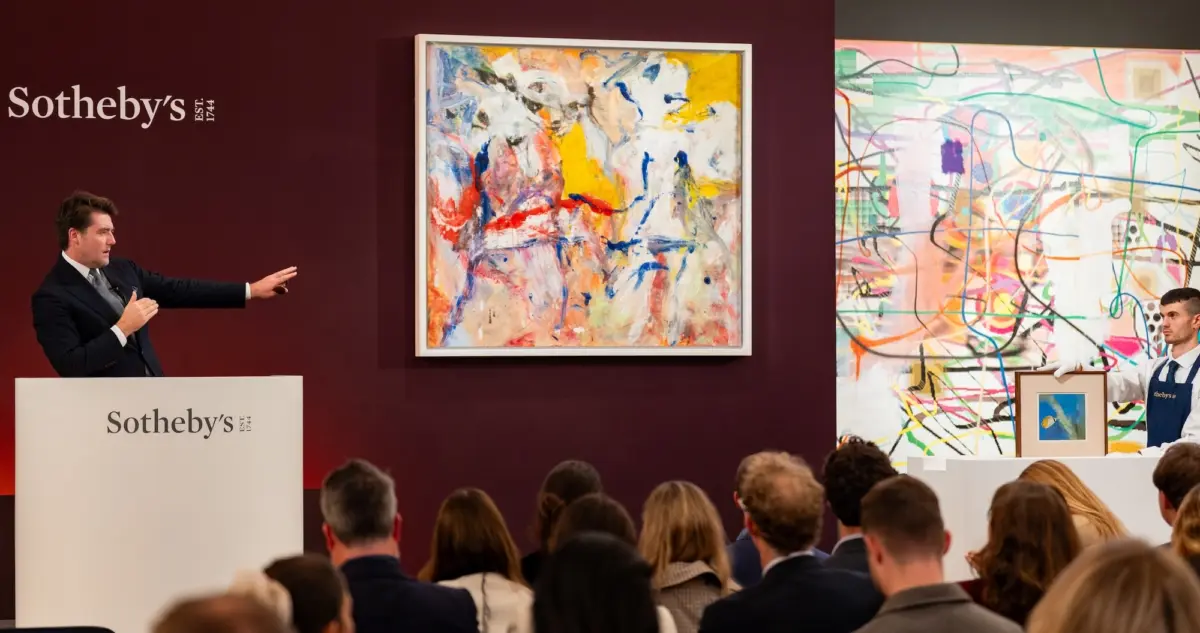
Against a backdrop of tense silences, anxious pauses, and a courtroom-like atmosphere inside a packed saleroom, Sotheby’s London orchestrated a steady and measured contemporary art evening sale on Thursday. The event raked in a combined £46.1 million ($61.1 million)—a performance that landed squarely within its pre-sale expectations but exposed underlying anxieties in the upper echelons of the global fine art market.
Presided over by auctioneer Tom Eddison, the trim, one-hour auction comprised 34 catalogued lots, 10 of which carried guaranteed backing. However, the path to the final tally was far from frictionless. Prior to the first gavel falling, three marquee works—by Damien Hirst, Anselm Kiefer, and Leon Kossoff—were quietly withdrawn. Furthermore, notable lots by blue-chip and high-demand names such as Banksy, Georg Baselitz, Jadé Fadojutimi, Lucian Freud, Gerhard Richter, and Lynette Yiadom-Boakye ultimately failed to find buyers, painting a nuanced portrait of an increasingly discerning collecting class.
The evening’s crown jewel was a commanding, five-foot-wide abstraction by Willem de Kooning from 1977. Estimated between £8 million and £12 million, the piece ultimately hammered at £8.2 million, translating to a total price of £9.8 million ($12.9 million) with buyer’s fees. While the sale’s overall hammer total of £36.9 million fell just shy of the £41.7 million lower estimate threshold (before accounting for house fees), auction house executives defended the results as a triumph of resilient demand in a conservative economic climate.
Read Also
Coming directly on the heels of a more expansive, buoyant multi-sale evening at Christie’s London—which totaled £218.6 million ($289.4 million)—Sotheby’s event served as a high-stakes temperature check during London’s bustling Frieze art fair week. As international collectors, celebrities like Tilda Swinton and Raf Simons, and elite dealers converged on the British capital, Thursday’s auction underscored a fundamental truth of the current market cycle: capital is undeniably present, but buyers are exercising unprecedented selectivity.
Detailed Chronology: The Anatomy of a High-Stakes Auction
The evening began with palpable tension. As Tom Eddison stepped up to the rostrum, the saleroom fell into heavy moments of dead silence, broken only by incremental bidding steps and the sharp drop of the auctioneer’s gavel. The pacing was deliberate, reflecting a market that has largely moved away from the speculative frenzy of previous years in favor of calculated, measured acquisitions.

The Top-Tier Tally: De Kooning Claims the Crown
The auction’s undisputed highlight arrived midway through the hour-long session with Willem de Kooning’s untitled 1977 oil-on-canvas abstraction. Exhibiting the artist’s signature aggressive brushwork and vibrant palette, the canvas commanded intense, localized attention. Having last changed hands at Sotheby’s New York in 2015 for $6.1 million, the work proved its long-term investment viability by cruising to its final realized price of £9.8 million ($12.9 million).
Securing the second-highest spot of the evening was Gerhard Richter’s imposing, eight-foot-wide Abstraktes Bild (1992). Estimated at £6 million to £8 million, the painting ultimately hammered below expectations at £5.4 million, realizing a total of £6.7 million ($8.9 million) with fees. The consignor, who had acquired the work at Christie’s London in 2011 for £3.6 million ($5.7 million at the time), experienced a respectable, if modest, return on investment—further evidence of a stabilizing secondary market where exponential overnight gains are increasingly rare.
Rounding out the top three was an untitled, dark-hued Mark Rothko abstraction from 1969. Estimated conservatively at £3 million to £4 million, the canvas hammered at its low estimate, fetching £3.8 million ($5 million) with fees. The work’s provenance added a compelling historical narrative: the seller had last acquired it at Christie’s New York in 1992 for a mere $264,000, underscoring the staggering multi-decade appreciation of Rothko’s late-period works.
Mixed Fortunes for the Under-50 Generation and School of London
While blue-chip masterworks anchored the evening’s valuation, the performance of younger and mid-career artists yielded a mixed ledger. Contemporary market favorites experienced a bifurcated reception. Louis Fratino’s intimate figurative painting Kissing Couple (2019) met expectations to bring £320,000 ($424,144), supported by strong institutional and commercial momentum, including Fratino’s concurrent sold-out exhibition at David Zwirner’s London showroom. Similarly, Adrian Ghenie’s The Wall (2019) secured £640,000 ($848,288).
Conversely, works by younger market darlings such as Jadé Fadojutimi and established contemporary figures like Lynette Yiadom-Boakye failed to ignite the room, ultimately going unsold. These passes highlighted a broader trend: speculative buying of ultra-contemporary art has cooled significantly, with collectors demanding airtight provenance and historical weight before deploying significant capital.

Supporting Context & Metrics: Navigating the Macro Environment
To fully understand Sotheby’s £46.1 million evening, one must examine the broader financial metrics of Frieze Week 2026 and compare them against historical benchmarks.
- Comparative Performance: Thursday’s tally fell slightly below the equivalent sale from the previous year, which brought in £47.6 million ($63.3 million) and was led by a Francis Bacon triptych that fetched £13 million ($17.5 million).
- The Christie’s Contrast: Sotheby’s cautious evening followed a blockbuster night at competitor Christie’s, which posted an impressive £218.6 million ($289.4 million) across two sales—more than double its total from the previous year. However, industry insiders noted that Christie’s offering relied heavily on structured guarantees and grander, safer consignments, whereas Sotheby’s curation felt more exposed to the raw anxieties of the current economic climate.
- The Withdrawal Factor: The pre-sale removal of three significant lots—by Damien Hirst, Anselm Kiefer, and Leon Kossoff—signaled that consignors and auction houses are increasingly unwilling to force properties onto a hesitant market if pre-sale bidding indicators suggest a shortfall.
- The Michael Andrews Phenomenon: One of the most electrifying moments of the night was the fierce bidding war for Michael Andrews’s 1978 work on paper, Butterfly Fish. Estimated at a modest £80,000 to £120,000, the piece sparked an extended contest before hammering at £550,000, ultimately totaling £704,000 ($933,117) with fees. The result shattered the previous auction high for a work on paper by the artist.
Official Statements & Expert Analysis
The atmosphere inside the saleroom provoked immediate analysis from historians, consultants, and auction house executives alike.
"I would say the market is very cautious," noted art historian and consultant Ivana Miloradovic, speaking to reporters on the sidelines of the sale. "Most of the lots either underperformed or were at the lower end. However, British sales on British soil are always joyous. Everybody knows the artist, the gossip, and the history. It was a homey atmosphere."
Miloradovic pointed to the rousing reception of David Hockney’s 10th–22nd June 2021, Water Lilies in the Pond with Pots of Flowers (2021) and Michael Andrews’s Butterfly Fish as prime examples of works that benefited from local familiarity and deep historical resonance.
The scarcity of Michael Andrews’s output was further contextualized by Ottilie Windsor, Sotheby’s head of contemporary art in London. Reflecting on the fierce competition for Butterfly Fish, Windsor highlighted the artist’s legendary status among his School of London peers—such as Francis Bacon and Lucian Freud—despite his lower mainstream profile today.

"The paintings that he did make were often bought as they were being made by a group of collectors who followed his work really closely," Windsor told reporters post-sale. "Those collectors have never really needed to sell, and so we get a very, very low supply of his work to the market. When they do come up, they really do very well."
Addressing the broader sell-through rate of 28 out of 34 catalogued lots, Windsor pushed back against narratives of a depressed market, framing the results as a pragmatic success.
"Any dealer at the [Frieze] fair would be thrilled to sell nearly 30 secondary market lots," Windsor argued. "There is both interest and money in the market, but the market continues to be selective and continues to surprise us with what it’s looking for."
Future Outlook: A Selective and Maturing Art Market
As London’s Frieze Week drew to a close, the overarching narrative of the autumn auction cycle crystallized: the era of unbridled, speculative exuberance has given way to an era of calculated maturity.
Sotheby’s £46.1 million contemporary sale demonstrated that while institutional-grade masterpieces and blue-chip anchors—such as de Kooning, Richter, and Rothko—retain their liquidity, buyers are no longer willing to purchase blindly. Collectors are prioritizing museum-quality provenance, historical significance, and fair market valuation over hype.

Moving forward into the remainder of the 2026 auction calendar in New York and Hong Kong, auction houses will likely lean further into structured guarantees, conservative estimates, and highly curated offerings. The resilience shown in the London salerooms—marked by packed benches, intense silent pauses, and fierce competition for rare works by artists like Michael Andrews—proves that global wealth remains deeply committed to fine art. Yet, as Thursday night demonstrated, the modern collector holds the reins tighter than ever before.


Comments
Facebook App ID not configured. Please add it in the Customizer.