For over half a century, William T. Williams has occupied a singular, pioneering space within American abstraction. Eschewing the comfort of rigid movements and the easy categorization of identity-driven narrative art, Williams has dedicated his career to the rigorous, demanding exploration of form, color, and spatial dynamics. His paintings do not merely sit passively on gallery walls; they challenge the viewer, introducing visual dissonance and poetic friction that demand an active, unmediated sensory experience.
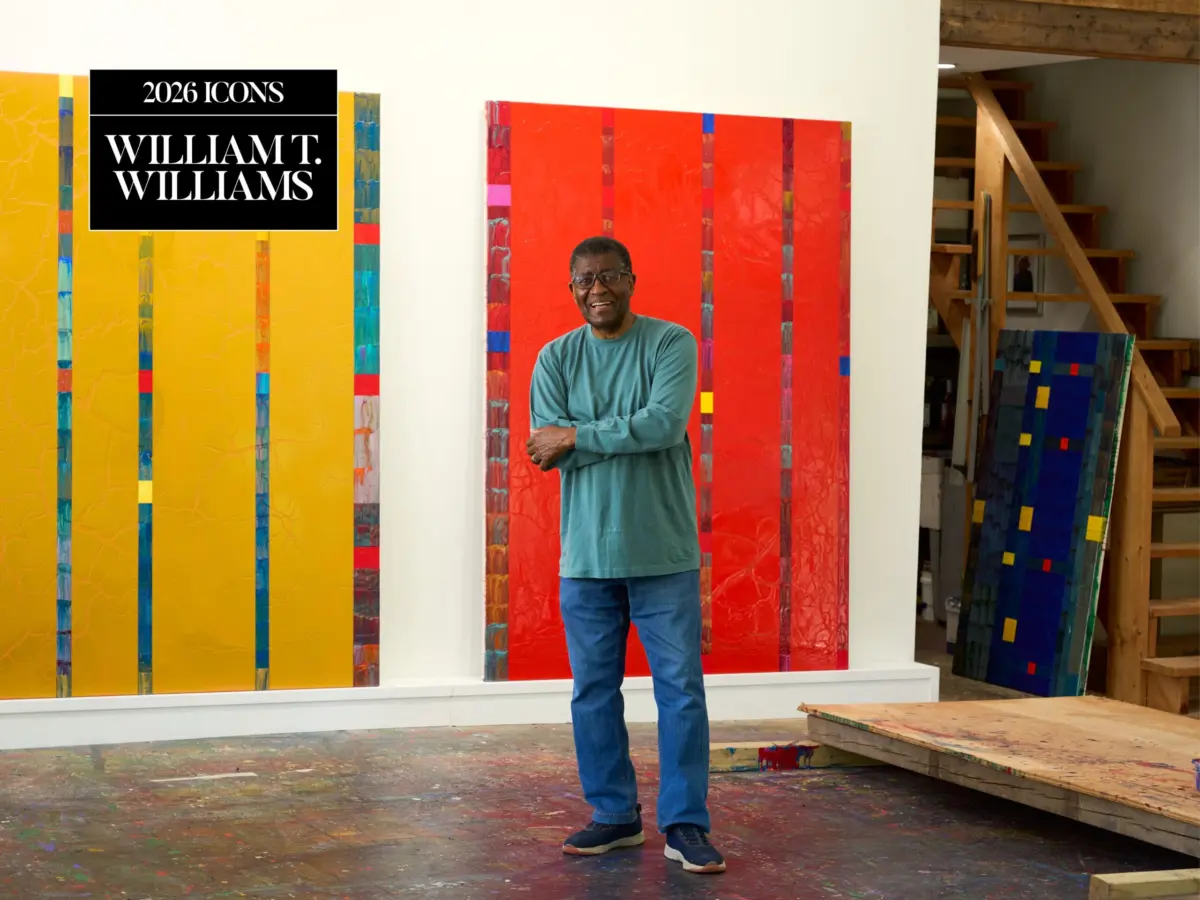
Today, operating out of his sun-drenched studio in Connecticut alongside his decades-long creative base in New York, Williams continues to reinvent his vocabulary. His recent works—characterized by intricate, vertical bands of color, meticulously layered paint, and a profound dialogue between surface and depth—reflect an artist who approaches his craft with the enthusiasm of a novice and the precision of a master.
Beyond his canvases, Williams’s indelible footprint is woven into the very infrastructure of contemporary American art. As a visionary educator who shaped generations of talent at Brooklyn College, a founding catalyst of the Studio Museum in Harlem’s residency program, and a guerrilla muralist who brought abstraction directly to urban communities through the Smokehouse Associates, Williams has continually expanded the boundaries of where and how art lives. This profile examines his enduring studio practice, his historic contributions to institutional equity, and his foundational role in redefining the possibilities of Black abstraction.
Detailed Chronology: From Cross Creek to the Vanguard of Abstraction
Early Foundations and Artistic Awakening (1942–1962)
Born in Cross Creek, North Carolina, in 1942, Williams experienced a childhood divided between the rural South and the urban landscape of Queens, New York, where his family relocated when he was four. Summers spent returning to North Carolina embedded a deep appreciation for vernacular material culture—patterns found in quilts and everyday household items—that would covertly inform his later geometric compositions.
Encouraged early on by community center directors and junior high school art teachers who recognized his innate drawing talent, Williams entered the specialized High School of Art and Design. This immersive environment provided his first true encounter with the profound power of art. Following a brief stint in advertising production and employment at Billboard Music Week, Williams enrolled at the Pratt Institute in 1962. Initially focused on graphic design, he transitioned to painting during his sophomore year. A pivotal encounter with the expressive, high-impact paintings of Hans Hofmann—urged upon him by instructor Richard Bovée—irrevocably shifted his understanding of paint as a living, physical material.
Skowhegan, Mentorship, and the "Diamond in the Box" Breakthrough (1965–1970s)
In 1965, Williams studied at the Skowhegan School of Painting & Sculpture in Maine, where he grappled with moving beyond the long shadow of Abstract Expressionism. Winning the Leonard Bocour Award led to a transformative professional relationship with paint manufacturer Bocour, who provided crucial material insights and patronage.
Proceeding to graduate studies at Yale University under mentors like Al Held, Williams developed his breakthrough "Diamond in a Box" series in the late 1960s. Drawing from the geometric forms of family quilts and domestic objects, these canvases forced the viewer’s eye through a rigorous optical journey of planes, edges, and overlapping geometries. This period also birthed the "Shimmer Series," inspired by the interplay of light on water, executed entirely in monochromatic variations of Dioxazine Purple to evoke rippling motion.
Institutional Legacy and the Smokehouse Years (1968–1970)
While finishing his MFA at Yale in 1968, Williams authored a comprehensive proposal for an artist residency program tailored to support minority artists navigating the transition from academia to professional practice. This document directly inspired the founding framework of the Studio Museum in Harlem. Simultaneously, Williams teamed up with Melvin Edwards, Guy Ciarcia, and Billy Rose to form the Smokehouse Associates. Between 1968 and 1970, the collective produced nine site-specific abstract murals across Harlem. By actively engaging local elders, church groups, and children in the creation process, the Smokehouse projects decentralized high art, demonstrating that abstraction could serve as a powerful vehicle for community empowerment and social uplift.
Pedagogy and Evolving Series (1970s–2000s)
Beginning in 1970, Williams embarked on a nearly 40-year teaching career across the School of Visual Arts, Pratt Institute, and Brooklyn College (retiring in 2008). His classrooms became crucibles for conceptual and material experimentation, influencing major contemporary figures like Nari Ward. Concurrently, Williams pursued daring stylistic departures, including his "Roller" series (1978–1982), which utilized wet-on-wet paint roller techniques to apply up to 15 layers of textured paint—a deliberate flirtation with anti-art gestures that yielded unexpected, rich tactile surfaces.
Supporting Context & Metrics: The Mechanics of Williams’s Practice
To fully appreciate William T. Williams’s work, one must examine the physical environment and meticulous methodologies of his studios. The transition 15 years ago from his deliberately windowless, light-controlled New York studio (maintained since 1968) to a sun-drenched, three-walled windowed space in Connecticut fundamentally altered his output. The new influx of natural light introduced dynamic afternoon geometry, prompting him to pivot toward vertical formats and to physically turn canvases against windows to study how light penetrates translucent layers.
Materiality and Process Metrics
Layering & Drying Time: Williams’s canvases typically require a minimum of six months to complete, with some undergoing subtle tonal adjustments over several years.
Medium Customization: Rather than using a traditional palette, Williams works from plastic cups containing custom paint mixtures. He thins his Golden acrylic paints using precise ratios of alcohol (to accelerate drying) and water (to reduce surface sheen)—a consistency perfected through decades of trial and error.
The Crackle Effect: By deliberately leaving gaps between thinned layers of paint, Williams exposes the chronological buildup of the canvas, creating a signature cracked appearance that celebrates the material’s structural evolution.
Preparatory Markings: In-progress works often feature sections mapped out with blue painter’s tape and varying shades of cut-up Post-it notes. These markers indicate spatial placement rather than final color choices, directly mirroring the two-inch vertical bands of color defining his modern abstractions.
Official Statements and Curatorial Perspectives
The profound impact of Williams’s dual legacy—as both an uncompromising formalist innovator and an institutional architect—is widely recognized by museum directors and art historians.
"There is a constant sense where you see him asking and answering questions in the space of the work, and he has done that for decades. What we then have is the legacy of not only this incredible practice but also the legacy of this incredible person who has been so committed to creating art, creating space, creating meaning."
— Thelma Golden, Director and Chief Curator of the Studio Museum in Harlem
Curator Eric Booker highlights Williams’s steadfast independence from fleeting artistic fads:
"He has existed outside of any one movement, and he hasn’t really been swayed by that. He’s stayed a very steady course that is true to him and what inspires him… There is always something in Bill’s paintings that remains entirely his own."
Art historian Mona Hadler emphasizes the socio-political subtext of Williams’s aesthetic choices, noting that his public murals and complex canvases proved definitively that "abstraction can uplift" and that an artwork "need not be figurative to have a message."
Future Outlook: Enduring Influence and Archival Reverence
As William T. Williams enters his eighth decade of artistic production, his influence on contemporary art continues to reverberate across generations. The alumni roster of the Studio Museum residency program—which he conceptualized in late 1960s New York—reads as a roll call of the 21st century’s most significant visual artists, including Kerry James Marshall, Julie Mehretu, Kehinde Wiley, Simone Leigh, and Lauren Halsey. Many of these figures have, in turn, established their own mentorship initiatives, proving the infinite scalability of Williams’s original vision.
Within his Connecticut studio, the personal and professional merge in a powerful physical archive. Tucked behind a wooden column stands a poignant memorial: dozens of dried-out paintbrushes, each bearing the unwashed pigment from the day a cherished friend, artist, poet, or musician—including long-time peers Sam Gilliam, Jack Whitten, and Melvin Edwards—passed away.
For Williams, the dialogue with these foundational peers never ceases. Every time he approaches a blank canvas, the collective rigor, philosophical debates, and absolute commitment to artistic autonomy shared by his late contemporaries remain active participants in the room. By stripping away narrative crutches and demanding that audiences engage directly with the optical and physical reality of paint, William T. Williams has secured a permanent, unassailable position in the canon of American modern art—not merely as a participant in history, but as one of its primary architects.





Comments
Facebook App ID not configured. Please add it in the Customizer.