
Executive Overview
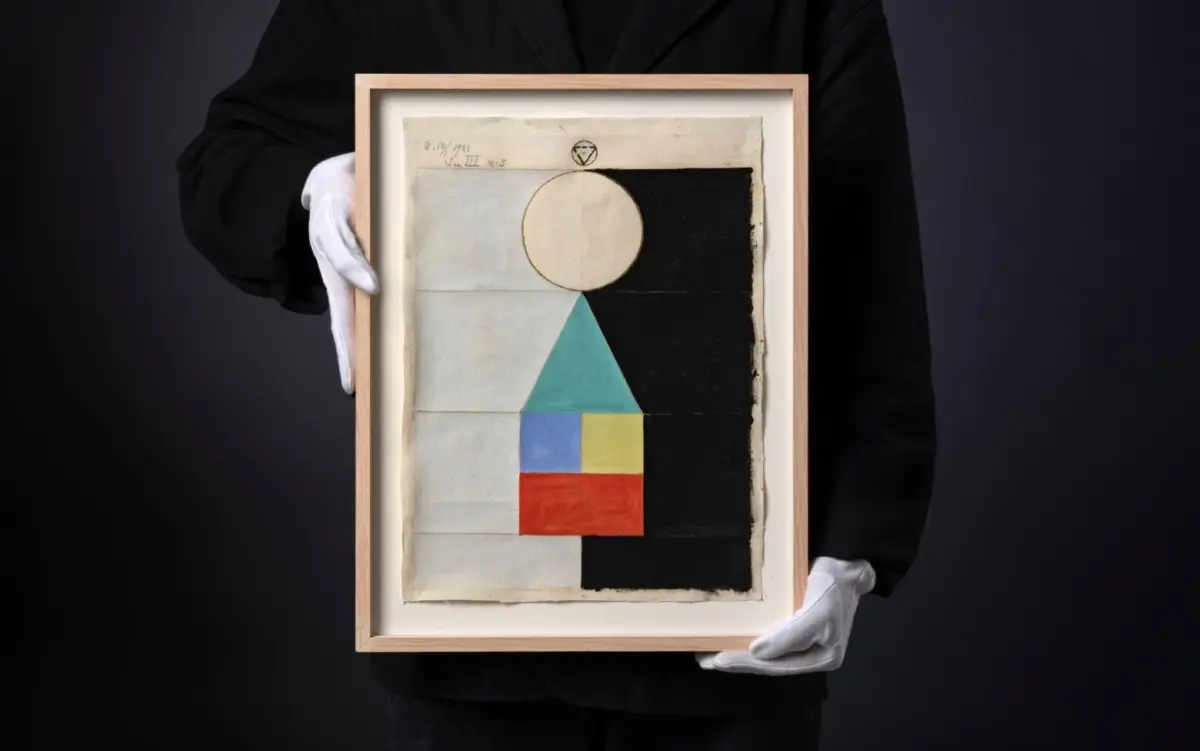
In what is already being hailed as a monumental event on the international art market, the Stockholm-based auction house Bukowskis is preparing to offer a rare abstract painting by the visionary Swedish artist Hilma af Klint. Titled Ser III No. 5 (1920), the work is slated to cross the auction block during a premier modern art and design sale. Estimated conservatively between $600,000 and $800,000, the painting is widely expected to eclipse its low estimate easily, a feat that will utterly shatter af Klint’s previous auction records and once again expose the fierce, pent-up demand for a creator whose work almost never changes hands in the commercial sector.
For decades, af Klint was an obscure footnote within twentieth-century art history, her radical contributions deliberately withheld from the public eye by her own stipulations. Today, however, she is recognized as a pioneering giant of early modernism. A landmark 2018 retrospective at the Guggenheim Museum in New York famously reframed her legacy, crediting her with inventing Western abstraction years before Wassily Kandinsky, Kazimir Malevich, or Piet Mondrian.
Despite her meteoric rise in institutional prominence—highlighted by major surveys at institutions like the Grand Palais in Paris—her presence in commercial galleries and auction houses remains exceptionally scarce. The Hilma af Klint Foundation, tasked with preserving her vast estate, maintains a notoriously tight grip on her inventory, adhering to the artist’s explicit wishes that her pioneering visual vocabulary not be prematurely commercialized or scattered recklessly across the global art market.
Read Also
Consequently, the upcoming sale of Ser III No. 5 represents much more than a routine commercial transaction. It is a rare collision between a tightly guarded institutional legacy and the relentless pressures of the open market, offering collectors a once-in-a-generation opportunity to acquire a certified masterpiece by an artist whose creations are essentially locked away in public institutions and private trusts.
Detailed Chronology: From Spiritualist Visions to Auction Block
To understand the magnitude of the upcoming Bukowskis sale, one must trace the extraordinary trajectory of af Klint’s life, her prolific creative bursts, and the decades of obscurity that preceded her global rediscovery.
The Spiritualist Genesis (1906–1920)
Born in Sweden in 1862, af Klint was formally trained at the Royal Academy of Fine Arts in Stockholm, where she mastered traditional landscape and portrait painting. However, her true calling transcended the visible world. Deeply engaged in spiritualism, Theosophy, and Anthroposophy, she—alongside a collective of female artists known as The Five (De Fem)—participated in regular seances. During these gatherings, af Klint believed she was acting as a medium, channeling higher spiritual forces that wished to communicate profound metaphysical truths through her art.
This spiritual mandate birthed her masterwork series, The Paintings for the Temple, executed primarily between 1906 and 1915. Composed of striking geometric motifs, pyramids, looping lines, biomorphic shapes, and delicate flowerlike forms, these canvases predated the conventionally accepted milestones of abstract art.
The painting heading to Bukowskis, Ser III No. 5, hails from a slightly later, intensely prolific period. Painted in 1920, it belongs to a sequence of 85 canvases that af Klint produced during a rapid, three-month burst of creative energy. By this point in her life, her visual language had matured into a sophisticated synthesis of cosmic diagrams, color theory, and esoteric philosophy.
Anticipating the Future and Posthumous Secrecy
Focussed entirely on the spiritual evolution of humanity, af Klint conceptualized a specialized, spiral-shaped temple to house her monumental temple paintings—a visionary architectural project that was never realized during her lifetime. Recognizing that the art world of her era was fundamentally unprepared to comprehend her radical iconography, she stipulated in her will that her vast oeuvre of more than 1,000 works and 26,000 pages of notebooks must not be shown publicly until at least twenty years after her death in 1944.
For decades, her crates of canvases remained rolled up and tucked away in a Swedish attic, safely preserved from a commercial art world that had no vocabulary for her output. When the moratorium finally expired, the art world was slow to wake up. It was not until the late twentieth and early twenty-first centuries that curators began to untangle the historical significance of her archive.
The Provenance of Ser III No. 5
The specific path that brought Ser III No. 5 to Bukowskis is remarkably well-documented, distinguishing it from works with murky histories. According to the auction house, the painting has been held by the same unidentified private collector since 1995.
The current consignor acquired the canvas in the wake of a rare administrative maneuver by the Hilma af Klint Foundation in the early 1990s. Facing operational and archival needs, the foundation made a carefully managed, “small number of works” available for private purchase. Since that brief window closed, the foundation slammed the door shut on private sales, making subsequent secondary-market appearances virtually nonexistent. According to Bukowskis, only two paintings by af Klint have ever appeared at public auction—both more than thirty years ago.
Supporting Context & Metrics: The Scarcity Economics of Hilma af Klint
The economic reality surrounding Hilma af Klint’s work is governed entirely by extreme scarcity and stringent institutional stewardship. In the high-stakes ecosystem of the global art market, scarcity drives valuation, but in af Klint’s case, it has created a closed loop that routinely frustrates elite galleries and high-net-worth collectors alike.
Institutional Dominance vs. Commercial Drought
While museums around the world scramble to acquire or exhibit her work, commercial galleries rarely host solo exhibitions of her paintings. When opportunities do arise, they are treated as major cultural events.
For instance, in 2021, the prestigious David Zwirner gallery mounted an exhibition featuring af Klint’s celebrated Tree of Knowledge series. The moment the works were made accessible, they were promptly acquired en bloc by the Glenstone Museum in Potomac, Maryland—a private museum founded by billionaires Mitchell Rales and Emily Wei Rales. The speed of the transaction underscored a fundamental truth of the market: whenever authentic af Klint canvases slip into commercial circulation, institutional buyers pounce to lock them away permanently.
The Foundation’s Iron Grip and Internal Discord
The primary gatekeeper of this scarcity is the Hilma af Klint Foundation, which manages the artist’s estate under strict mandates. The foundation cites af Klint’s own written instructions demanding that her art not be fragmented, commercialized, or commodified in ways that strip away its spiritual and philosophical context.
This protective stance has occasionally spilled over into controversy. Plans to forge a deeper institutional or commercial relationship between the foundation and commercial mega-galleries like David Zwirner have historically faced internal resistance. Reports have surfaced indicating that descendants of the artist have vigorously challenged certain stewardship decisions, revealing deep-seated tensions behind the scenes regarding how best to balance public access with commercial integrity.
The great-grandnephew of the artist, who currently chairs the foundation, has continuously championed plans to finally build the physical temple envisioned by af Klint. Such a structure would act as a permanent, sacred repository for her art, permanently insulating it from the whims of the commercial auction market. However, despite years of discussions, a concrete timeline for the temple’s realization has yet to materialize.
Market Projections: Smashing the Record Books
Given that public auction appearances are exceedingly rare, the $600,000–$800,000 estimate assigned to Ser III No. 5 by Bukowskis is widely viewed by market analysts as a placeholder rather than a ceiling. Because historical comparable sales are virtually nonexistent—with only two auction results logged over thirty years ago—bidders operating in the modern art and design sector are entering uncharted waters.
If aggressive international collectors, institutional representatives, and high-net-worth speculators engage in a bidding war on November 19, the final hammer price could easily dwarf the high estimate. In doing so, it will reset the financial benchmark for an artist whose market value has long lagged behind her towering art-historical status.
Official Statements and Industry Reactions
As the countdown to the November 19 sale continues, art world stakeholders, market watchers, and institutional representatives are closely monitoring developments in Stockholm.
-
Bukowskis Representatives: In their official press announcements, auction house executives emphasized the extraordinary provenance of Ser III No. 5, noting its direct link to the pivotal 1920 production period and its unbroken lineage within a single private collection for nearly three decades. The house framed the offering as a "once-in-a-lifetime milestone for collectors of early modern abstraction."
-
Market Analysts and Curators: Independent market commentators have pointed out that the auction serves as an ultimate stress test for the af Klint market. With supply severely constrained by foundation policies, every public offering acts as a bellwether for the artist’s enduring financial valuation.
-
The Hilma af Klint Foundation: As of press time, the foundation has maintained a cautious silence regarding the upcoming sale. Investigative inquiries directed to foundation representatives by ARTnews and other cultural publications regarding their level of awareness or potential involvement in the consignment of Ser III No. 5 have not yet yielded an official statement. This deliberate reticence aligns with the foundation’s historic wariness of commercial market dynamics.
Future Outlook: What the Sale Means for the Legacy of Modern Abstraction
The impending sale of Ser III No. 5 at Bukowskis is much more than a routine auction headline; it is a watershed moment that will reverberate across the global art landscape.
First, the event will provide a definitive, modern market valuation for an artist whose work has traditionally defied commercial categorization. By establishing a new benchmark at public auction, the sale will force insurance companies, private collectors, and institutional lenders to recalibrate the financial appraisals of any remaining privately held af Klint canvases.
Second, the sale highlights the persistent tension between the sacred intentions of visionary artists and the voracious demands of the contemporary art market. While Hilma af Klint explicitly designed her works to serve a higher, collective spiritual purpose—free from the vulgarities of the commercial art trade—her creations have inevitably become some of the most coveted and fiercely contested trophies of the twenty-first-century art market.
Finally, whether Ser III No. 5 is absorbed into another private collection or quietly acquired by an ambitious museum, its journey from a Swedish attic to a high-profile auction podium underscores the ongoing rewriting of art history. Hilma af Klint’s rightful place at the absolute vanguard of abstract art is no longer a matter of academic debate; on November 19 in Stockholm, it will be etched permanently into the economic ledgers of global art history.


Comments
Facebook App ID not configured. Please add it in the Customizer.