
Executive Overview
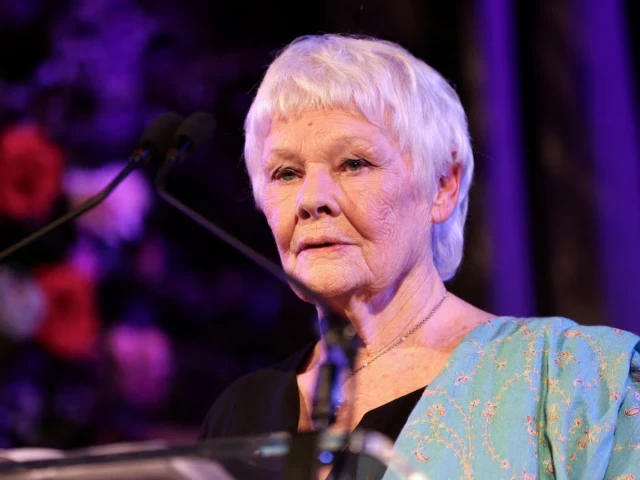
For over seventy years, British acting royalty Dame Judi Dench has commanded stages and screens with a rare combination of raw emotional intensity, razor-sharp wit, and formidable presence. From commanding Shakespearean heroines to her iconic, steely portrayal of "M" across eight James Bond films, Dench has firmly cemented her status as one of the most revered performers in the history of cinema and theatre.
However, in a deeply candid and poignant interview with BBC Radio, the 91-year-old Oscar-winning actress officially closed the book on her active performance career. Confirming what many in the entertainment industry had long feared, Dench revealed that advanced age-related macular degeneration (AMD)—a condition she has battled for more than a decade—has progressed to a point where she can no longer read scripts, memorize lines for the stage, or navigate film sets.
Rather than succumbing to bitterness, Dench approached the heartbreaking announcement with her characteristic pragmatism and resilience. "I can’t be on stage, I can’t do a play anymore, I can’t do a film anymore, I can’t read anymore," she told listeners. "So you’ve got to adjust to all that, and make allowances for it and just get on and don’t think about it too much."
Read Also
This milestone moment marks the definitive end of an era for British performing arts. While Dench’s physical presence will no longer grace future productions, her indelible legacy remains untouched. This comprehensive retrospective explores the final chapter of her legendary career, the physical and emotional realities of managing advanced macular degeneration, her profound literary passions, and the enduring philosophy of a performer who viewed fear not as a hindrance, but as the very fuel of her art.
Detailed Chronology: From the Stage to the Silver Screen
To fully appreciate the gravity of Dame Judi Dench’s retirement, one must trace a magnificent trajectory spanning seven decades of extraordinary artistic output. Born in 1934 in Heworth, Yorkshire, Dench’s journey into the arts began not in film, but in the hallowed halls of classical theatre.
The Classical Foundations (1950s–1970s)
Dench made her professional stage debut in 1957 with the Old Vic Company, playing Ophelia in Hamlet at the Royal Court Theatre in Liverpool. From the outset, critics and audiences alike recognized a generational talent. Her early career was heavily defined by her work with the Royal Shakespeare Company (RSC) and the National Theatre.
During these formative decades, Dench tackled virtually every major female role in the Shakespearean canon. She brought unprecedented nuance and psychological depth to characters such as Juliet in Romeo and Juliet, Lady Macbeth in Macbeth, and Cleopatra in Antony and Cleopatra. Her stage work earned her widespread critical acclaim, culminating in an unprecedented seven Laurence Olivier Awards—a testament to her unmatched dominance of the British stage.
The Television and Film Crossover (1980s–1990s)
While Dench was already a titan of the British theatre, international household recognition came slightly later in life. In the 1980s, she showcased her remarkable comedic and dramatic range on television, starring alongside Michael Williams (her late husband) in the beloved sitcom A Fine Romance (1981–1984), and later anchoring the brilliant romantic comedy As Time Goes By (1992–2005) with Geoffrey Palmer.
Her transition into global cinematic prominence accelerated exponentially in 1995 when she was cast as "M"—the steely, uncompromising head of MI6—in Martin Campbell’s GoldenEye, starring alongside Pierce Brosnan. Dench broke a major glass ceiling as the first woman to play the iconic spy master, a role she would famously reprise across eight films, seamlessly transitioning into the Daniel Craig era (Casino Royale, Skyfall) before her character’s dramatic exit.
Key Milestones in Dame Judi Dench's Career:
-----------------------------------------------------------
1957 : Professional stage debut as Ophelia (Old Vic Company)
1995 : Debuts as MI6 chief "M" in the James Bond film 'GoldenEye'
1998 : Wins the Academy Award for Best Supporting Actress for 'Shakespeare in Love'
2011 : Receives global acclaim for her portrayal of Queen Elizabeth I in 'Shakespeare in Love' / Queen Victoria in 'Mrs Brown'
2012–2016 : Concludes her run as "M" in 'Skyfall' and 'Spectre'
2026 : Officially confirms retirement from stage and film due to advanced macular degeneration
The Oscar Era and Global Stardom (Late 1990s–2020s)
Despite her relatively brief screen time of just under eight minutes in John Madden’s 1998 romantic comedy-drama Shakespeare in Love, Dench delivered an unforgettable, acerbic performance as Queen Elizabeth I. The role earned her the Academy Award for Best Supporting Actress, cementing her status as a global cinematic icon.
Throughout the 2000s and 2010s, Dench’s filmography read as a masterclass in versatile acting. She earned additional Oscar nominations for her powerhouse performances in Mrs. Brown (1997), Chocolat (2000), Iris (2001), Mrs. Henderson Presents (2005), Notes on a Scandal (2006), and Philomena (2013). Even well into her eighties and nineties, she continued to work tirelessly, appearing in Kenneth Branagh’s semi-autobiographical drama Belfast (2021), which earned her yet another Academy Award nomination at age 87, making her one of the oldest nominees in Oscar history.
Supporting Context & Metrics: The Reality of Macular Degeneration
Behind the glamour of red carpets, golden statuettes, and standing ovations, Dench has spent the latter half of her life quietly navigating a progressive and debilitating medical condition: age-related macular degeneration (AMD).
Understanding Age-Related Macular Degeneration
Macular degeneration affects the central part of the retina (the macula), which is responsible for sharp, straight-ahead vision needed for reading, driving, and recognizing faces. While it rarely leads to total blindness—as peripheral vision usually remains intact—the loss of central vision profoundly disrupts daily independence.
For an actor whose craft relies heavily on reading physical scripts, catching subtle micro-expressions of co-stars on set, and navigating complex stage blocking under blinding theatrical spotlights, the diagnosis presented an existential professional crisis.
Dench first went public with her diagnosis around 2012, noting at the time that she could no longer read restaurant menus or see faces clearly. Over the subsequent decade, she adapted remarkably well, employing a network of devoted assistants, relying on friends to read lines aloud to her so she could memorize them aurally, and using specialized optical magnification tools.
The Human Toll: Humor Amid Heartbreak
True to her resilient nature, Dench has often addressed her failing eyesight with self-deprecating British humor. During her recent interview with BBC Radio, she revealed the more vulnerable—and sometimes comical—everyday consequences of her advanced vision loss.
She shared that she can no longer recognize faces at a distance, a limitation that has occasionally led to socially awkward encounters. "I can’t no longer recognise faces," she explained with a warm chuckle, admitting that she frequently finds herself nearly embracing complete strangers on the street, mistakenly believing them to be lifelong friends or colleagues.
Medical experts and low-vision advocacy groups have frequently lauded Dench for speaking openly about her condition. By destigmatizing age-related visual impairment, she has provided comfort and visibility to millions of older adults facing similar neurological and ophthalmological challenges.
Official Statements & Reflections: Love for Shakespeare and the Energy of Fear
During her comprehensive retrospective interview, Dame Judi opened up about the emotional anchors that sustained her career, her profound literary devotions, and her unique psychological approach to performance anxiety.
Besotted by the Sonnets
While Dench’s film career made her a global superstar, her heart has always belonged to classical literature—specifically, the works of William Shakespeare. Having spent decades inhabiting his most complex heroines, Dench spoke with lingering passion about the timeless brilliance of his poetry.
"I am besotted by the sonnets, I just love them," Dench reflected. "The way he summed up so simply the way that any of us feel about, well, anything."
This deep literary connection informed every theatrical performance she delivered. To Dench, Shakespeare was not a dusty historical artifact, but a vital, breathing emotional mirror reflecting the universal complexities of human desire, grief, ambition, and love.
The Alchemy of Fear
Perhaps one of the most revealing insights from Dench’s final interview was her perspective on performance anxiety. For the general public, the notion that an Oscar-winning icon with seven decades of experience could still suffer from stage fright seems implausible. Yet, Dench insisted that fear was not an obstacle to be avoided, but an essential catalyst for artistic excellence.
Reflecting on the risks she took when selecting diverse, demanding roles throughout her career, she noted that performing was always a daunting and terrifying enterprise:
"For me, always frightening, but that’s part of it," Dench stated candidly. "It’s part of what that fear generates—an energy that you can use up, use the energy."
This philosophy transformed nervous energy into dynamic, unpredictable power on stage and screen. To Dench, artistic complacency was the true enemy. Summarizing her lifelong philosophy toward her craft, she offered a final, definitive perspective that defines her entire career:
"It’s always ‘work in progress’, always."
Future Outlook: A Legacy Carved in Stone
As the entertainment world processes the formal conclusion of Dame Judi Dench’s acting career, the overwhelming sentiment is one of profound gratitude rather than sorrow.
While the film sets and theatres of London’s West End will certainly feel the absence of her commanding presence, her cultural footprint is permanently etched into the global artistic consciousness. From her groundbreaking tenure as MI6’s "M" to her breathtaking masterclasses in Shakespearean tragedy and comedy, Dench set an impossibly high benchmark for generations of actors to follow.
In her retirement, Dench leaves behind a roadmap of resilience—proving that physical limitations do not diminish a titan’s spirit, and that true artistry lies not in perfection, but in the courage to continuously embrace the "work in progress." As she steps away from the spotlight to adjust to life’s next chapter, Dame Judi Dench remains, unequivocally, a national treasure and an immortal icon of stage and screen.





Comments
Facebook App ID not configured. Please add it in the Customizer.