For decades, writing pedagogy has relied on a foundational maxim: to execute a compelling character arc, a protagonist must be burdened by a "Lie the Character Believes." Widely popularized by writing authorities, notably author K.M. Weiland in her seminal text Creating Character Arcs, this framework dictates that a character harbors a limited, erroneous perspective that prevents them from embracing a broader, thematic "Truth." In a positive change arc, the narrative forces the protagonist to dismantle this deception and adopt the expansive truth, while negative change arcs portray the tragic consequences of clinging to falsehoods.
However, a radical re-evaluation of this foundational concept is currently reshaping how master storytellers conceptualize narrative growth. Recent theoretical shifts argue that the "Lie" is not inherently an outright falsehood or a simple trick of the mind. Instead, narrative experts propose a more nuanced paradigm: the Lie is a comparatively limited perspective that once served as a functional truth, acting as an ego-driven coping mechanism born out of early developmental trauma or backstory "Ghosts."
By examining character development through the lens of psychological individuation—drawing on the theories of Carl Jung, Marie-Louise von Franz, and modern neurobiology—this updated perspective suggests that writing a character arc is less about radical "transformation" and more about alignment. Storytelling, at its core, mirrors the human journey of stripping away the false self, overcoming ego-driven separation, and uniting conscious awareness with the unconscious mind.
Detailed Chronology: The Evolution of the Character Arc Paradigm
To understand the current theoretical revolution regarding the character’s internal conflict, one must trace the evolution of story structure across modern screenwriting and fiction craft literature.
The Traditional Era (Late 20th Century): Script doctors and fiction instructors like Robert McKee and Blake Snyder established structural foundations prioritizing external beats and clear emotional hurdles. Within this framework, internal flaws were largely treated as binary hurdles: a character has a flaw (the Lie), encounters conflict, learns a lesson (the Truth), and changes.
The Mid-2010s (The Formalization of the Lie): Craft educators, including K.M. Weiland, codified the specific mechanics of the "Lie the Character Believes" as a vital anchor for thematic resonance. This era standardized the understanding of positive versus negative change arcs, anchoring the protagonist’s internal shift directly to the plot’s external climax.
The Late 2010s to 2020s (The Continuum Discovery): Writers began noticing the limitations of treating the Lie as a flat "wrong answer." Protagonists in long-form narratives—such as Feyre in Sarah J. Maas’s A Court of Thorns and Roses series—frequently outgrew a truth learned in a previous book, proving that what functions as an ultimate revelation in Act III can become a restrictive limitation in a sequel.
The Present Day (The Consciousness & Alignment Paradigm): Contemporary structural analysis has expanded past mechanics into depth psychology. Theorists now view the Lie not as a random mistake, but as a systematic defense mechanism of the ego. The conversation has shifted from "How do we fix a character’s wrong belief?" to "How do we map the structural stripping away of the ego to achieve psychological wholeness?"
Supporting Context & Metrics: The Three Models of Limiting Beliefs
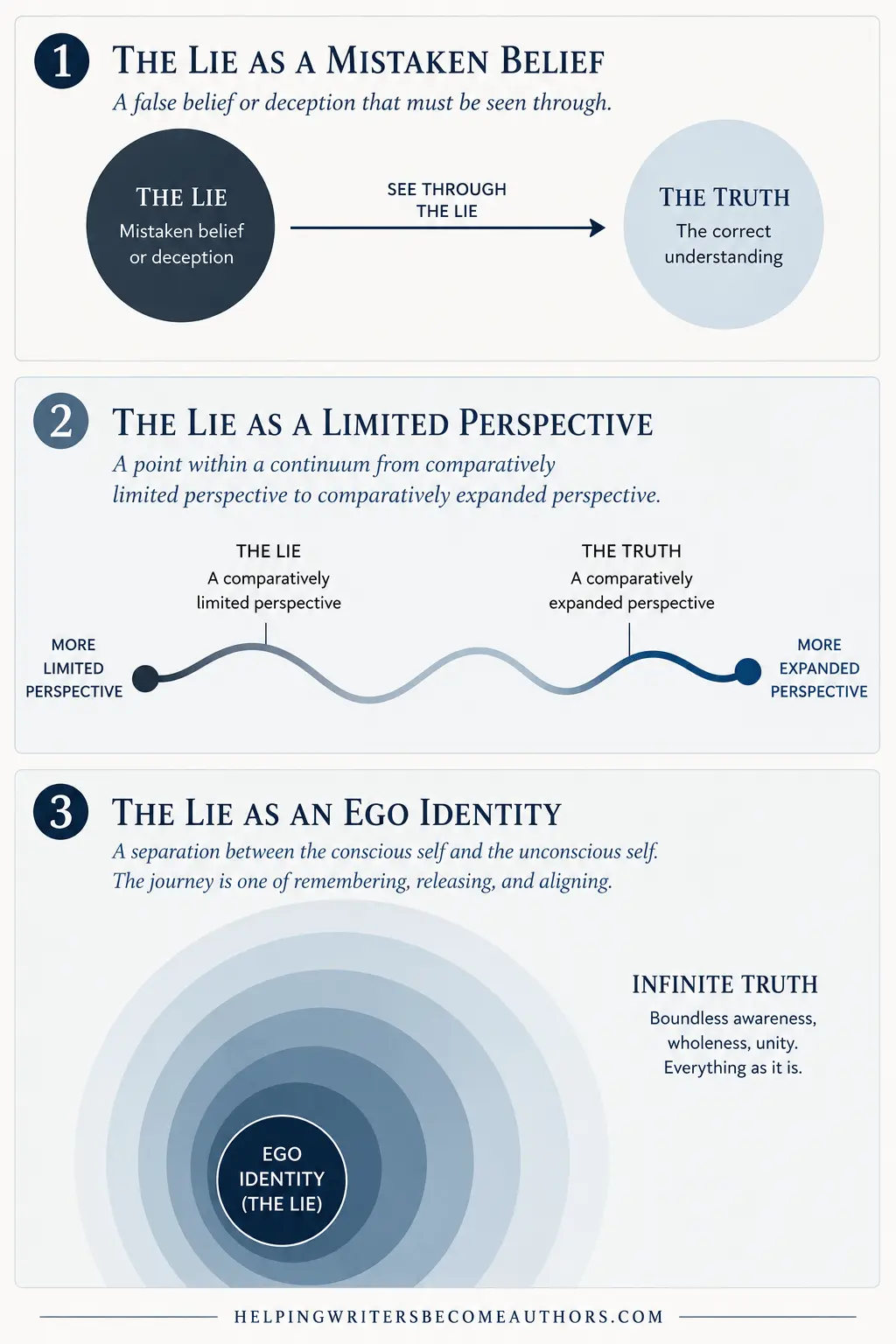
To operationalize this deeper understanding of internal character arcs, modern writing theory breaks down the concept into three ascending layers of psychological complexity.
[Layer 1: The Mistaken Belief]  --> An outright deception or factual error to be corrected.
[Layer 2: The Limited Horizon]   --> A functional perspective that must expand along a continuum.
[Layer 3: The Ego Identity]    --> A deep-seated separation between the conscious self and the soul.
1. The Lie as a Mistaken Belief
At its most basic level, the Lie functions as an outright deception or a surface-level error in judgment. For example, a protagonist may believe that "nobody can be trusted," leading them to push away allies. The narrative acts as a reality check, proving through empirical evidence that trust is safe, thus dismantling the deception.
2. The Lie as a Limited Perspective on a Continuum
Moving past binary right-and-wrong answers, this model views the Lie and the Truth as comparative reference points on an infinite continuum of human understanding. At the start of a narrative, the protagonist’s perspective is not necessarily evil or delusional; rather, it is insufficient for the new environmental demands of the story. Yesterday’s truth naturally becomes tomorrow’s limitation as the horizon broadens.
3. The Lie as an Ego Identity and Separation
At its deepest psychological tier, the Lie is understood as an ego-driven construct. Drawing from Jungian psychology, the ego maintains a restricted awareness of identity ("I am my job," "I am my trauma," "I am my social status"). This identity creates a fissure—a separation—between the conscious self and the deeper, integrated unconscious self. The character’s internal struggle is no longer just about correcting a thought; it is about dissolving the false self to allow the authentic soul to emerge.
Official Statements & Expert Perspectives
The intersection of narrative architecture and depth psychology has generated profound insights from literary scholars, psychoanalysts, and master craft educators alike.
"The suffering we feel, though real within the context of our physiology, is an illusion when it comes to our minds. And our minds hold the key to its release… All it takes is willingness to feel the pain, and the miracle begins."
— Richard Rudd, author of The Gene Keys
This perspective highlights why character arcs frequently feature intense emotional friction. The ego is biologically wired for survival; when a narrative forces a protagonist to confront the limitations of their coping mechanisms, the ego perceives annihilation and resists fiercely.
Jungian scholar Marie-Louise von Franz expands upon this dynamic when discussing the process of individuation—the psychological blueprint underlying the Hero’s Journey and archetypal character arcs:
"The ego must be able to listen attentively and to give itself, without any further design or purpose, to that inner urge toward growth."
In modern narrative applications, this means that profound character growth is less about forced transformation—adding new behaviors or learning external lessons—and more about alignment. The narrative strips away the false ego identities, societal expectations, and childhood coping mechanisms (the "Ghost" in the backstory) so the protagonist can realize the totality of their inner psyche.
Future Outlook: The Intersection of Narrative Craft and Psychological Depth
As storytelling continues to evolve across literature, streaming media, and interactive gaming, audiences increasingly demand complex, psychologically authentic characters over flat archetypes. The movement away from viewing the "Lie" as a simple narrative bug to be fixed—and toward viewing it as a structural manifestation of ego separation—heralds a new golden age for character-driven fiction.
Writers who embrace this multi-tiered approach to the Lie the Character Believes can construct richer internal conflicts, more resonant thematic metaphors, and deeply cathartic transformations. By recognizing that character arcs ultimately mirror the human quest for individuation and wholeness, authors can craft stories that do not merely entertain, but fundamentally resonate with the primal, evolutionary drive of human consciousness itself.








Comments
Facebook App ID not configured. Please add it in the Customizer.