
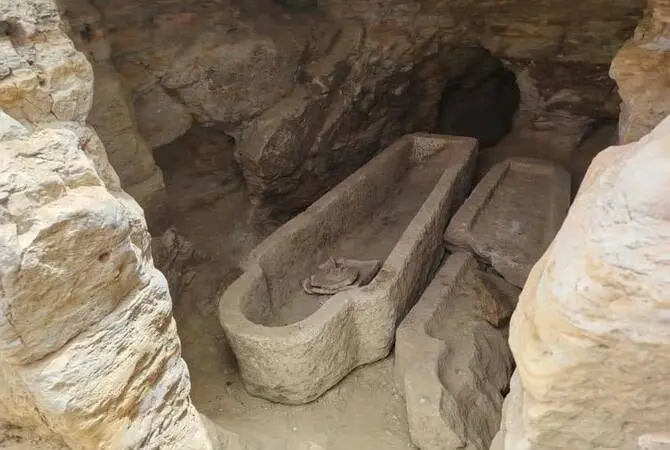
CAIRO, EGYPT — In a remarkable stride forward for Egyptology, an archaeological mission operating in Egypt’s Western Desert has announced the discovery of three ancient tombs spanning different historical epochs. Unearthed at the Sheikh Sobi archaeological site within the remote and historically rich Bahariya Oasis—located approximately 225 miles southwest of Giza—the find offers profound insights into the funerary practices, artistic expressions, and socio-religious evolution of provincial elites who inhabited Egypt’s periphery during the Late and Roman periods.
The discovery, initially announced by Egypt’s Ministry of Tourism and Antiquities and subsequently detailed by regional and international outlets, highlights the enduring potential of the Bahariya Oasis as a treasure trove of archaeological data. Comprising a rock-cut family vault from the Late Period and two distinct Roman-era structures, the newly uncovered subterranean architecture demonstrates how funerary traditions adapted over centuries under shifting imperial and cultural hegemonies.
Executive Overview
The excavation project, spearheaded by a dedicated 40-member team of Egyptian archaeologists, restorers, and logistical personnel, culminated after three months of intensive fieldwork at the Sheikh Sobi site. According to Sabri Farag, Director General of Antiquities at the Bahariya Oasis and head of the excavation mission, the multi-disciplinary approach adopted by the team allowed for the meticulous documentation of fragile organic remains, stone architecture, and delicate artifacts.
Read Also
The significance of the Sheikh Sobi site extends far beyond these three newly found tombs. The broader necropolis has long been recognized by scholars as a primary burial ground for the governors, high-ranking priests, and affluent administrators who managed the strategic agricultural and trade assets of the oasis during Egypt’s Late Period (664–332 BCE). Furthermore, the site is intimately connected to the Bawiti Temple, a monumental religious complex constructed during Egypt’s 26th Dynasty (664–525 BCE) in honor of Pharaoh Ahmose II (Amasis). As the last great native ruler of Egypt before the tumultuous Persian conquests, Ahmose II’s reign represents a period of artistic revival and political recalibration—themes that are increasingly echoed in the artifacts recovered from the surrounding necropolises.
By uncovering tombs that bridge the indigenous Late Period and the subsequent administrative integration into the Roman Empire, researchers are now uniquely positioned to trace the evolution of provincial elite culture. The discovery promises to answer lingering questions regarding how distant regional communities navigated the transition from native dynastic rule through the Ptolemaic era and deep into the administrative architecture of Rome.
Detailed Chronology and Architectural Breakdown of the Tombs
The tripartite discovery at Sheikh Sobi is particularly valuable because the three tombs belong to distinctly different chronological phases and employ varying architectural typologies. This variation provides archaeologists with a cross-section of burial engineering across millennia.
+-------------------------------------------------------------------------+
|                  CHRONOLOGICAL BREAKDOWN OF TOMB FINDS                  |
+-------------------+--------------------------+--------------------------+
| Tomb Designation  | Historical Period        | Architectural Typology   |
+-------------------+--------------------------+--------------------------+
| Tomb 1            | Late Period (664–332 BCE)| Rock-Cut Shaft & Chambers|
+-------------------+--------------------------+--------------------------+
| Tomb 2            | Roman Era                | Stairwell-Style Design   |
+-------------------+--------------------------+--------------------------+
| Tomb 3            | Roman Era                | Rectangular Well & Hall  |
+-------------------+--------------------------+--------------------------+
Tomb 1: The Late Period Family Vault
The earliest of the three discoveries is a sophisticated, rock-cut subterranean family tomb dating to the Late Period. Access to the complex is gained via a vertical square shaft plunging approximately 10 feet into the bedrock, which opens directly into a bipartite chamber system.
- The Western Chamber: Upon excavating the western section of the tomb, the mission encountered a meticulously carved limestone sarcophagus. Within this stone chest lay a remarkably well-preserved mummy, tightly swathed in traditional linen bandages that had darkened gracefully over the centuries.
- The Northern Chamber: The larger northern chamber proved even more fruitful, housing four distinct limestone sarcophagi. Each of these heavy stone vessels contained a linen-wrapped mummy. The communal nature of the interments strongly suggests that this subterranean space served as a generational family vault for high-status individuals—likely members of the local governing or priestly class who administered the Bahariya region during the political instabilities and resurgences of the Late Period.
Tomb 2: The Unfinished Roman Stairwell
Representing a later architectural tradition, the second tomb shifts away from vertical shaft designs toward a descending stairwell-style layout. A flight of stone steps leads directly downward into a subterranean chamber.
Intriguingly, detailed structural analysis revealed a complete absence of wall inscriptions, painted murals, or funerary furniture. This lack of preparation and decoration indicates that the chamber was likely never utilized for an actual interment. Whether construction was abruptly halted due to the death of the patron’s family line, economic shifts, or sociopolitical upheaval remains an open question for the research team. Nonetheless, the architectural blueprint offers valuable data regarding Roman-period masonry techniques adapted to the soft sandstone and limestone geology of the Western Desert.
Tomb 3: The Roman Preparation Complex
The third tomb, also dating to the Roman era, presents a complex layout centered around a rectangular vertical well. This well descends into a small hall or an antechamber that researchers believe functioned as a mortuary preparation area—a space dedicated to the rituals, embalming processes, and final blessings required before laying the deceased to rest.
Branching off from this central reception hall are two interconnected chambers. Inside these secondary rooms, the mission recovered fragmented remnants of stone sarcophagi. The presence of these fragments suggests that while the tomb was utilized for burials, it likely suffered from ancient looting, structural collapse, or secondary reuse over the centuries, a common fate for archaeological sites throughout the Western Desert.
Supporting Context & Metrics: Artifacts, Artistry, and Daily Life
Beyond the structural integrity of the tombs themselves, the excavation yielded a rich assemblage of small finds and material culture. These artifacts provide a window into the daily realities, religious syncretism, and domestic economy of the Bahariya Oasis inhabitants.
Ceramic and Stone Material Culture
The mission recovered a diverse array of domestic and ritual pottery vessels, including storage jars, delicate flasks, and functional plates. These ceramics are critical for establishing archaeological stratigraphy and dating the phases of occupation and use at the site.
Additionally, the team unearthed numerous offering tables meticulously carved from local limestone and sandstone. These tables would have been utilized by families during commemorative feasts and ritual offerings to the deceased ancestors—a cornerstone of ancient Egyptian funerary religion that persisted well into the Greco-Roman period, albeit with localized stylistic modifications.
Terracotta Votive Figurines
Among the most evocative discoveries are small terracotta votive figurines. These delicate artistic expressions include:
- Maternal Figures: Statues depicting mother-and-child motifs, likely tied to domestic cults, fertility, and the protection of newborns and mothers during childbirth—a period fraught with high mortality rates in antiquity.
- Stylized Animals: Zoomorphic figurines representing sacred or protective animals, reflecting a blend of traditional Egyptian animal worship and Hellenistic-Roman artistic sensibilities.
Insights from Egyptology: The Bahariya Artistic Identity
Eminent Egyptologist Dr. Hassan Selim, commenting on the discoveries to Arab News, emphasized the unique artistic character demonstrated by the artifacts. Unlike the strictly codified, formal artistic canons maintained in the royal workshops of Memphis or Thebes, local artisans in the remote Bahariya Oasis enjoyed a degree of stylistic independence.
"Local artists did not always adhere to traditional ancient Egyptian styles," Dr. Selim noted. Instead, their work reveals a fascinating cultural syncretism. The deviations from canonical art forms are not viewed by modern scholars as a lack of skill, but rather as deliberate stylistic choices that capture the authentic daily life, localized religious beliefs, and independent identity of oasis dwellers. These objects serve as a testament to how provincial communities filtered imperial religious concepts through their own indigenous desert worldview.
Official Statements and Institutional Significance
The announcement by Egypt’s Ministry of Tourism and Antiquities underscores the government’s ongoing commitment to supporting archaeological research across the nation’s vast desert governorates. In recent years, Egypt has increasingly leveraged high-profile archaeological discoveries not only to enrich global historical knowledge but also to revitalize its critical tourism sector.
Sabri Farag, leading the 40-member expedition, praised the dedication of his multi-disciplinary team. "The depth of our research over these past three months reflects the complexity of the Sheikh Sobi site," Farag stated. "Every stratum we excavate tells a deeper story of how generations adapted to life in the desert, managing the delicate balance between imperial rule from the Nile Valley and the unique demands of oasis isolation."
The integration of conservators, osteoarchaeologists (specialists in ancient human remains), and ceramicists into the Bahariya mission ensures that every piece of physical evidence is handled with state-of-the-art preservation techniques. Given the fragile nature of linen-wrapped mummies and painted organic artifacts exposed to modern atmospheric conditions, the immediate stabilization and scientific analysis of these finds represent a major logistical triumph for the Egyptian antiquities sector.
Future Outlook: Preservation, Analysis, and Tourism
As the current excavation phase draws to a close, the work in the Bahariya Oasis is far from finished. The comprehensive analysis of the human remains found within the five limestone sarcophagi of Tomb 1 is slated to begin shortly. Utilizing non-destructive imaging techniques, isotopic analysis, and paleopathology, researchers hope to determine:
- The approximate age, sex, and health status of the mummified individuals.
- Dietary habits and environmental stressors experienced by the elite governing class of the Late Period.
- Possible familial relationships through DNA extraction and genetic profiling, confirming whether the tomb was indeed restricted to a single genetic lineage.
Furthermore, the ceramic assemblages, votive figurines, and stone architectural elements are undergoing thorough cataloging and conservation at regional magazines. Once stabilization is complete, select artifacts are expected to be curated for exhibition, potentially enhancing regional museum displays and offering visitors to the Western Desert a tangible link to its deep historical roots.
The discoveries at Sheikh Sobi reinforce the status of the Bahariya Oasis as a premier landscape for archaeological discovery. As researchers continue to probe the sands surrounding the Bawiti Temple and its adjacent necropolises, each newly unearthed tomb peels back another layer of Egypt’s rich, multifaceted past—proving that even after centuries of exploration, the desert sands still guard extraordinary secrets waiting to be brought to light.


Comments
Facebook App ID not configured. Please add it in the Customizer.