
Executive Overview
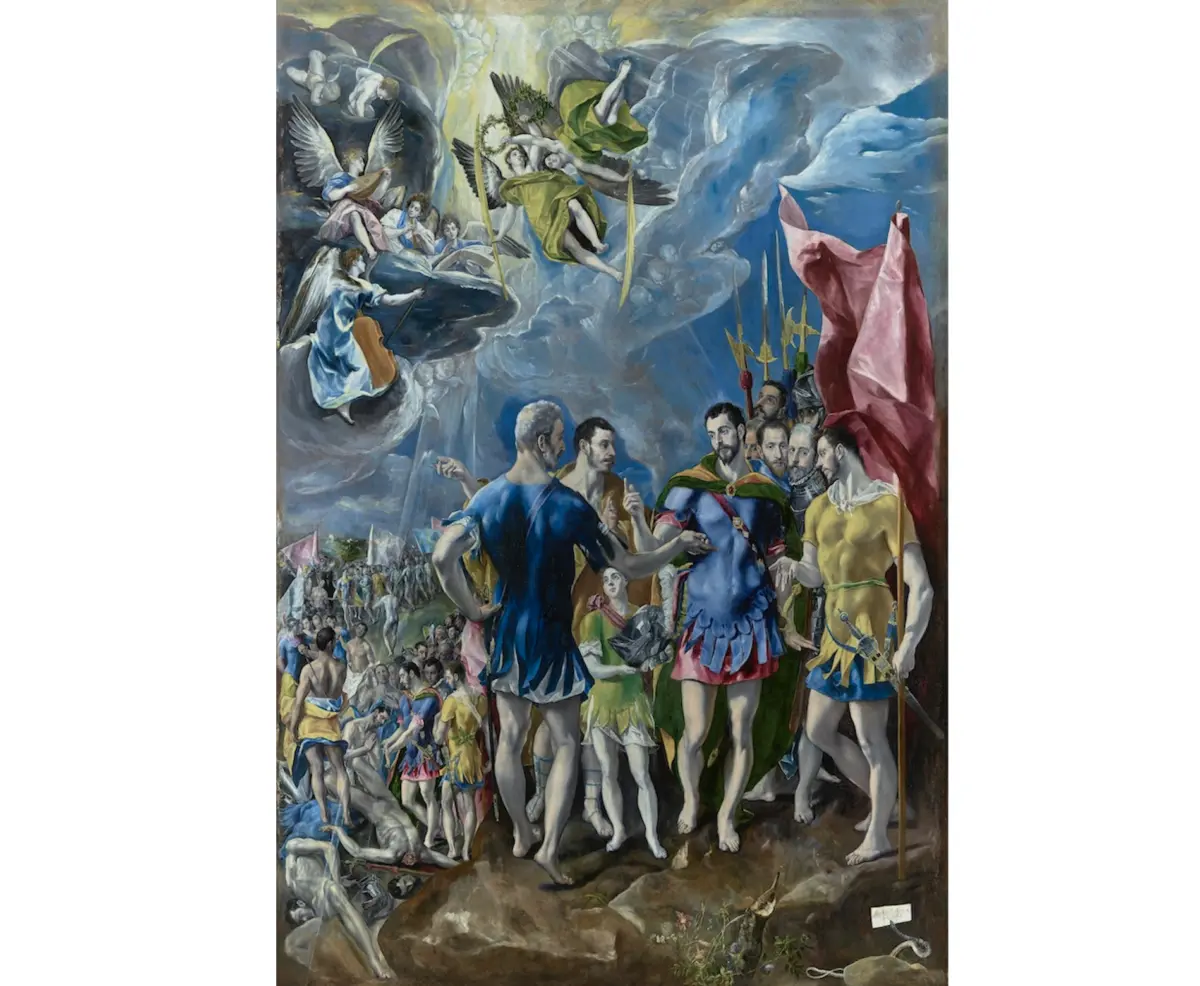
After nine grueling months of meticulous conservation work behind closed doors at Madrid’s Royal Collections Gallery, one of the most misunderstood masterpieces of the Spanish Renaissance has stepped out of the shadows. El Greco’s monumental The Martyrdom of Saint Maurice and the Theban Legion—a canvas measuring nearly 15 feet high and 10 feet wide—has been triumphantly restored to the vivid chromatic brilliance and striking spatial depth envisioned by its creator over four centuries ago.
For generations, viewers encountered the grand canvas through a veil of heavy, oxidized yellow varnish, centuries of accumulated grime, and heavy-handed 19th-century repainting that flattened the composition into a morass of muddy browns and sickly greens. Today, thanks to a high-stakes collaborative project overseen by veteran restorer Rafael Alonso, those centuries of visual decay have been peeled away. In their place lies a stunning explosion of brilliant blues, vibrant reds, luminous yellows, and rich purples.
The restoration is more than a technical triumph; it is a bridge across time. Commissioned originally by King Philip II between 1580 and 1582 for the basilica at El Escorial—the monarch’s formidable monastery and palace outside Madrid—the painting famously failed to impress its royal patron. Relegated to a secondary room, it remained isolated from the public eye for centuries, slowly losing its luminous atmosphere. Now, following an intensive conservation campaign spearheaded by the Patrimonio Nacional in partnership with the Fundación Callia, The Martyrdom is finally ready to reclaim its rightful place as a cornerstone of European art history.
Read Also
Detailed Chronology of the Conservation Project
The journey to save The Martyrdom of Saint Maurice and the Theban Legion was as fraught as it was historically significant. Chronicled extensively by the Spanish daily El País, the project began in earnest in February, when the massive canvas was carefully uninstalled from its permanent home in El Escorial and transported to Madrid’s state-of-the-art conservation laboratories at the Royal Collections Gallery.
Rafael Alonso, an 81-year-old former Prado Museum restorer who has dedicated decades of his life to studying and preserving the idiosyncratic works of Doménikos Theotokópoulos (known universally as El Greco), initially estimated that the conservation effort would take roughly four months. However, upon removing the protective frame and taking a closer look at the canvas’s surface, Alonso and fellow restorer Adela Murgui realized the task ahead of them was vastly more perilous than anticipated.
"When I put the cotton to the painting, my heart sank," Alonso admitted in an interview with El País.
Decades of historical interventions had taken a severe toll. During the 19th century, well-meaning but misguided painters had attempted to repair damaged sections by simply painting directly over the original layers. These intrusive touch-ups were compounded by successive coats of thick, amber-tinted varnish that warped the palette, transforming El Greco’s sophisticated color harmonies into a monotonous wash of dark, muddy tones.
Working under magnifying lenses and utilizing advanced analytical tools to map the canvas’s structural integrity, Alonso and Murgui embarked on a painstaking, month-long process of chemical and mechanical cleaning. Every millimeter of the canvas required the gentle removal of stubborn layers of dirt and non-original pigments.

By October, the restoration team had successfully uncovered the startlingly bright, jewel-toned original paint beneath. Where previous generations saw dark, impenetrable shadows, modern conservators revealed shimmering textiles, crisp facial expressions, and an architectural depth that redefines the viewer’s spatial relationship to the narrative. Rather than relying on permanent modifications to fill in gaps, the restorers utilized strictly soluble materials for minor structural repairs—ensuring that every modern intervention remains entirely reversible for future generations of art historians.
Supporting Context & Metrics: Patronage, Politics, and Scale
To understand the weight of this conservation effort, one must look back to the turbulent genesis of the painting in the late 16th century. El Greco had arrived in Spain with grand ambitions. Having honed his craft under the tutelage of Titian in Venice and absorbing the muscular, dynamic compositions of Michelangelo in Rome, the Cretan-born master settled in Toledo hoping to secure the ultimate professional prize: a permanent appointment as an official court painter to King Philip II.
The commission for The Martyrdom of Saint Maurice seemed to offer the ideal vehicle for this ambition. Philip II wanted a monumental statement of unwavering Catholic faith for the high altar of the basilica at El Escorial, a sprawling architectural monument dedicated to Saint Lawrence that served as the spiritual and political heart of the Spanish Empire.
Yet, El Greco’s avant-garde artistic sensibilities clashed sharply with the austere, counter-Reformation demands of the Spanish monarch. Instead of focusing on the visceral, bloody details of the execution of Saint Maurice and his Christian Roman legion—who chose martyrdom over renouncing their faith—El Greco made a radical compositional choice. He relegated the actual execution to a dimly lit background.
In the foreground, the artist placed a group of handsome, elegantly attired soldiers rendered with the elongated proportions, theatrical contrapposto poses, and hyper-stylized anatomy that would become his signature. While Philip II paid the artist a very respectable sum of 800 ducats for his labor, he ultimately judged the painting unsuited for its sacred liturgical context. The work was quietly banished to a secondary space within the complex, dashing El Greco’s hopes for royal patronage and setting the stage for 444 years of relative obscurity.
The Economics of Preservation: A Modern Renaissance
The successful rescue of The Martyrdom also highlights a shifting paradigm in Spanish cultural funding. Traditionally reliant almost exclusively on state subsidies, Spain’s rich artistic heritage has increasingly benefited from private-public partnerships championed by cultural organizations.
The project was made possible through the backing of the Fundación Callia, a philanthropic institution founded by Carmen Reviriego. In partnership with Madrid’s Royal Academy of Fine Arts of San Fernando and Spain’s Patrimonio Nacional, the foundation has helped mobilize a staggering €5 million for the preservation of masterworks across Spain. Over the years, Fundación Callia’s targeted initiatives have rescued pivotal pieces by titans of art history, including Diego Velázquez, Peter Paul Rubens, Francisco de Zurbarán, and Pieter Brueghel the Elder.
Official Statements and Perspectives
The synergy between historical patronage and modern philanthropy has been a central theme of the foundation’s mission. When ARTnews spoke with Carmen Reviriego regarding her vision for European art philanthropy, she described the foundation as an "incubator of patrons," uniting collectors and corporate leaders from Spain, Latin America, and international spheres to safeguard endangered cultural treasures.

Reflecting on the completion of the El Greco project, Reviriego drew a fascinating parallel between the art world of the 16th century and our contemporary cultural landscape:
"El Greco was the Jeff Koons or Damien Hirst of his day, and Philip II was the most powerful man and greatest patron of the 16th century."
Reviriego emphasizes that masterworks do not emerge in a vacuum; they are the joint products of artistic genius and financial vision. Without powerful patrons willing to take financial risks on experimental artists, many of humanity’s greatest cultural artifacts would simply not exist.
For Rafael Alonso, the completion of this monumental project marks a poignant milestone. Having spent a lifetime restoring some of the most challenging canvases in Spanish museum collections, Alonso confirmed to El País that The Martyrdom of Saint Maurice is officially the final masterwork by El Greco awaiting a comprehensive conservation treatment. After decades of dialogue with the master’s brushstrokes, Alonso’s swan song as a restorer has brought one of history’s most enigmatic paintings back to life.
Future Outlook: Returning to the Light
With the conservation laboratories packing up their instruments, The Martyrdom of Saint Maurice and the Theban Legion is preparing for its public homecoming.
Before it returns to its permanent home inside the historic walls of El Escorial, the painting will be featured in a special, limited-engagement public exhibition at the Royal Collections Gallery in Madrid. For contemporary museum-goers, art historians, and casual visitors alike, this temporary display offers a rare window into the past.
When visitors stand before the canvas in Madrid, they will not be peering through a haze of 19th-century repaints and centuries of accumulated palace dust. Instead, they will see precisely what Philip II saw over four decades ago—a bold, uncompromising, and dazzlingly colorful vision by a master who was centuries ahead of his time.


Comments
Facebook App ID not configured. Please add it in the Customizer.