
Executive Overview
In the contemporary art landscape, few painters capture the visceral, unsettling fluidity of existence quite like Elizabeth Glaessner. Operating at a primordial threshold where anatomy, fauna, and topography continuously dissolve and reform, Glaessner’s surreal canvases evoke a deep, mythic resonance. Her figures do not merely inhabit their environments; they emerge from them, caught in a perpetual state of biological and psychological becoming. Following the critical and commercial success of her solo exhibition, Running Water, staged last year at P.P.O.W. in New York, the Brooklyn-based artist is currently charting an ambitious trajectory toward a major solo presentation at Perrotin Paris in early 2027.
A recent, exclusive visit to Glaessner’s Brooklyn studio reveals an ecosystem of creation defined by literary inspiration, historical reverence, and rigorous technical experimentation. Walls lined with postcard-sized charcoal sketches, poetry fragments by Sylvia Plath, and visual touchstones spanning centuries—from the visionary engravings of William Blake to the harrowing satires of Otto Dix and Francisco de Goya—testuminate to an intellectual rigor underpinning her surrealism. As Glaessner prepares for her upcoming Parisian debut, including a monumental triptych featuring over a dozen interconnected figure-creatures, the art world watches closely. This profile investigates her creative genesis, her idiosyncratic working methodologies, the material alchemy of her poured pigments, and the broader art-historical implications of her boundary-breaking practice.
Detailed Chronology
To understand the trajectory of Elizabeth Glaessner’s current studio output—culminating in the highly anticipated 2027 Perrotin Paris exhibition—one must trace the evolutionary milestones of her career, marked by a steady convergence of mythic storytelling and material subversion.
Read Also
- Formative Years and Conceptual Roots: Long before her signature dissolving figures captivated collectors and critics, Glaessner developed an early fascination with the porousness of bodily boundaries. Drawing from ancient mythologies, folklore, and psychological texts, she began experimenting with how narrative painting could bypass strict linear storytelling in favor of atmospheric, emotional resonance.
- The Breakthrough and Running Water (2024): Glaessner’s momentum accelerated significantly with her solo exhibition Running Water at P.P.O.W. in New York. The exhibition served as a public crystallization of her mature style, showcasing canvases where water, flesh, and earth intermingle. The show garnered widespread critical acclaim, cementing her reputation as an essential voice in contemporary figurative surrealism and expanding her international collector base.
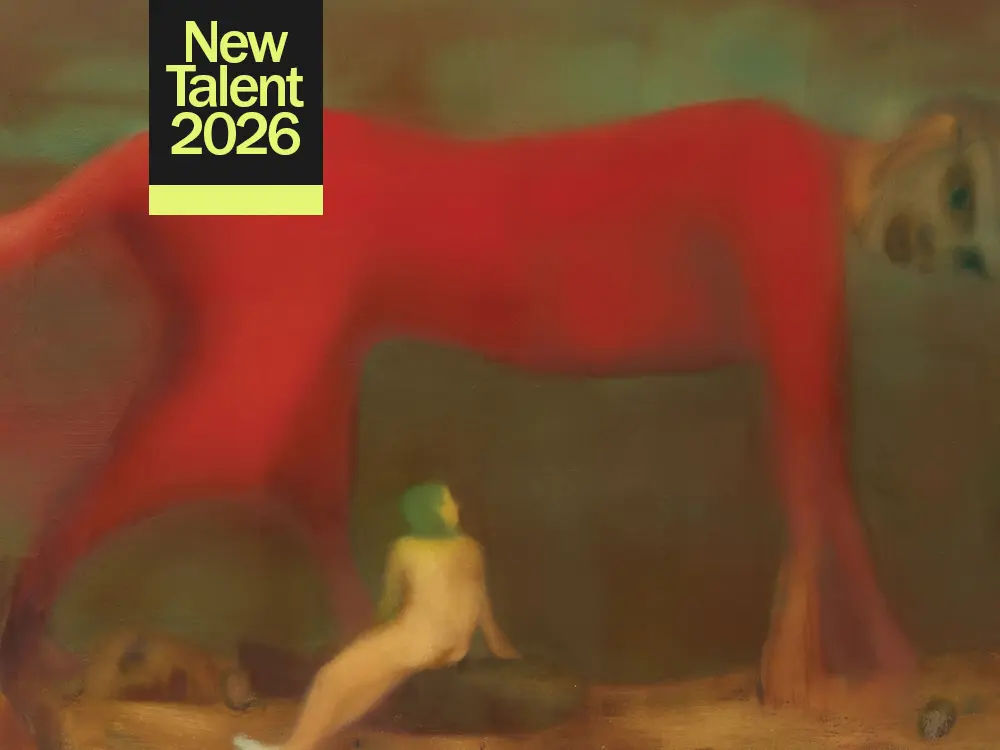
- Mid-2025: Production of Transitional Works (Hot Spring and Workhorse): Following Running Water, Glaessner entered a period of intensified studio production throughout 2025. During this window, she completed pivotal works such as Hot Spring and Workhorse. These pieces demonstrated a technical shift toward heightened compositional tension, where the edges of human and animal forms soften into atmospheric haze, challenging the viewer’s eye to separate subject from ground.
- Late 2025 – Early 2026: The Conception of the Perrotin Paris Project: With a confirmed solo exhibition slated for early 2027 at Perrotin Paris, Glaessner began mapping out her most ambitious spatial and narrative challenge to date: a series of multipanel works and large-scale triptychs. Her Brooklyn studio walls were taped off to mark the exact proportions of these upcoming compositions, initiating a rigorous phase of preliminary charcoal drawing and textual accumulation.
- The Present (2026–2027 Horizon): Currently, Glaessner is in the thick of executing the large-scale canvases destined for Paris. Balancing scale with her signature improvisational wet-into-wet techniques, she continues to layer oils over poured pigments, allowing incidental detritus and material friction to dictate the final anatomical contours of her mythic figures.
Supporting Context & Metrics
Elizabeth Glaessner’s artistic process relies heavily on an intricate web of literary, historical, and material influences. Within her studio, the boundaries between research and execution are intentionally blurred.
Literary and Historical Constellations
The intellectual framework of Glaessner’s work is mapped across her studio walls. Pinned alongside quick anatomical studies are direct poetic touchstones, notably Sylvia Plath’s Metamorphosis and Mirror, as well as Beatriz Miralles de Imperial’s evocative line, “I bring forth voids.” These texts serve as conceptual anchors, dealing directly with identity fragmentation, reflection, and psychological excavation.
Visually, Glaessner anchors her contemporary surrealism within a rich historical lineage. Reference images by William Blake provide a precedent for visionary, cosmic myth-making; Otto Dix contributes an unflinching, grotesque edge regarding the physical realities of the body; and Francisco de Goya offers lessons in psychological shadow and the monstrous manifestations of the human subconscious.
Material Metrics and Technical Execution
The physical reality of Glaessner’s paintings is defined by specific, unconventional parameters:
- Scale and Scope: Her studio currently accommodates works ranging from intimate, postcard-sized sketches to monumental triptychs designed to house upwards of 10 distinct figure-creatures.
- The Poured Pigment Method: Rather than building an image solely through traditional direct painting, Glaessner initiates her surfaces by pouring liquid pigments. This unpredictable base layer forces her to respond to accidental pooling, sediment collection, and textural irregularities.
- Tooling: Eschewing fine, precision brushes for the majority of the block-in phase, she employs large, heavy-duty brushes. This choice enforces broad, physical gestures that prevent the overdefinition of anatomical features, keeping the figures in a permanent state of visual genesis.
- Inadvertent Inclusions: Stray hairs, studio dust, and incidental paint detritus are frequently folded directly into the canvas layers, cementing the physical environment of the studio into the very skin of the artwork.
Official Statements & Studio Insights
During the exclusive studio visit, Glaessner articulated the philosophical and physical mechanics driving her current body of work. Her commentary sheds light on why her figures resist static definition and how she allows tension to dictate composition.
Discussing the painstaking process of bringing multipanel works to life, Glaessner noted the delicate timing required for a composition to reveal itself:
"It takes time for the figures to ‘catch,’" Glaessner explained, gesturing toward a half-finished canvas resting against her studio wall. "It’s as if the environment is putting tension on the painting and pushing the image to the forefront."
This environmental tension is palpable in canvases like Workhorse (2025), where a feminine figure crouches on all fours while a secondary, truncated figure merges into a haze of limbs and disembodied heads. When asked about the intentional ambiguity of these anatomical boundaries—where arms dissolve into translucent greenish masses and skin bleeds into fur—Glaessner emphasized the collaborative role of the viewer:
"The work operates on a threshold," she noted. "If you define every line, you kill the myth. The figures must remain porous so that whatever the viewer brings to the canvas—their own anxieties, recognitions, or projections—can find a temporary home within the shifting forms."
This philosophy extends to her handling of paint. By utilizing large brushes on modest surfaces, she actively fights the human impulse to over-render details. "The brush is too big for the small spaces, and that friction is where the painting actually happens," she added. "You are fighting the material as much as you are shaping it."
Future Outlook
As the global art community looks toward early 2027, all eyes are fixed on Paris and the anticipated debut of Elizabeth Glaessner at Perrotin. This upcoming exhibition represents a critical inflection point in her career, offering international audiences an immersive encounter with her expanding lexicon of mythic, metamorphic bodies.
The logistical preparation for the Paris show is already reshaping her Brooklyn studio practice. The ambitious triptych currently in production—spanning proportions mapped out with painters’ tape across drywall—signals a move toward grander, more architectural compositions. By scaling up her multi-figure narratives without sacrificing the intimate, psychological vulnerability of smaller pieces like Hot Spring, Glaessner is poised to challenge traditional boundaries of history painting and contemporary surrealism.
Furthermore, the integration of her rigorous preparatory methodology—combining poetry, historical art references, and raw material hazard—ensures that her upcoming works will not merely repeat past successes, but rather push deeper into uncharted conceptual territory. As collectors, curators, and critics anticipate the 2027 unveiling, Glaessner remains quietly at work in Brooklyn, coaxing new forms out of poured pigments and atmospheric tension, proving that in her hands, the human form is an endless horizon waiting to be discovered.


Comments
Facebook App ID not configured. Please add it in the Customizer.