
Executive Overview
In a stunning daylight robbery that has sent shockwaves through the international art and museum communities, two unidentified men executed a meticulously planned heist at Vienna’s prestigious Museum of Applied Arts (MAK) on Thursday. Posing as ordinary visitors during standard opening hours, the perpetrators targeted the museum’s high-profile exhibition showcasing legendary jewelry by the French maison Van Cleef & Arpels. With calculated precision, the thieves smashed open a glass display case using a simple hammer, seized an irreplaceable multi-million-dollar platinum necklace with profound historical lineage, and vanished into the bustling streets of the Austrian capital before security personnel could intervene.
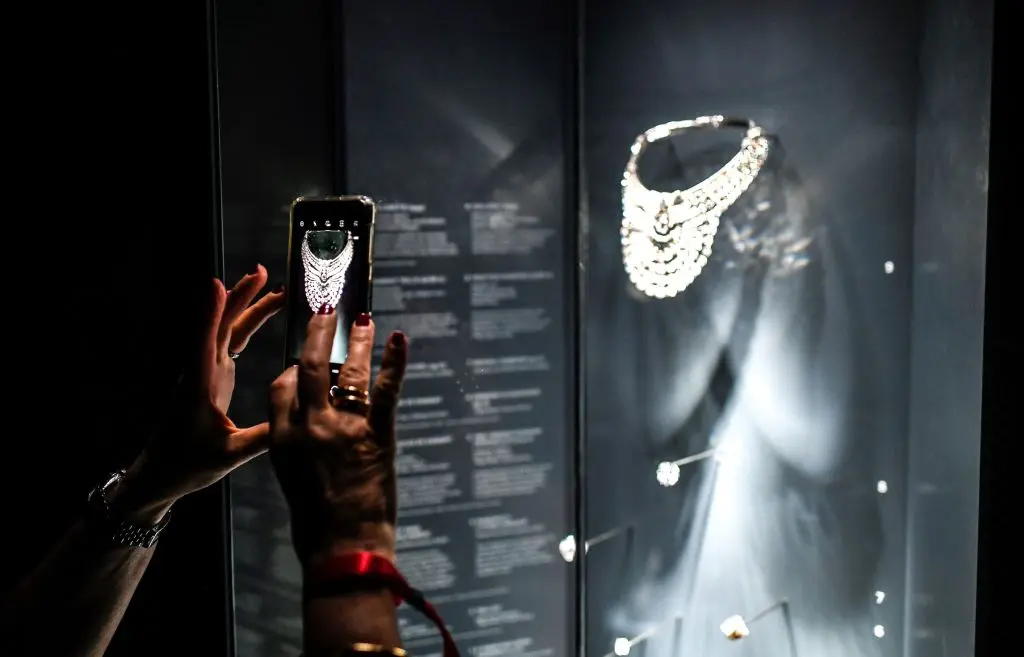
The stolen artifact is no ordinary piece of modern luxury; it is a historically priceless royal treasure. The platinum Van Cleef & Arpels necklace is set with an astonishing 673 diamonds totaling more than 200 carats. Originally crafted for Egypt’s royal family, the jewel gained international renown when it was worn by Queen Nazli of Egypt in 1939 at the opulent wedding of her daughter, Princess Fawzia, to Mohammad Reza Pahlavi—then the crown prince of Iran and later the nation’s last shah. At a 2015 Sotheby’s New York auction, the magnificent piece commanded $4.3 million. Today, experts agree that its historical and cultural value renders its financial worth nearly immeasurable.
Miraculously, no staff members or visitors were injured during the violent breach, though the psychological impact on the museum’s administration and the cultural sector at large has been profound. In response to the security failure, the MAK immediately shuttered the exhibition—titled “Glanzstücke”—indefinitely, canceling the remainder of its run, which had been scheduled through September 27.
Read Also
Austrian law enforcement has launched an intensive, multi-jurisdictional manhunt. Because the suspects made no attempt to conceal their faces and purchased tickets at the admissions desk, investigators possess exceptionally clear high-definition surveillance footage. However, the brazen nature of the crime—executed in broad daylight without masks—has raised alarming questions about security vulnerabilities in major European cultural institutions. As police sift through digital evidence and weigh potential links to organized international theft rings, the incident has inevitably drawn comparisons to other historic cultural heritage heists, most notably the 2003 theft of Benvenuto Cellini’s Saliera in Vienna and the staggering October 2025 jewelry robbery at the Louvre in Paris.
Detailed Chronology of the Robbery
To understand how a multi-million-dollar royal heirloom could be plucked from a major European museum in the middle of the day, investigators have meticulously reconstructed the timeline of the operation. The sequence of events highlights a troubling combination of brazen confidence, lack of basic preventive security measures, and ruthless efficiency.
Pre-Heist Infiltration
The operation began during regular public visiting hours on Thursday at the Museum of Applied Arts (MAK) on Stubenring in Vienna. The two male suspects arrived like any other tourists or art enthusiasts. Crucially, neither man wore masks, facial coverings, or heavy outerwear that might have raised immediate suspicion from floor staff or automated security systems. They approached the ticket counter, paid the standard admission fee, and passed through security checkpoints without triggering alarms.
Targeting the Exhibition
Once inside the museum, the men moved with purpose directly toward the target area: the museum’s special exhibition space hosting “Glanzstücke.” This landmark exhibition explored the dialogue between Van Cleef & Arpels high jewelry creations and historical artifacts from the MAK’s own permanent collections. Rather than casing the joint for weeks or attempting a complex after-hours breach involving cutting-edge electronic tools, the thieves relied on speed, element of surprise, and sheer audacity.
The Smash-and-Grab Execution
Navigating the gallery rooms among other patrons, the suspects located the specific display case housing the Egyptian royal necklace. Eyewitness accounts and police reports indicate that the men produced a heavy tool—specifically, a construction or claw hammer—concealed either on their persons or within a bag.
Without warning, one or both men struck the thick laminated safety glass of the display case with immense force, shattering the barrier. While the sound of breaking glass echoed through the gallery, causing momentary shock and panic among nearby visitors, the perpetrators wasted no time. Reaching into the compromised case, they snatched the 200-carat Van Cleef & Arpels diamond necklace.
The Escape
The entire physical breach and extraction took mere seconds. Leaving behind the shattered display case and the shocked murmurs of museum-goers, the two men sprinted toward the exit. Unlike cinematic depictions of elaborate museum heists involving getaway vans waiting on the tarmac, these suspects blended into the dense pedestrian traffic of Vienna’s inner city. By the time museum security guards converged on the gallery and alerted law enforcement, the perpetrators had completely disappeared into the urban labyrinth.
Historical Provenance and Valuation of the Stolen Necklace
The crown jewel of the MAK exhibition—and now the center of an international police investigation—is a masterwork of mid-century high jewelry design carrying a deeply layered royal history.
Architectural and Gemological Specifications
The stolen piece is an exquisite platinum necklace designed and executed by the legendary Parisian jewelry house Van Cleef & Arpels. The mounting alone represents a triumph of master craftsmanship, engineered to hold an extraordinary weight of precious stones while maintaining fluidity and comfort for the wearer. The necklace is pavé- and prong-set with a staggering 673 individual diamonds, with a total aggregate weight exceeding 200 carats. The centerpiece design balances geometric Art Deco influences with the sweeping, organic floral motifs that became synonymous with the maison’s mid-century aesthetic.
Royal Lineage and Historic Pageantry
Beyond its material and gemological value, the necklace derives its true gravity from its association with 20th-century Middle Eastern royalty. The piece was originally commissioned for the Egyptian royal family and achieved legendary status in 1939.
That year, Queen Nazli of Egypt wore the monumental diamond necklace to grace one of the most politically and socially significant royal weddings of the era: the marriage of her daughter, Princess Fawzia of Egypt, to Mohammad Reza Pahlavi, who was then the crown prince of Iran and would later become the nation’s final shah. Photographs and newsreels from the glittering Cairo celebrations captured Queen Nazli adorned in the Van Cleef & Arpels masterpiece, cementing the necklace’s place in the annals of royal fashion and international history.
Market Valuation and Cultural Worth
In June 2015, the necklace crossed the auction block at Sotheby’s New York, where it was sold as part of a prestigious "Magnificent Jewels" sale for $4.3 million. However, fine art and antique jewelry experts emphasize that auction hammers prices rarely reflect the true replacement value of such items. Because the necklace possesses an unreplicable provenance tied to the royal houses of Egypt and Iran, its historical significance makes it essentially priceless. Furthermore, pieces of this magnitude are notoriously difficult to liquidate on the legitimate open market, leading investigators to fear that the perpetrators may attempt to dismantle the platinum setting and break down the 673 diamonds into smaller, unidentifiable stones to sell illicitly.
Supporting Context & Metrics
To fully grasp the gravity of the MAK robbery, it is essential to examine the broader operational scope of the exhibition, the institutional response, and the escalating trend of high-stakes museum thefts globally.
The "Glanzstücke" Exhibition Profile
The targeted exhibition, titled "Glanzstücke" (Masterpieces), was designed as a sweeping cultural dialogue. It brought together approximately 500 objects, creating an unprecedented juxtaposition between high jewelry and historical decorative arts.
- Van Cleef & Arpels Contributions: More than 300 objects—representing masterpieces of historical design, sketches, and finished high jewelry pieces—were on loan from the French jewelry house.
- MAK Holdings: More than 200 objects were drawn directly from the Museum of Applied Arts’ permanent collections, highlighting centuries of European and international craftsmanship.
Originally opened to the public in June, the exhibition was projected to be a major cultural draw for Vienna through its scheduled closing date of September 27. Instead, the brazen theft has forced an abrupt and indefinite closure.
Comparative Timeline of Major Recent Museum Heists
| Date | Institution | Stolen Object(s) | Estimated Value | Method of Entry | Recovery Status |
|---|---|---|---|---|---|
| June 2026 | Museum of Applied Arts (MAK), Vienna, Austria | Van Cleef & Arpels Platinum & Diamond Necklace (200+ carats) | $4.3 million (2015 auction value; historical value immeasurable) | Day-visitor infiltration; display case smashed with a hammer. | Outstanding (Active Investigation) |
| October 2025 | Louvre Museum, Paris, France | Eight pieces of French crown jewels (including items linked to Empress Eugénie and Queen Marie-Amélie) | ~$102 million (market value; historical value far higher) | Rapid forced entry into the Galerie d’Apollon (heist completed in under 8 minutes). | Outstanding (Active Investigation) |
| May 2003 | Kunsthistorisches Museum, Vienna, Austria | Benvenuto Cellini’s gold-and-enamel Saliera | €50 million – $58 million | Climbing exterior scaffolding and entering through a window during renovations. | Recovered three years later (2006) in a forest hiding spot. |
Official Statements and Investigation Updates
In the wake of the heist, Austrian authorities and museum officials have maintained a tight-lipped posture, balancing the need for public transparency with the operational secrecy required to track down professional thieves.
Law Enforcement Measures
The Vienna State Police (Landeskriminalamt Wien) immediately mobilized a special task force dedicated to the case. Investigators spent Friday securing the crime scene, dusting for latent fingerprints, and downloading every frame of high-resolution digital video captured by the museum’s internal closed-circuit television (CCTV) network.
Because the two suspects purchased tickets at the admissions desk and made no effort to conceal their faces, detectives have obtained exceptionally clear facial images of the perpetrators. These stills are currently being analyzed through facial recognition databases and shared with international law enforcement agencies, including Interpol and Europol.
The Balkan Criminal Syndicate Theory
According to investigative reporting published by the Austrian newspaper Kronen Zeitung, law enforcement is actively pursuing a working hypothesis that the robbery was not a crime of opportunity committed by local amateurs. Instead, investigators suspect it may have been a targeted contract job commissioned by an organized international crime syndicate—specifically pointing toward criminal networks operating out of the Balkans.
Such syndicates have historically been linked to high-profile jewelry heists across Europe, often utilizing specialized cells that specialize in stealing high-value, easily transportable luxury goods to fund broader illicit enterprises or trade them within underground networks. As of Friday afternoon, however, Vienna police officials have declined to publicly confirm or deny the validity of the Balkan syndicate theory, stating only that all investigative avenues remain wide open.
Museum Response
Representatives for the Museum of Applied Arts (MAK) released a brief statement confirming the incident and announcing the indefinite closure of the Glanzstücke exhibition. Museum administrators emphasized that the safety of staff and visitors remains paramount, but stressed that they will not provide further operational or security details while the active police investigation is ongoing. Representatives for Van Cleef & Arpels have expressed deep regret over the incident and are cooperating fully with both museum curators and law enforcement agencies to assist in the recovery of the historic artifact.
Future Outlook and Security Implications for European Museums
The audacious theft at the MAK is not an isolated incident; rather, it is the latest chapter in a deeply troubling global trend that highlights systemic vulnerabilities in the security architecture of the world’s premier cultural institutions.
The Vulnerability of Daylight Security
For decades, museum security directors focused their primary countermeasures on preventing sophisticated after-hours break-ins involving electronic disabling tools, alarm bypassing, and covert roof or window entries. However, the Vienna heist—echoing a disturbing pattern of modern art crime—demonstrates that thieves are increasingly exploiting the chaotic, high-traffic environment of daytime operating hours.
By posing as ordinary tourists, perpetrators can bypass perimeter security, study guard patrol routines in real-time, and execute a violent, high-speed smash-and-grab before armed guards or local police can respond. The reliance on laminated glass display cases rather than bulletproof or shatter-proof polycarbonate barriers in temporary or specialized exhibitions has emerged as a critical vulnerability that museums worldwide must now urgently address.
Echoes of Past Traumas and Global Fallout
The incident has inevitably stirred painful memories within Austria’s cultural sector, specifically recalling the infamous 2003 theft of Benvenuto Cellini’s golden Saliera from Vienna’s Kunsthistorisches Museum. In that case, a thief brazenly climbed exterior scaffolding during renovations, smashed a glass case, and walked out with a masterpiece valued at €50 million. While the Saliera was miraculously recovered three years later buried in a lead box in a forest, the psychological scar left on Austrian institutions has never fully healed.
Furthermore, the Vienna robbery comes on the heels of the catastrophic October 2025 heist at the Louvre in Paris, where thieves breached the Galerie d’Apollon in under eight minutes, making off with $102 million worth of French crown jewels. The compounding effect of these high-profile losses—the Louvre, the recent incidents in German museums (such as the 2019 Dresden Green Vault heist), and now the MAK in Vienna—signals an urgent crisis for European heritage management.
The Road Ahead
As the investigation into the disappearance of Queen Nazli’s diamond necklace unfolds, cultural ministries across Europe are facing intense political and public pressure to overhaul museum security protocols. Experts argue that institutions must adopt a multi-layered defense strategy combining state-of-the-art ballistic glass, advanced AI-driven behavioral analytics to spot suspicious visitor movements before a strike occurs, and increased physical security presence within gallery spaces.
For now, the primary objective for Austrian police remains locating the two suspects, capturing the criminal network behind them, and recovering the irreplaceable 200-carat Van Cleef & Arpels masterwork before it is broken down and lost to history forever.


Comments
Facebook App ID not configured. Please add it in the Customizer.