
Executive Overview
In the contemporary landscape of American education, the empty desk has emerged as one of the most stubborn and pervasive crises of the post-pandemic era. While policymakers debate curricula, standardized testing, and school choice, a quieter, more devastating metric continues to climb: chronic absenteeism. According to recent data highlighted by national publications like The New York Times, chronic absenteeism rates in U.S. schools remain roughly 50% higher than pre-pandemic levels. While this academic emergency impacts districts of every size and demographic, low-income communities bear the heaviest burden, where approximately 30% of students are chronically absent.
At the heart of this crisis is a profound failure of empathy and systemic support—a disconnect between the rigid expectations of institutional education and the chaotic, often desperate realities of children living in poverty.
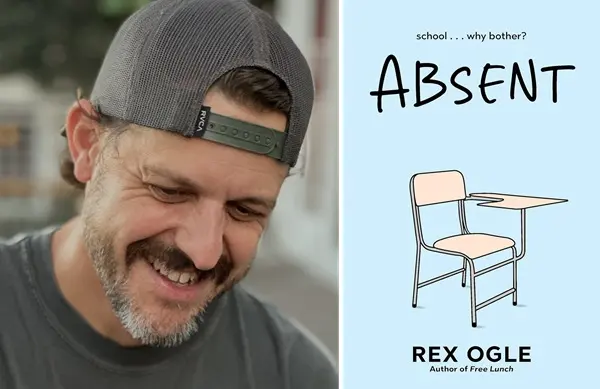
Enter acclaimed author Rex Ogle. Best known for his Printz Honor-winning and YALSA Nonfiction Award-winning memoirs (Free Lunch, Punching Bag, Road Home, and Abuela, Don’t Forget Me), Ogle has dedicated his literary career to illuminating the marginalized experiences of youth navigating penury, abuse, and neglect. Now, in his new mixed-media middle-grade novel, Absent (Norton Young Readers, September), illustrated by LJ-Baptiste, Ogle turns his lens toward the complex, frequently misunderstood ecosystem of school absenteeism.
Read Also
Drawing from his own harrowing childhood in 1990s Los Angeles—where missing school was not a choice, but a survival necessity dictated by familial chaos and systemic failure—Ogle explores the invisible weights that drag students down before the morning bell even rings. In Absent, which follows three impoverished boys trapped in detention, Ogle exposes a broken funding model that penalizes schools for the very absences they are unequipped to solve. More than just a piece of fiction, Absent is a cultural mirror, an urgent call to action, and a much-needed lifeline for a generation of children facing the same impossible choices Ogle confronted three decades ago.
Detailed Chronology: From Personal Trauma to Literary Activism
The 1990 Reality: A Prelude of Neglect
Long before he became an award-winning author for young readers, Rex Ogle was just a sixth-grade boy in Los Angeles, standing outside a classroom dreading the inevitable encounter with his English teacher, Mrs. Winstead.
In 1990, Ogle’s life was defined by the precarious existence of a roach-infested, government-subsidized apartment, regular verbal warfare with his mother, and a gnawing, ever-present hunger. Breakfast was a luxury his household rarely afforded; instead, he waited desperately for the free lunch provided in the school cafeteria. Yet, upon walking into Mrs. Winstead’s classroom, his struggles were met not with curiosity or care, but with institutional disdain.
"Decided to finally come to class?" Winstead would sneer, her eyes rolling in practiced irritation.
For a child whose teeth were clenched in suppressed rage, whose hands squeezed into fists with nails digging painfully into his palms, the temptation to lash out was overwhelming. But outbursts only resulted in trips to the principal’s office for "mouthing off," further alienating a boy who desperately loved literature. Sixth-grade English should have been Ogle’s sanctuary—he devoured books like Lois Lowry’s The Giver, Gary Paulsen’s Hatchet, and William Shakespeare’s Much Ado About Nothing cover-to-cover. Instead, it was an arena of unwarranted judgment where educators knew nothing of the trauma he endured outside school hours.
Ogle possessed a wealth of adolescent rage, but he lacked the adult maturity, the vocabulary, and the safe space to explain his reality: “I’m sorry I missed class, but I had to stay home and watch my toddler brother while my parents look for work.”
Instead of voicing his trauma, Ogle weaponized his intellect. He would return assigned and extra-credit essays and books with the precision of Edmond Dantès seeking vengeance—not to harm, but to systematically dismantle the negative expectations teachers held of him. It was his solitary defense mechanism in a world that demanded perfection from children who were given zero tools to survive.
The Evolution of a Creator
Growing up, Ogle harbored a singular dream: to be a writer. Envisioning a solitary life spent clacking away at a typewriter for twelve hours a day, he never anticipated that his career would involve traveling across the country for school visits.
Yet, as his memoirs gained national acclaim, those very school visits—and the countless hours spent in dialogue with frustrated educators, school librarians, and administrators—revealed a sobering truth. Ogle discovered that in many school districts across the United States, public funding is directly tied to student attendance. When attendance drops, funding plummets, stripping already impoverished schools of the precise resources they need to support vulnerable youth. The system, Ogle realized, was fundamentally inverted: it punished institutions for the societal failures manifesting inside their walls.
The Spark of Absent
The catalyst for Absent arrived swiftly. Following three intense days of school visits, conversations with exhausted teachers, and witnessing the identical struggles faced by contemporary youth, Ogle returned to his hotel room. In a single sitting, he mapped out the entire outline for a book he didn’t just want to write, but needed to write.
What kids face today, Ogle recognized, is precisely what he faced three decades prior. The technological landscape may have shifted, but the fundamental socio-economic pressures crushing marginalized children remain identical. Driven by a desire to offer young readers a "shortcut to healing" that he never received, Ogle crafted Absent.
Supporting Context & Metrics: The Anatomy of Modern Absenteeism
To fully grasp the urgency of Ogle’s literary intervention, one must examine the staggering macroeconomic and sociological data governing modern education.
The Post-Pandemic Spike
The COVID-19 pandemic acted as an earthquake across the foundations of American society, and its aftershocks are nowhere more visible than in public school attendance records. According to comprehensive interactive data compiled by The New York Times, chronic absenteeism skyrocketed during pandemic-era lockdowns and, crucially, has failed to recede in the years since.
Key metrics defining the current landscape include:
- The 50% Surge: The national chronic absenteeism rate for the 2023–2024 academic year hovers approximately 50% higher than pre-pandemic baselines.
- Geographic Universality: While absenteeism rates spike dramatically in urban centers, the crisis is entirely agnostic to district size—affecting massive metropolitan school boards and small rural districts alike.
- The Wealth Disparity: Although students from all socioeconomic and racial backgrounds are missing more school, impoverished communities remain the hardest hit. In low-income school districts, an alarming 30% of students are chronically absent.
The Funding Trap
The structural mechanics of American public education compound this crisis. In numerous states and districts, school budgets are calculated using Average Daily Attendance (ADA) formulas. Under this archaic model, if a student is absent—regardless of whether they are sick, caring for an ailing relative, translating for parents, or working an off-the-books job to help pay rent—the school loses state funding for that student’s seat that day.
Consequently, schools operating in economically disadvantaged areas face a cruel paradox:
- Poverty drives high rates of student absenteeism due to housing instability, lack of healthcare, and caregiving duties.
- Absenteeism slashes school funding.
- Reduced funding forces schools to cut counseling staff, social workers, after-school programs, and nutritional support—the very infrastructure required to stabilize at-risk students and entice them back to the classroom.
As Ogle observes, the system is fundamentally broken. It places adult-sized burdens onto the shoulders of children who are entirely powerless over their circumstances, and then penalizes the institutions attempting to catch them as they fall.
Official Statements & Industry Perspectives
The release of Absent has triggered vital conversations across the literary and educational sectors regarding how society perceives and penalizes children living below the poverty line.
Rex Ogle has been vocal about the emotional and psychological toll that institutional judgment takes on vulnerable students. Reflecting on his own upbringing and the inspiration behind his latest novel, Ogle notes:
"I spent much of my youth embarrassed and ashamed of my circumstances. But I shouldn’t have. Someone should have said, ‘Whatever is going on at home, it is not your fault. And if you put in the work, you can do great things.’ But no one said that to me. Instead, it took me decades to learn it myself. But maybe—hopefully—with Absent, I can give kids a shortcut to healing."
Educators and librarians who have previewed the novel and engaged with Ogle during his school tours emphasize the critical need for empathy-driven literature in middle-grade classrooms. Rather than viewing truancy and chronic absenteeism solely through a punitive disciplinary lens—detentions, suspensions, and truancy officers—educational advocates argue for a trauma-informed approach.
Literary critics have similarly praised the structure of Absent. By utilizing a mixed-media approach alongside illustrator LJ-Baptiste, the novel honors the diverse ways in which modern youth process trauma and articulate their inner lives. The book’s protagonists—Liam, Calvin, and Manny—are not portrayed as "bad kids" or delinquents, but as whole, complex human beings whose ambitions have not yet been extinguished by the crushing weight of poverty.
Future Outlook: Healing the Cracks in the System
As Absent makes its way into classrooms, libraries, and homes, its release serves as a timely cultural touchstone. Addressing the modern absenteeism crisis will require far more than punitive attendance policies or automated robocalls warning parents of unexcused absences. It demands systemic structural reform, increased federal and state investment in low-income community schools, and a fundamental paradigm shift among educators.
Teachers, administrators, and policymakers must look beyond the empty desk and ask the difficult questions: What is happening in this child’s home? Are they hungry? Are they caring for a sibling? Are they carrying the emotional weight of a family on the brink of eviction?
Rex Ogle’s Absent does not offer a simplistic policy paper or a neat legislative blueprint for fixing public school funding formulas. Instead, it offers something infinitely more powerful: radical empathy. Through the interwoven stories of Liam, Calvin, and Manny, Ogle reminds readers that behind every unexcused absence is a human story—often one defined by extraordinary resilience, hidden talent, and a desperate, quiet hope for a better tomorrow.
If society is to successfully reverse the post-pandemic absenteeism epidemic, it must learn to listen to the voices of children who have long been rendered invisible. By dismantling negative institutional expectations and replacing them with unwavering support, educators and communities can ensure that every child feels seen, valued, and welcome—not just when they manage to beat the odds and make it to class, but every single day.





Comments
Facebook App ID not configured. Please add it in the Customizer.