
Executive Overview
In the sprawling landscape of filmed media, personal and cultural style is too frequently relegated to the background, treated as an accidental byproduct of production design rather than an intentional engine of worldbuilding. Unless a narrative explicitly focuses on the fashion industry—such as The Devil Wears Prada—audiences are generally expected to accept that characters "just wake up like this." This oversight ignores one of the most potent non-verbal tools available to creators: sartorial expression, grooming, and aesthetic choices as reflections of socio-political shifts.
Nowhere is this oversight more glaring—and yet more rich for analytical re-examination—than in the Star Trek universe. Specifically, the visual transition between the rigid, utilitarian, and monochromatic aesthetics of the mid-23rd century war-footing era and the vibrant, unapologetically retro-futuristic exuberance of Star Trek: Strange New Worlds and The Original Series (TOS) presents a fascinating sociological case study.
By analyzing the franchise through a lens of in-universe historical materialism, post-conflict recovery, and galactic diplomacy, this report examines how the aesthetic choices of Starfleet’s golden era were not merely design decisions made by 1960s television producers, but calculated, deliberate cultural signaling by a post-war United Federation of Planets.
Read Also

Detailed Chronology: From the Trenches of the Klingon War to the Bright V-Necks of the Enterprise
To understand why the crew of the U.S.S. Enterprise under Captain Christopher Pike sports bright primary-color tunics, intricate braided hairstyles, and dramatic winged eyeliner, one must trace the chronological aesthetic evolution of Starfleet through its most tumultuous decades.
1. The Crucible of Conflict: The Post-Binary Stars Era
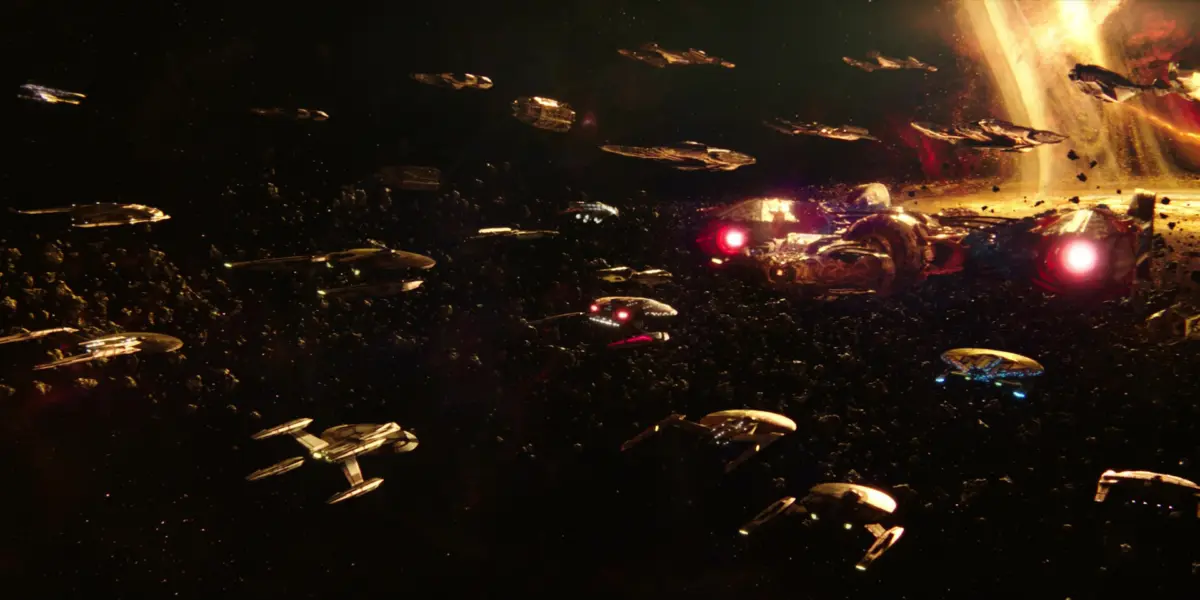
During the harrowing Federation-Klingon War—sparked by the Battle at the Binary Stars—Starfleet’s operational reality demanded absolute functional austerity. The conflict resulted in the decimation of one-third of the Federation fleet, the loss of tens of thousands of Starfleet personnel, and over one hundred million civilian casualties.
The sartorial response to this existential crisis was predictable:

- The Uniforms: As seen in the early seasons of Star Trek: Discovery, Starfleet uniforms of this era evolved directly from naval-style coveralls. Rendered in stiff, heavily starched, and functionally rigid fabrics, these garments featured metallic piping to denote divisions (gold for command, silver for sciences, copper for operations). They were designed for survival, endurance, and military readiness, lacking any room for personal stylistic flair.
- Grooming Standards: Hair was kept strictly functional, and cosmetics were minimal. The psychological and physical toll of the war left officers like Dr. Joseph M’Benga and Nurse Christine Chapel grappling with profound post-traumatic stress, leaving little cultural bandwidth for physical self-expression.
2. The Transitional Phase: The Bridge Between Era Aesthetics
Immediately following the conclusion of the Klingon War and the neutralization of the rogue Section 31 Control threat, the Federation entered a fragile, highly volatile reconstruction period.
During the interim period captured toward the end of Discovery’s second season, Starfleet began experimenting with early versions of the colorful tunic ensembles that would later define TOS. However, these transitional uniforms retained high, stiff collars, sharpened geometric shoulders, and a distinctly militant silhouette. They represented an institution tentatively stepping away from a war footing, testing the waters of a new design philosophy without yet shedding its militaristic armor.
3. The Strange New Worlds Renaissance: The Post-War Cultural Explosion
By the time Star Trek: Strange New Worlds opens, the Federation has secured a century-long foothold of relative peace. This period functions structurally as a classic post-war era, historically paralleling the roaring 1920s or the post-World War II countercultural revolutions on Earth.

The aesthetic transformation across Starfleet is absolute and undeniable:
- Silhouettes and Comfort: High, choking collars are replaced by relaxed, low V-neck tunics. Trousers and leggings replace mandatory skirts, though skirts remain an option worn with practical footwear—gorgeous, low-heeled boots that prioritize mobility without sacrificing elegance.
- Grooming and Cosmetics: The Enterprise crew embraces elaborate hair artistry—braids, coiffures, buzz cuts, and complex twists. Furthermore, heavy winged eyeliner becomes a staple across departments, worn by command, science, and security personnel alike (including the notoriously no-nonsense security chief, La’an Noonien-Singh).
Supporting Context & Metrics: Sociological and Real-World Parallels
The visual evolution of Starfleet aligns seamlessly with real-world sociological phenomena regarding post-conflict societies and television history.
Historical Parallels of Post-War Fashion
Societal shifts from austerity to vibrancy are well-documented across human history:

- Post-World War I: The trauma of global trench warfare birthed the Roaring Twenties, characterized by the liberation of the flapper style—shorter hemlines, bold makeup, and a rejection of Victorian rigidity.
- Post-World War II: Economic prosperity and renewed security ushered in the beatniks, greasers, and eventually the radical, color-soaked counterculture of the 1960s, featuring mods, hippies, and unprecedented sexual liberation.
In the Star Trek timeline, the Federation’s successful navigation of total war and an artificial intelligence apocalypse created a similar psychological release valve. Citizens and Starfleet officers alike embraced vibrant physical expression as an assertion of life, survival, and cultural optimism.
The Real-World Context of TOS Production Design
To fully appreciate the in-universe implications, one must acknowledge the 1960s television landscape that birthed The Original Series:
- The Miniskirt as Liberation: While modern viewers sometimes critique the miniskirted uniforms of TOS through a contemporary critical lens, 1960s actresses frequently defended them at the time as symbols of modern female liberation and bodily autonomy.
- The Color Television Boom: Premiering amid the rapid transition from black-and-white to color broadcasting, TOS capitalized on saturated primary colors because technology finally allowed it.
- Universal Makeup Application: Because early color cameras required heavy, specialized makeup to prevent actors from appearing washed out on mixed black-and-white/color home sets, both male and female actors wore heavy cosmetics, including pronounced eye shadow. In-universe, this historical artifact translates to a society where cosmetic enhancement is entirely gender-neutral and normalized.
Official Statements and Creative Implications
While the production teams behind modern Star Trek iterations have brilliantly updated 1960s aesthetics for contemporary audiences, critics and analysts note a persistent narrative silence regarding why these changes occurred within the fiction of the universe.

"When we look at this particular era of Starfleet, it is the least militant and structured of any regalia shown on screen," notes cultural media analysis. "Their officers are decked out in cheerful primary colors, and the captain of their flagship literally sculpts his hair with putty every morning. Yet, the narrative treats this massive cultural pivot as business-as-usual."
The Strategic Value of "Soft Diplomacy"
The lack of in-universe dialogue concerning fashion choices misses an extraordinary worldbuilding opportunity. The shift to bright, approachable, and non-threatening aesthetics was not accidental; it was a calculated geopolitical strategy.
After surviving an existential war, the United Federation of Planets made a deliberate choice about how they wanted to project power across the quadrant. Rather than patrolling space in iron-clad dreadnoughts wrapped in austere gray coveralls, Starfleet sent forth ships crewed by vibrant, stylish, diverse intellectuals signaling a clear message:

"Our ships are full of interesting nerds, and we would like to be your friends. We brought photon torpedoes just in case, but we also brought cake."
This aesthetic choice functioned as soft power outreach. It told potential allies and adversaries alike that the Federation was secure, confident, and open-minded. Naturally, this invited distinct diplomatic risks—such as cynical rival factions underestimating Starfleet officers because they appeared too relaxed or cheerfully earnest in their vibrant primary-color tunics.
Future Outlook: Integrating Sartorial Consciousness into Modern Storytelling
As Star Trek: Strange New Worlds continues its critically acclaimed run, opportunities remain for the creative team to lean deeper into the sociological implications of its own worldbuilding.

Integrating minor narrative nods to personal style—such as characters debating the resurgence of winged eyeliner, navigating the comfort of low-collar tunics, or exploring historical cosmetic trends—would elevate the narrative texture. It would ground high-concept science fiction in the relatable, mundane, and deeply human (and alien) rituals of daily life.
Ultimately, Starfleet’s aesthetic evolution from the steel-gray trenches of the Klingon War to the optimistic, brilliantly colorful corridors of the Enterprise reminds audiences that style is never neutral. In the Star Trek universe, fashion is a barometer of peace, a tool of diplomacy, and a joyful celebration of survival against the dark void of space.




Comments
Facebook App ID not configured. Please add it in the Customizer.