
Executive Overview
The landscape of smart home decor and digital display technology is experiencing a quiet revolution. For years, digital photo frames have been tethered to standard LCD or OLED panels—screens that, while bright and vivid, demand continuous power, emit harsh blue light, and often look jarringly out of place in rooms styled with classic wooden furniture or minimalist aesthetics. Enter the e-paper digital picture frame: a device designed to mimic the tactile, non-reflective appearance of real ink on paper while offering the dynamic versatility of a digital screen.
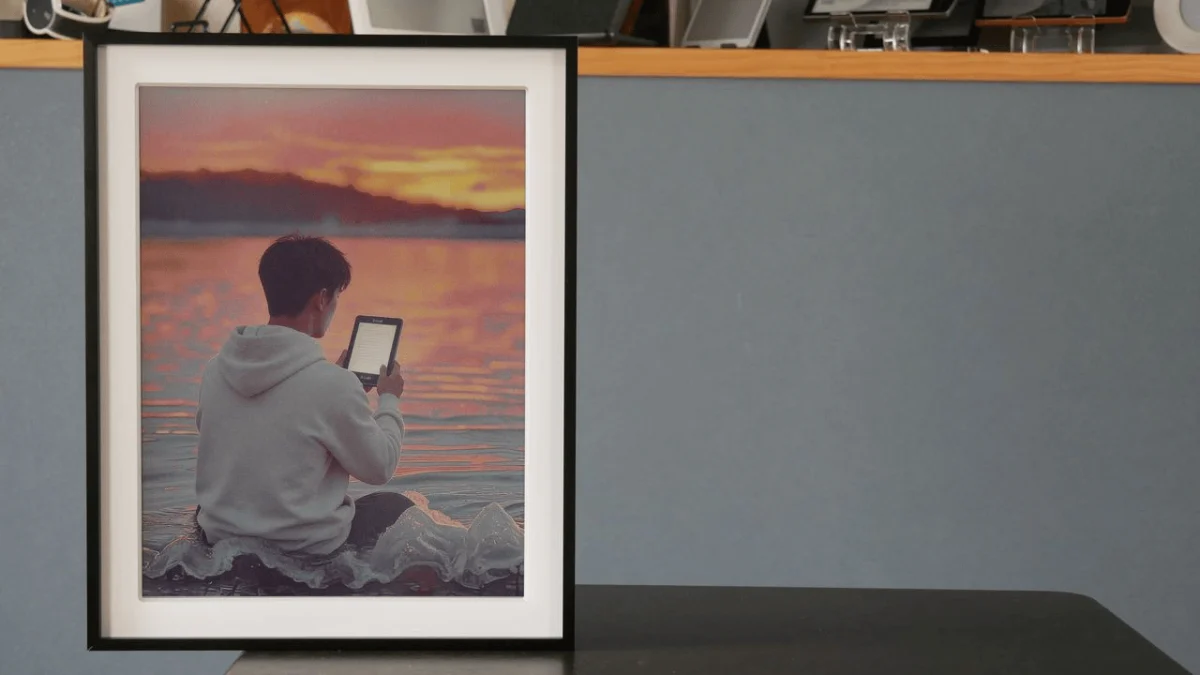
Bigme, a manufacturer widely recognized for its diverse lineup of E-Ink tablets, reading devices, and monitors, has entered this market with its latest flagship offering: the Bigme F13. Promoted as a premium, 13.3-inch smart E-Ink photo frame, the F13 leverages cutting-edge Spectra 6 e-paper technology to deliver rich, highly saturated, glare-free, and print-quality visuals. Encased in a sleek aluminum outer bezel, the device presents an undeniably sophisticated physical aesthetic. It is outfitted with a built-in microphone and speaker, a USB-C charging port, and a remarkably robust 18,000 mAh battery capable of sustaining operations for over two years on a single charge under typical usage conditions.
However, beneath its polished exterior and impressive hardware specifications lies a product defined by stark operational contradictions. Most notably, the Bigme F13 eschews a traditional companion smartphone app for loading custom personal content. Instead, it relies on a built-in, voice-activated artificial intelligence assistant designed to generate images on command.
Read Also
While innovative in concept, this implementation introduces notable friction for international consumers. The AI engine, originally optimized for the Chinese market, features a voice model that speaks broken English and generates images that reviewers have criticized as low-quality and unmistakably artificial. Despite these software and localization hurdles—compounded by limited native image file format support and the requirement of an SD card for manual file transfers—the F13 manages to carve out a distinct niche. Beyond its primary function as a digital canvas preloaded with 1,000 world-famous paintings, it doubles as a smart calendar hub capable of syncing with Google and Outlook. Retailing for $269.99, the Bigme F13 offers a fascinating case study in hardware excellence colliding with experimental software implementation.
Detailed Chronology & Product Evolution
To understand how the Bigme F13 arrived on the market, it is necessary to examine the rapid evolution of E-Ink color technology over the past several years. For decades, electrophoretic displays (commonly known as E-Ink) were constrained to a monochrome palette of black, white, and a handful of intermediate gray scales. While ideal for long-form reading due to their eye-comfort and sunlight legibility, they were wholly unsuitable for digital signage, graphic art displays, or photo frames.
The Rise of Color E-Paper: From Kaleido to Spectra 6
The journey toward color e-paper saw incremental advancements through technologies such as E-Ink Kaleido, which layered a Color Filter Array (CFA) on top of a monochrome electronic ink layer. While Kaleido brought color to e-readers and tablets, the washed-out pastel hues and reduced overall brightness limited its appeal for dedicated artistic photo frames.
The breakthrough for static and low-refresh digital art came with advanced particle-migration color technologies, culminating in E-Ink Spectra 6. Unlike filter-based systems, Spectra 6 utilizes multiple colored pigment particles inside microcapsules that migrate under electrical fields to produce deeply saturated primary and secondary colors directly on the display. This technology eliminates the muted look of earlier generations, yielding vibrant, high-contrast visuals that genuinely rival physical print media.
Bigme’s Pivot to Home Decor
Capitalizing on the maturation of Spectra 6 technology, Bigme sought to expand its hardware portfolio beyond productivity-focused note-taking tablets and e-readers. Recognizing a growing consumer desire for low-power, aesthetically pleasing smart home appliances, the company conceptualized the F13 as a statement piece.
However, the product development path took an unconventional turn regarding user interaction. Rather than developing a robust, cloud-backed mobile application for wireless photo management—a standard feature found in competing frames like the Bloomin8—Bigme elected to integrate an on-device AI voice assistant. This design choice reflected a broader corporate push toward integrating generative artificial intelligence across all product tiers. Unfortunately, as the product transitioned from domestic design boards to international markets, the localization of the AI engine lagged behind the physical hardware’s manufacturing timeline, resulting in the distinct operational quirks observed by early reviewers.
Supporting Context & Technical Metrics
An evaluation of the Bigme F13 requires a granular look at its technical specifications, physical design, and the broader competitive landscape of digital photo frames.
Hardware Specifications & Display Performance
At the heart of the Bigme F13 is a 13.3-inch E-Ink panel utilizing Spectra 6 technology. Key technical parameters include:

- Display Technology: Advanced E-Ink Spectra 6 color e-paper.
- Resolution: 1200 × 1600 pixels.
- Pixel Density (PPI): 150 PPI, striking a balance between crisp text rendering and smooth photographic gradients.
- Visual Quality: Glare-free, high-saturation, print-quality visuals that remain perfectly legible under direct, harsh sunlight without washing out.
- Physical Build: Sleek, premium aluminum outer bezel designed to blend seamlessly into modern and classic interior decors.
- Audio System: Integrated microphone for voice command capture and an onboard speaker for auditory feedback from the AI assistant.
- Power Management: An exceptionally large 18,000 mAh internal battery. Due to the bi-stable nature of E-Ink technology—which consumes electrical power only when the image on the screen is changing—this battery capacity yields an operational lifespan exceeding two years between charges under standard static image-rotation schedules.
- Connectivity & Ports: Equipped with a modern USB-C port utilized for battery recharging and firmware maintenance.
The User Experience & Content Loading Dilemma
The defining point of friction for the Bigme F13 lies in how users supply content to the frame. The device breaks away from contemporary smart frame conventions in several ways:
- Absence of a Native Companion App: Unlike popular rivals that offer feature-rich iOS and Android applications for effortless, wireless photo uploads from anywhere in the world, the F13 features no such smartphone ecosystem for personal photo synchronization.
- The AI Voice Assistant: Content generation is primarily driven by spoken prompts. A user interacts with the device by speaking commands into the built-in microphone—phrasing requests such as "Hey Bigme, make an image about a goat playing basketball."
- Localization Shortfalls: Because the underlying AI engine was engineered primarily for the domestic Chinese market and adapted globally without deep localization, the voice assistant speaks broken English. Furthermore, the generated artwork frequently exhibits hallmarks of early-generation generative AI, suffering from erratic composition, unnatural rendering, and low overall aesthetic fidelity.
- Manual Alternatives & File Format Limits: For users seeking to bypass the AI generator, the frame comes preloaded with 1,000 world-famous paintings by master artists. Additional content can theoretically be loaded via an SD card or directly through the on-device menu system. However, the software supports only a narrow subset of image file formats. Moreover, because modern computing hardware—particularly ultrathin laptops and tablets—frequently lacks built-in SD card readers, performing manual file transfers can prove cumbersome for the average consumer.
Competitive Positioning
When weighed against alternatives in the digital frame market, the Bigme F13 occupies a polarizing position. Competitors such as the Bloomin8 photo frame prioritize seamless user experience through polished, highly responsive wireless mobile applications that allow family members to push photos to the display from across the globe. By contrast, the F13 functions more as a standalone, art-centric appliance. Its primary strengths lie not in effortless smartphone integration, but in its gorgeous Spectra 6 color reproduction, premium aluminum construction, unmatched multi-year battery life, and secondary utility as a smart calendar display (compatible with Google and Outlook integration).
Official Statements & Industry Reception
Early reviews and technical analyses of the Bigme F13 highlight a fascinating dichotomy between hardware craftsmanship and software execution.
Industry analysts and consumer tech reviewers have universally lauded the physical engineering of the device. Publications specializing in e-paper technology have praised the sleek aluminum outer bezel for giving the frame a high-end, gallery-ready appearance. Furthermore, technical evaluations confirm that the Spectra 6 color display delivers on its promise of rich, saturated, and paper-like visuals that completely avoid the reflective glare characteristic of traditional LCD panels.
Conversely, the reception surrounding the AI voice-to-image assistant has been decidedly mixed. Reviewers have pointed out that while the concept of generating custom artwork entirely via voice command is futuristic and innovative, the execution falls short of consumer expectations. The broken English of the voice model and the subpar, visibly artificial quality of the generated imagery have been frequent points of critique. Additionally, tech commentators have noted that the absence of a built-in content discovery library within a companion app places an undue burden on the user when it comes to curating personal photo collections.
Despite these software limitations, market observers emphasize that the F13 excels as a decorative centerpiece. Its ability to pivot seamlessly into a functional smart calendar hub—pulling schedule data from Google or Outlook onto a glare-free, low-power screen—adds substantial utility that compensates for its unconventional approach to photo management.
Future Outlook & Market Implications
The launch of the Bigme F13 at its retail price point of $269.99 signals an important evolutionary step for commercial E-Ink applications. As color e-paper technologies like Spectra 6 become more commercially viable, manufacturers are actively experimenting with how these displays can transition from utilitarian e-readers and electronic shelf labels into desirable home and office appliances.
Implications for E-Paper Home Decor
The F13 demonstrates that consumers are ready for large-format, low-power electronic art displays that do not require constant tethering to wall outlets. The prospect of a digital photo frame boasting a two-year battery life addresses one of the primary consumer pain points of smart home technology: battery anxiety and unsightly power cords snaking down walls.
However, the challenges faced by the F13 serve as a cautionary tale for hardware manufacturers targeting international markets: hardware excellence cannot completely offset software friction. For future iterations of e-paper photo frames to achieve mainstream adoption, companies must pair advanced display technologies with localized, intuitive, and robust software ecosystems. Consumers accustomed to seamless cloud integration and polished mobile applications will demand effortless wireless synchronization alongside high-end physical design.
What Lies Ahead for Bigme
Moving forward, Bigme faces a clear roadmap for product refinement. A software update introducing a refined English-language AI model, expanded native image file format support, and perhaps a streamlined cloud or app-based synchronization utility could instantly resolve many of the early criticisms leveled against the F13.
Even in its current form, the Bigme F13 carves out a compelling niche for enthusiasts of e-paper technology, minimalists seeking a zero-glare digital art display, and professionals looking for a sophisticated, low-power calendar hub. As color electronic ink continues to advance in resolution, refresh speed, and color fidelity, devices like the F13 provide a clear glimpse into a future where digital art seamlessly merges with traditional home decor.



Comments
Facebook App ID not configured. Please add it in the Customizer.