
Executive Overview
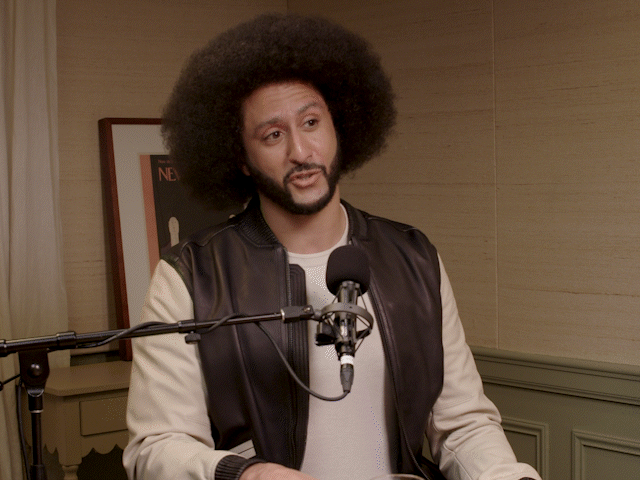
Nearly a decade after leading the San Francisco 49ers to Super Bowl XLVII, Colin Kaepernick remains one of the most polarizing and consequential figures in modern American culture. What began in 2016 as a quiet, solitary protest against police brutality and systemic racial injustice—refusing to stand during the national anthem—catalyzed a paradigm shift in the intersection of sports, politics, and corporate labor. Kaepernick’s dissent enraged political figures, most notably former President Donald Trump, embarrassed the ownership class of the National Football League (NFL), and ultimately resulted in his premature exile from professional football.
With the release of his memoir, The Perilous Fight, and subsequent in-depth reflections, Kaepernick provides an exhaustive accounting of his journey. Far from an accidental activist, his trajectory reveals a deliberate intellectual evolution—from an isolated young athlete in rural California to a student of decolonization theory, radical Black literature, and systemic analysis.
This comprehensive report examines Kaepernick’s life and legacy. It explores the labor mechanics of the NFL, the structural hypocrisy of league management, the physical realities of elite football, and the financial metrics that debunk the claim that political activism is inherently toxic to corporate bottom lines.
Read Also
Detailed Chronology: From Turlock to Institutional Exile
+-----------------------------------------------------------------------------------+
|                            KEY MILESTONES & TRAJECTORY                            |
+-----------------------------------------------------------------------------------+
| 1987       | Born in Milwaukee, WI; adopted by white parents and raised in Turlock, CA |
| 2011       | Drafted by San Francisco 49ers (Round 2, Pick 36)                     |
| 2012–2013  | Takes over as starter; leads 49ers to Super Bowl XLVII                    |
| 2012       | Media backlash over tattoos; originates "Kaepernicking" celebration       |
| 2014–2015  | Audits UC Berkeley courses; deepens study of Black radical tradition      |
| Aug 2016   | Begins sitting/kneeling during national anthem in NFL preseason           |
| March 2017 | Opts out of contract following notice of imminent release; becomes exiled  |
| Oct 2017   | Files grievance against NFL alleging collusion (settled in 2019)         |
| Sept 2018  | Fronts Nike's "Dream Crazy" campaign; Nike valuation gains ~$6B           |
| 2026       | Releases memoir *The Perilous Fight*; reaffirms desire to play in NFL    |
+-----------------------------------------------------------------------------------+
Early Life and the Search for Identity
Raised by adoptive white parents in Turlock, California—a predominantly conservative, agricultural community in Central California where the Black population hovered between 1 and 3 percent—Kaepernick experienced early isolation. While his parents were open about his adoption and racial identity, the household lacked the cultural framework necessary to navigate the realities of being a young Black man in America.
Kaepernick gravitated toward sports, specifically football, to find community. Unlike baseball or basketball, football offered a unique environment:
- Structural Interdependence: A quarterback’s physical safety relies entirely on ten other players executing their assignments, fostering intense camaraderie.
- Cultural Representation: The sport provided Kaepernick with his first meaningful exposure to Black peers and mentors, filling a social void present in his hometown.
Gridiron Stardom and Intellectual Awakening
After a stellar collegiate career at the University of Nevada, Kaepernick was selected by the San Francisco 49ers in the 2011 NFL Draft. By 2012, he had replaced injured starter Alex Smith, mesmerizing the league with a combination of elite arm strength and rare explosive athleticism.
However, his rise was accompanied by subtle and overt racial tropes. Following his early success, sportswriters questioned his aesthetic, with one columnist asking if fans wanted a team leader who looked like he had "just got paroled" due to his extensive tattoos. Kaepernick responded on the field by kissing his bicep after touchdowns—a celebration dubbed "Kaepernicking"—which he later recognized as an initial, individualistic defense of his identity.
Behind the scenes, Kaepernick was undergoing a profound political radicalization. Between 2014 and 2016, he began auditing graduate-level courses on decolonization at the University of California, Berkeley, and studying the works of:
- Frantz Fanon (The Wretched of the Earth)
- Malcolm X (The Autobiography of Malcolm X)
- James Baldwin
- Angela Davis
- Huey P. Newton
This intellectual groundwork shifted his worldview from seeing racial incidents as isolated "bad moments" to analyzing them as outcomes of deeply entrenched structural systems.
2016: The Anthem Protests
The summer of 2016 marked a critical tipping point following high-profile police killings of Black Americans, including Mario Woods in San Francisco, Alton Sterling in Baton Rouge, and Philando Castile in Minnesota.
During the NFL preseason, Kaepernick began quietly sitting on the bench during the national anthem. After NFL Media reporter Steve Wyche brought public attention to the gesture, Kaepernick engaged in conversations with teammate Eric Reid, a safety from Louisiana. To address bad-faith claims that sitting showed disrespect toward the military, Reid suggested kneeling instead—a posture traditionally associated with solemnity, reverence, and prayer.
+-----------------------------------------------------------------------------------+
|                        EVOLUTION OF KAEPERNICK'S DISSENT                          |
+-----------------------------------------------------------------------------------+
|  [Early Preseason 2016]  -->  [Post-Game Interview]  -->  [Final Preseason Game]    |
|  Sits alone on bench          Wyche brings public       Reid joins; both kneel    |
|  during anthem.               attention to protest.     to emphasize solemnity.   |
+-----------------------------------------------------------------------------------+
The gesture sparked immediate national outrage. Republican presidential candidate Donald Trump weaponized the protest on the campaign trail, calling for NFL owners to fire any player who refused to stand for the anthem. Several powerful NFL owners, who had donated heavily to Trump’s campaign, aligned with this rhetoric.
Following the 2016 season, 49ers head coach Kyle Shanahan and general manager John Lynch informed Kaepernick that he would be released. To control his free agency timeline, Kaepernick opted out of his contract. Despite coming off a season in which he threw 16 touchdowns against 4 interceptions, he never received another contract offer or formal tryout from an NFL franchise. A visit to the Seattle Seahawks yielded extensive questioning about his political beliefs, but no physical workout or contract offer.
Supporting Context & Institutional Metrics
The Mechanics of Labor and the NFL Combine
In reflecting on his career, Kaepernick highlights the systematic commodification of athletes within professional sports, beginning with the NFL Scouting Combine. While the public views the Combine as an evaluation of athletic performance, Kaepernick points out its uncomfortable dehumanizing aspects:
- Physical Display: Prospective players are forced to strip down to compression shorts and parade across a stage to be photographed and evaluated—a practice absent in most other professional sports, carrying unsettling historical parallels to auction blocks.
- Coercive Interview Tactics: Teams frequently ask invasive, non-football-related questions regarding players’ sexuality, family history, and political leanings. Post-2016, prospects were explicitly asked their opinions on Kaepernick to gauge compliance and obedience.
- Racialized Quarterback Nomenclature: Kaepernick notes the persistent linguistic divide in sports media. White quarterbacks are historically framed in intellectual terms ("student of the game," "field general," "coach on the field"), whereas Black quarterbacks are reduced to their physical attributes ("monstrous athlete," "physically gifted"), obscuring their cognitive command of the sport.
+-----------------------------------------------------------------------------------+
|                      EVALUATION BIAS IN NFL QUARTERBACKS                          |
+-----------------------------------------------------------------------------------+
| DESCRIPTORS FOR WHITE QBs             | DESCRIPTORS FOR BLACK QBs                 |
+---------------------------------------+-------------------------------------------+
| • Student of the Game                 | • Physically Gifted                       |
| • Field General                       | • Freakish Athleticism                    |
| • Pocket Passer / Cerebral            | • Dual-Threat / Raw Talent                |
| • High Football IQ                    | • Dynamic Playmaker                       |
+---------------------------------------+-------------------------------------------+
The Economic Myth of Political Toxicity
A central argument used by NFL executives to justify Kaepernick’s exile was that his presence was "bad for business" and alienated core fan bases. Economic data from the period directly contradicts this framing:
- Merchandise Demand: Immediately following his protest, Kaepernick’s #7 jersey skyrocketed to become the top-selling jersey in the entire NFL shop, driven heavily by marginalized communities and progressive allies.
- The Nike "Dream Crazy" Campaign (2018): When Nike selected Kaepernick to lead the 30th-anniversary campaign of its "Just Do It" slogan, critics predicted a boycott. Instead, Nike’s market capitalization surged by approximately $6 billion in the weeks following the campaign’s launch, demonstrating massive consumer backing for socially conscious branding.
+-----------------------------------------------------------------------------------+
|                     ECONOMIC IMPACT OF KAEPERNICK ACTIVISM                        |
+-----------------------------------------------------------------------------------+
| METRIC                                | RESULT                                    |
+---------------------------------------+-------------------------------------------+
| NFL Shop Jersey Sales (Late 2016)     | #1 Best-Selling Jersey in the League      |
| Nike Market Value Impact (Sept 2018)  | Increased by ~$6 Billion                  |
| Corporate Brand Alignment             | Record-high engagement among Gen Z/Y      |
+---------------------------------------+-------------------------------------------+
The Physical Toll: Football as a Collision Sport
Beyond the political arena, Kaepernick addresses the severe physical risks inherent to the sport—risks highlighted by ongoing research into Chronic Traumatic Encephalopathy (CTE).
Refuting conservative league estimates suggesting that 25 percent of former players suffer from brain injury, Kaepernick points to independent post-mortem studies showing CTE rates exceeding 90 to 99 percent among tested brains of former NFL players.
+-----------------------------------------------------------------------------------+
|                         THE PHYSICS OF NFL IMPACTS                                |
+-----------------------------------------------------------------------------------+
| AVERAGE IMPACT FORCE      | Equivalent to a 35 mph automobile crash              |
| GAME FREQUENCY            | 60 to 70 full-collision plays per game                 |
| SEASONAL ACCUMULATION     | 17 consecutive weeks (excluding practice/postseason)  |
| INJURY PROBABILITY        | ~100% lifetime injury rate for professional players    |
+-----------------------------------------------------------------------------------+
Kaepernick emphasizes that football is not merely a "contact sport" like basketball, but a collision sport. The equipment, particularly modern helmets, often creates a false sense of security, encouraging players to use their heads as weapons. The resulting sub-concussive micro-traumas accumulate over seasons, leading to permanent neurological damage.
Official Statements and Perspectives
Colin Kaepernick on Activism and Systemic Thinking
"I think sometimes people assume there was a journey to find my Blackness, and I just don’t view it that way… The evolution comes from putting your experiences as a young Black boy into the context of larger Black society and Black history that you don’t receive in your own household."
"I wasn’t protesting the NFL! There was no point in time when I was like, ‘The NFL: you are the ones doing this.’ But their reaction was, ‘Oh, we have to make this stop. We’re going to take an oppositional position.’ They aligned themselves with Donald Trump in the process."
"How I look at it is: I had football taken away from me. I didn’t get to leave on my terms, and I didn’t get to leave because, ‘Oh, you’re not good enough to play anymore.’ It was because of the causes I was supporting, and the change I was trying to effect."
On the Violence of Football and Potential Return
"Every collision equates to approximately a thirty-five-mile-an-hour car crash… The chance of you getting injured is a hundred per cent. You’re going to get hurt."
"I don’t miss the politics of the NFL, but the game of football and going out and competing and being in the huddle with teammates… if somebody gave me a call… we would be suited up and on the field throwing the football."
Comparative Analysis: The NFL vs. The WNBA
Kaepernick contrasts the NFL’s punitive stance toward political dissent with the progressive posture of the Women’s National Basketball Association (WNBA). WNBA players have organized systemic protests, influenced political elections (such as the 2020 Georgia Senate race), and openly advocated for LGBTQ+ rights. Kaepernick credits the WNBA players as true pioneers in modern sports activism, noting that their labor force embraced collective action far more effectively than their male counterparts in the NFL.
Future Outlook and Legacy
Colin Kaepernick’s exile from the NFL represents a pivotal moment in sports history, placing him alongside historical icons of athletic dissent:
+-----------------------------------------------------------------------------------+
|                       HISTORICAL PARALLELS OF ATHLETIC DISSENT                    |
+-----------------------------------------------------------------------------------+
| ATHLETE(S)            | ERA   | ISSUE                         | CONSEQUENCE       |
+-----------------------+-------+-------------------------------+-------------------+
| Muhammad Ali          | 1967  | Vietnam War Draft Resistance  | Stripped of title |
|                       |       |                               | Banned 3+ years   |
| Tommie Smith &        | 1968  | Civil Rights / Black Power    | Expelled from     |
| John Carlos           |       | Raised Fists at Olympics      | Olympic Games     |
| Colin Kaepernick      | 2016  | Police Brutality / Systemic   | Blackballed from  |
|                       |       | Racism (Anthem Kneeling)      | NFL employment    |
+-----------------------+-------+-------------------------------+-------------------+
The "Wokeism" Debate and Cultural Resistance
As contemporary political discourse seeks to weaponize terms like "wokeism"—with even moderate politicians attempting to distance themselves from 2020-era racial justice slogans—Kaepernick remains steadfast. He rejects right-wing attempts to refuel cultural grievances and dismisses mainstream political recalibrations that devalue grassroots activism. To Kaepernick, the structural work conducted by activists on the ground is what created the current conditions for social progress, and abandoning that framework for short-term political convenience undermines genuine reform.
An Unfinished Chapter
At age 38, despite nearly a decade away from professional competition, Kaepernick maintains a rigorous training regime, holding onto a quiet readiness should an NFL franchise ever look past political considerations.
However, his primary focus has firmly shifted toward structural advocacy, publishing, and community empowerment through his Know Your Rights Camp. While the NFL successfully removed Kaepernick from its sidelines, it failed to neutralize his impact. His legacy stands as an enduring critique of sports institutionalism, labor rights, and the cost of principled dissent in modern America.



Comments
Facebook App ID not configured. Please add it in the Customizer.