
Executive Overview
WASHINGTON, D.C. — On Saturday, August 22, the annual Library of Congress National Book Festival transformed the Walter E. Washington Convention Center into a sprawling epicenter of culture, literature, and human inspiration. Drawing a staggering 45,000 attendees across its cavernous halls, the day’s programming offered a masterclass in the power of storytelling. Yet, amid a constellation of high-profile celebrities, bestselling authors, and political figures, the beating heart of the festival was perhaps best embodied not by the headliners on the main stages, but by its youngest and most tenacious chroniclers.
The emotional zenith of the morning occurred when Reid Wiseman, commander of the Artemis II lunar spacecraft, delivered a riveting, tear-inducing address to an enraptured audience of 2,200. Wiseman spoke with profound eloquence about courage, cosmic curiosity, and the unbreakable bonds of the four-person crew that recently circled the Moon. His message was singular and direct: to ignite a passion within the next generation of dreamers, compelling them to reach past the terrestrial bounds of possibility.
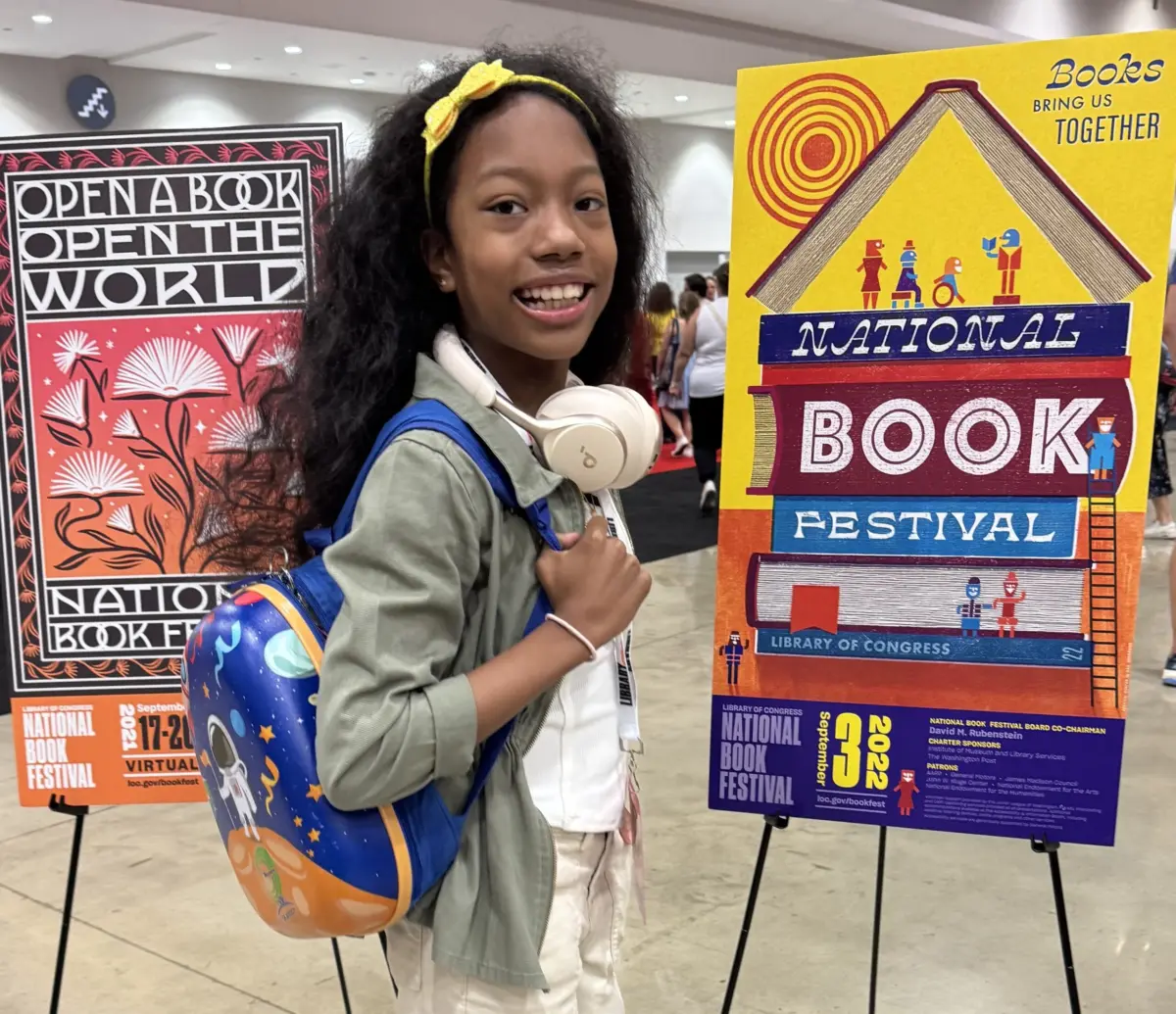
For 11-year-old Ishara Lacsina, a precocious home-schooled sixth-grader from Wilmington, Delaware, Wiseman’s words were not merely inspirational—they were a reflection of her own lived trajectory. Equipped with an astronaut-themed backpack, an unwavering scientific curiosity, and a microphone, Lacsina spent 11 relentless hours navigating the festival’s vast ecosystem. As the host of Ishara’s Reading Podcast and a four-year veteran of the festival circuit, Lacsina utilized the event to conduct high-level interviews with a curated wish list of authors, scientists, and spiritual leaders.
Read Also
This comprehensive report examines the intersection of aerospace inspiration and literary devotion at the 2025 National Book Festival, tracing the day through the dual lenses of grand geopolitical-cultural milestones and the granular, ground-level reporting of one of the nation’s youngest accredited podcasters.
Detailed Chronology: A 11-Hour Odyssey of Discovery
Morning Session: The Cosmic Call to Action
The festival gates opened at 9:00 a.m. to a palpable wave of anticipation. The primary anchor of the morning’s emotional resonance was Commander Reid Wiseman’s address. Taking the stage in front of 2,200 spectators, Wiseman detailed the psychological and physical realities of space exploration aboard the Artemis II mission.
Rather than focusing solely on the rocketry and orbital mechanics, Wiseman centered his narrative on the human element: the vulnerability of viewing Earth from the lunar void, the deep trust required among crewmates, and the profound responsibility of stewardship. Observers noted that the audience was visibly moved, with many wiping away tears as the astronaut described the horizon of our home planet disappearing behind the lunar limb.
While Wiseman maintained a strict schedule that excluded press scrums and audience Q&A sessions, his address set an inspirational frequency that vibrated across every hall. Among those tuned directly into this frequency was Ishara Lacsina. Arriving alongside her "crew"—her mother, Odessa, a scientist serving as videographer, and her father, Joshua, a physician providing technical support—Lacsina immediately set off to execute a meticulously planned interview itinerary.
Midday Engagements: Weaving Science, History, and Morality
By midday, the convention center’s three primary halls were humming at maximum capacity. Lacsina’s first major appointment of the day bridged the gap between speculative fiction and rigorous scientific inquiry.
She met with Donna Barba Higuera, an optometrist turned critically acclaimed author whose novel The Last Cuentista claimed the prestigious Newbery Medal in 2022. Lacsina posed a foundational question: “Why did you become a storyteller?” Barba Higuera’s response emphasized the immutable nature of narrative: stories are the only possessions we can truly carry across light-years and life-altering transitions, even when all physical objects are stripped away.
Moving swiftly through the crowds, Lacsina rendezvoused with Geo Rutherford, author of the forthcoming Spooky Rivers: 25 Strange and Mysterious Rivers That Snake Across Our Planet (Tantor, Sept.). Drawing parallels to Rutherford’s previous work on aquatic anomalies, the two discussed the hydraulics of tidal rivers, the enduring myths of the Bermuda Triangle, and the influence of maternal scientists. Lacsina noted the symmetry between Rutherford’s background and her own mother’s pedigree in biology and immunology—a fitting foundation for Lacsina’s parallel writing project on hero scientists in immune research.
The afternoon session pivoted toward historical preservation and civic courage. Lacsina engaged Beronda L. Montgomery, author of When Trees Testify: Science, Wisdom, History, and America’s Black Botanical Legacy (Holt). Their discourse explored the silent witness of nature, with Montgomery noting that childhood play in natural landscapes is, in effect, an immersion into an archive of generational history.
Following this, Lacsina crossed paths with the Episcopal Bishop of Washington, D.C., Mariann Edgar Budde. Bishop Budde’s recent book, How We Learned to be Brave (Avery), achieved national prominence when she publicly counseled political leadership on mercy toward marginalized communities. Budde discussed her new picture book, I Can Learn to Be Brave (Flamingo), sharing with Lacsina that her own moral framework was forged in youth through the rigorous study of historical biographies.
Afternoon Climax: Literary Meetups and STEM Exploration
As the afternoon waned, the logistical challenges of covering a massive cultural festival intensified. Lacsina’s ultimate literary pilgrimage was to meet B.B. Alston, author of the celebrated Supernatural Investigations series. For Lacsina, whose natural curls cascade to her waist, Alston’s protagonist, Amari—a magician with a prominent afro—represents a vital mirror in contemporary fantasy literature. To accommodate an interview with Alston and secure a signed copy of Amari and the Metalwork Menace (Storytide), Lacsina made the tactical decision to depart early from a high-profile talk by actor and singer Cynthia Erivo.
The final hours of the 11-hour marathon were dedicated to experiential learning. Lacsina immersed herself in the Library of Congress activities pavilion, specifically targeting the STEM District. As a home-schooled sixth-grader active in a competitive robotics club, she evaluated coding initiatives designed to foster technical literacy among young girls. Additionally, she consulted voice actor Arthur Dent regarding the acoustic and technical divergences between live podcasting and professional audiobook narration.
The day concluded with a formal writing workshop where Lacsina absorbed critical structural techniques. Rather than feeling intimidated by the prospect of long-form composition, she walked away with a transformative realization:
"I discovered you don’t have to write for five uninterrupted hours. Sometimes you could just do 20 minutes, stop writing, then just come back to it tomorrow."
Balancing competitive figure skating, advanced academic coursework, and her media obligations, Lacsina embraced this modular approach to creativity before departing the capital with a celebratory dinner of fish and chips.
Supporting Context & Metrics
The 2025 Library of Congress National Book Festival reaffirmed its status as one of the premier public humanities events in the United States. Key operational and attendance metrics underscore its scale:
- Total Attendance: Approximately 45,000 visitors navigated the convention center floors over the course of the single-day event.
- Audience Capacity: Major keynote sessions, including Reid Wiseman’s lunar address, filled auditoriums to capacities exceeding 2,200 seated participants.
- Exhibitor & Presenter Scope: Hundreds of authors, poets, illustrators, scientists, and public intellectuals participated across dozens of specialized stages, pavilions, and signing booths.
- Digital Reach: Independent youth media initiatives, exemplified by outlets like Ishara’s Reading Podcast, collectively generated hundreds of hours of niche literary content distributed globally via YouTube, podcast directories, and dedicated web portals.
Official Statements
While institutional actors and guest speakers maintained rigorous schedules, their public commentaries throughout the festival underscored the overarching themes of institutional accessibility and generational empowerment.
Dr. Carla Hayden, Librarian of Congress (reflecting on the mission of the festival):
"The National Book Festival has always been designed to lower the barrier between the curious mind and the repository of human knowledge. When we invite astronauts, scientists, historians, and novelists under one roof, we are signaling to every young person that the entirety of human achievement is accessible to them."
Commander Reid Wiseman, Artemis II (excerpt from his address):
"When you look back at Earth from the vantage of deep space, national borders vanish, and what remains is an overwhelming sense of fragility and interconnectedness. We did not go to the Moon simply to plant flags; we went to expand the horizon of human potential. To every child sitting in this audience today: the universe is waiting for your generation to author its next chapter."
Bishop Mariann Edgar Budde (on the roots of moral courage):
"Bravery is not the absence of fear, but the deliberate choice to act in alignment with one’s deepest moral convictions. We learn this muscle when we are young—through stories, through mentors, and through the quiet witness of history."
Future Outlook
The convergence of high-tier aerospace diplomacy and grassroots youth journalism at the 2025 National Book Festival provides a clear preview of the shifting paradigms in cultural curation. As institutional festivals increasingly incorporate digital-native creators into their press ecosystems, traditional journalism is being augmented by hyper-focused, peer-to-peer media enterprises.
For Ishara Lacsina, the immediate future involves a methodical rollout of her festival interviews across her podcast and digital channels throughout the autumn and winter months. Academically and athletically, she continues her preparation in competitive figure skating and robotics, while applying the time-management techniques acquired during the festival’s writing workshops to her twin book projects on immune-system research scientists and speculative fiction.
Looking toward the horizon, the Library of Congress has confirmed that the National Book Festival will return next August, maintaining its mission to champion literacy, scientific inquiry, and civic engagement. And as for Lacsina’s long-term trajectory—aiming to become the first woman to walk on Mars—the institutional infrastructure of events like the National Book Festival ensures that the literary fuel required for such interplanetary ambitions remains readily available to any young mind willing to pick up a book and a microphone.


Comments
Facebook App ID not configured. Please add it in the Customizer.