Two definitive statements often provoke immediate fatigue, yet remain undeniably true: all science fiction is inherently political, and every narrative set in the future is fundamentally a commentary on the present.
At its broadest definition, science fiction imagines and extrapolates stories from significant disruptions to our societies, our species, and our physical worlds. While some creators genuinely—and erroneously—believe they are crafting stories untainted by the mundane prejudices and geopolitical fractures of their current eras, masterpieces exist at the opposite extreme.
Alfonso Cuarón’s 2006 cinematic triumph, Children of Men, is a masterclass in this rare discipline. Crafted to articulate sharp, complex truths about human cruelty, systemic indifference, and authoritarian slide, the film has only grown more urgent and powerful in the two decades since its theatrical debut.
Loosely based on the 1992 novel The Children of Men by British author P.D. James (Baroness James of Holland Park), the film operates more as a creative variation on a theme than a rigid, page-to-screen adaptation. Cuarón made this distinction clear from the outset, and James herself ultimately embraced the cinematic reinterpretation.
P.D. James’s original novel sketches a near-future United Kingdom crippled by global human infertility—a world where children are no longer born, precipitating sweeping social, political, and philosophical decay. The book follows an Oxford historian, navigating the halls of government power alongside dissident factions, exploring the rise of demagogues amidst societal despair, the exploitation of migrant populations, and the tenuous role of faith.
Because James’s novel is intellectually dense, contemporary critics frequently resisted labeling it as science fiction. A notable 2006 New York Times critique insisted:
“The Children of Men is not another of Ms. James’s famed detective novels, and it is not, as it has sometimes sloppily been described, science fiction. It is a trenchant analysis of politics and power that speaks urgently to this social moment.”
This artificial dichotomy—separating “science fiction” from “a trenchant analysis of politics and power”—pursued both the novel and the film adaptation. Yet dismissing the work as "not sci-fi" because it explains its world, or conversely claiming the film "isn’t sci-fi" because it deliberately omits exposition, is a tedious semantic exercise. The film is science fiction of the highest order. Let us move on.
From Page to Screen
The journey to adapt James’s novel began shortly after its publication, but development stalled across multiple screenwriters and years. Paul Chart drafted the initial screenplay, followed by rewrites from Mark Fergus and Hawk Ostby, whose early drafts remained heavily faithful to the source material.
When Mexican filmmaker Alfonso Cuarón encountered their script, he initially passed. However, the premise lingered in his subconscious. Partnering with screenwriter Timothy J. Sexton, Cuarón approached the material from an entirely unexpected angle. As Cuarón recalled: "We said: let’s do something like Y tu mamá también—but in the future."
The reference to his breakout 2001 Mexican road-trip movie might seem jarring. Yet Cuarón was deliberately rejecting the polished, sanitized sheen of standard Hollywood speculative filmmaking to prioritize raw, localized intimacy. Eschewing the macro-political machinations of James’s novel, Cuarón re-focused his lens through a post-9/11 sociopolitical prism. He narrowed the scope away from the origin of authoritarian regimes to focus instead on what those regimes inflict upon the most vulnerable populations.
Supporting Context & Production Metrics
The core speculative premise remains intact: nearly two decades prior, humanity suffered an incurable mass infertility epidemic. No children have been born since. Cuarón wisely refused to explain the biological cause of the infertility, recognizing that any exposition would immediately invite trivializing nitpicks.
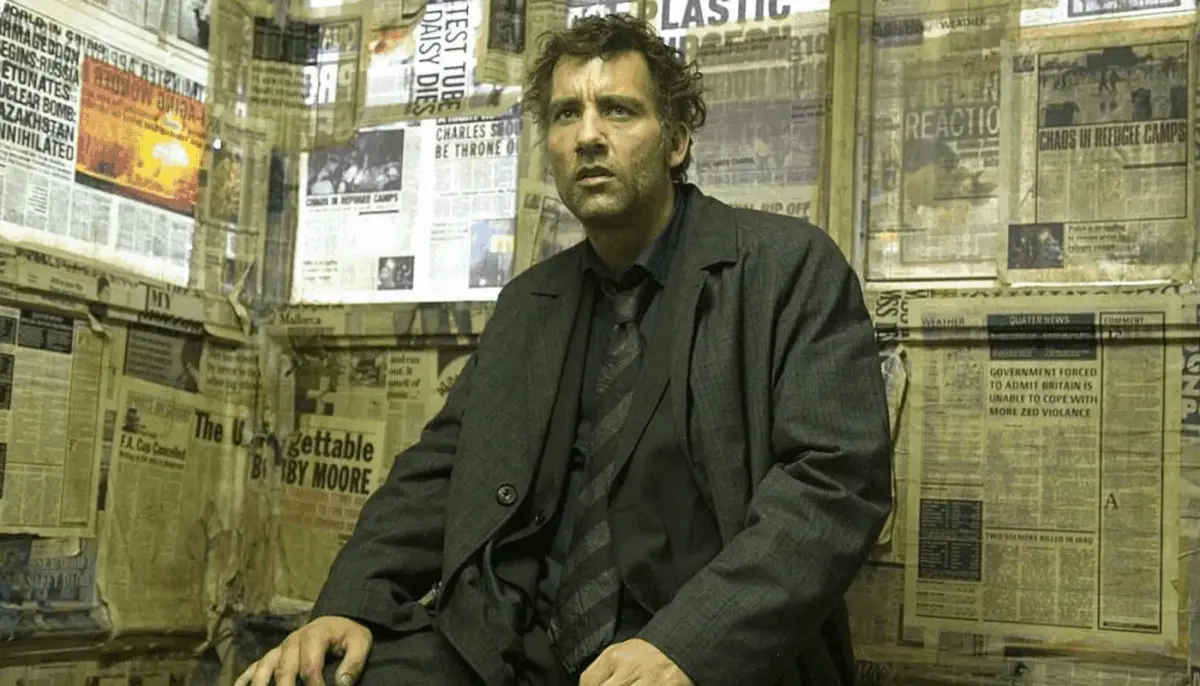
The story anchors itself on Theo Faron (Clive Owen), a weary bureaucrat navigating a dystopian London in 2027. The United Kingdom has sealed its borders behind xenophobic propaganda, herding refugees into violent internment camps while pretending to be the last bastion of civilization.
When pro-immigration activists—led by Theo’s estranged former partner Julian (Julianne Moore)—abduct him, they draft him not for ideological fervor, but for bureaucratic access. They need transit papers for Kee (Clare-Hope Ashitey), a young undocumented refugee. Following an ambush that claims Julian’s life, the stakes skyrocket: Kee is pregnant. She carries the world’s first known pregnancy in nearly two decades.
Production Engineering and Craftsmanship
What elevates Children of Men from a conventional dystopian action flick to a masterpiece of modern cinema is its uncompromising production design and technical virtuosity.
Cuarón modeled the film’s gritty authenticity on Gillo Pontecorvo’s 1966 classic The Battle of Algiers, deploying a documentary-style lens to ground speculative fiction in tangible reality. To construct a decaying 2027 London, visual effects supervisor Frazer Churchill and his team digitally aged and battered iconic locations—Fleet Street, Trafalgar Square, and Battersea Power Station—filming on location in 2005 just weeks after real-world terrorist attacks shook the city.
The film’s visual language relies heavily on natural lighting orchestrated by cinematographer Emmanuel Lubezki. Eschewing stylized sci-fi neon or artificial gloom, Lubezki utilized minimal lighting, treating the overcast English weather as an organic environment.
Statistical Overview: Shot Economy
Total Runtime: 109 minutes
Total Shot Count: Approximately 460 shots
Average Shot Length (ASL): ~14.2 seconds (In stark contrast to modern action cinema, which averages 2,000+ shots with 4-to-6-second intervals).
This expansive ASL is weaponized through dynamic, complex long takes that amplify spatial disorientation and visceral peril. The legendary six-minute car ambush and the harrowing, nine-minute continuous tracking shot through the war-torn refugee camp utilize seamless digital compositing to stitch together extended physical takes. These choices force the audience into the perspective of a terrified bystander caught in the crossfire.
Official Statements & Creative Vision
Reflecting on the film’s intentional lack of exposition and its refusal to offer easy narrative resolutions, Cuarón underscored that the narrative is not about heroic savior complexes.
"We didn’t want to offer the comforting, simplistic fantasy that a white man’s heroic actions will immediately and noticeably save the world," production notes and interviews echo.
Instead, the film ends in literal fog. We never learn the long-term fate of Kee, her child, or the collapsed global order. The final message is profoundly fragile yet enduringly powerful: there is inherent moral value in fighting for a better future, even when the odds are insurmountable and you will not live to witness the outcome.
Future Outlook & Cultural Legacy
Twenty years after its theatrical release, Children of Men remains terrifyingly prophetic. Its imagery of militarized borders, cages, systemic xenophobia, and ecological collapse mirrors our contemporary geopolitical landscape with chilling accuracy.
As streaming platforms and retrospective screenings continue to introduce the film to new generations of viewers, its status as a 21st-century sci-fi benchmark remains unassailable. It stands as a timeless reminder that speculative fiction’s greatest power lies not in predicting tomorrow, but in demanding that we open our eyes to the injustices of today. Don’t look away.








Comments
Facebook App ID not configured. Please add it in the Customizer.