

Executive Overview
In the contemporary literary landscape, few works capture the precarious, delicate interplay between queer domesticity, systemic vulnerability, and the relentless march of time quite like David Eileen’s newly minted Poem of the Week selection, "Sonnet with Beautiful Lies." Published by The Missouri Review for the week of September 21, 2026, Eileen’s sonnet serves as both an intimate love letter and a sharp political commentary. Set against the backdrop of the rugged Virginia mountains—where the poet resides alongside a partner and an abundance of unruly tomato plants—the poem defies traditional tropes of idealized romance, choosing instead to anchor itself in the bruised, resilient realities of trans and queer survival.
Eileen, whose work has previously appeared in esteemed publications such as The Atlantic, Black Warrior Review, and Prairie Schooner, brings a distinct voice forged at the intersections of transness, rural living, and contemporary poetics. "Sonnet with Beautiful Lies" does not offer readers the comfortable escapism often associated with pastoral poetry. Instead, it drags the anxieties of aging, hormone replacement therapy, systemic violence, and public exclusion squarely into the light, utilizing the rigid, time-tested architecture of the sonnet to construct a temporary fortress against an uncertain world.
This comprehensive review explores the anatomy of Eileen’s latest poetic achievement, contextualizing the work within the broader sociopolitical climate of contemporary America, analyzing the text’s formal mechanisms and imagery, and examining the profound authorial notes that illuminate the poem’s complex emotional core.
Read Also
Detailed Chronology: The Evolution of Eileen’s Poetic Voice and the Path to The Missouri Review
To understand the weight of "Sonnet with Beautiful Lies," one must trace the trajectory of David Eileen’s growing presence in American letters. Over recent years, Eileen has steadily carved out a unique space within contemporary literary magazines, marked by a rare combination of lyrical precision and raw, unvarnished vulnerability.
The journey to this latest recognition by The Missouri Review spans several key milestones:
- The Critical Breakthrough: Eileen’s early publication credits in prominent journals like Prairie Schooner and Black Warrior Review established a reputation for verse that explores bodily autonomy, queer geography, and the tension between interior emotional landscapes and external sociopolitical threats.
- National Recognition: The inclusion of Eileen’s work in The Atlantic signaled a broadening audience, introducing the poet’s distinct rural-queer perspective to national readerships accustomed to more urban-centric narratives of LGBTQ+ life.
- Relocation and Domesticity: Moving to the mountains of Virginia, Eileen established a life defined by quiet domesticity—tending to a partner and cultivating an overwhelming number of tomato plants—while simultaneously navigating the hyper-visibility and localized dangers of rural living as a trans person.
- The Selection (September 2026): The Missouri Review officially named "Sonnet with Beautiful Lies" as its Poem of the Week on September 21, 2026. The release was accompanied by authorial commentary and digital distribution through Eileen’s electronic newsletter (the "e-pistle"), cementing the poem’s status as a major literary talking point of the early autumn publishing season.
This chronology reflects a writer moving with deliberate intention, translating the quiet rhythm of mountain life and the loud, persistent hum of systemic anxiety into tightly coiled verse.
Supporting Context & Metrics: The Sociopolitical Anatomy of Aging While Trans
While "Sonnet with Beautiful Lies" reads on the surface as an intimate meditation on a long-term partnership, its undercurrents pulse with contemporary anxieties unique to the transgender and queer experience. In the author’s notes accompanying the poem, Eileen explicitly links the universal dread of aging to the distinct, hyper-vigilant terror experienced by marginalized bodies navigating public and private spheres.
The Metrics of Marginalization
- The Intersect of Aging and Transition: For many cisgender individuals, aging is experienced as a gradual loss of youth and cultural capital. For transgender individuals—particularly those undergoing hormone replacement therapy (HRT) later in life—aging is layered over a delayed or ongoing transition. As Eileen notes, the daily ritual involves applying retinol at night alongside the administration of hormone shots, studying mirror reflections for the dual markers of time and medical intervention.
- Public Space and Elimination: Recent political and social shifts across the United States have placed acute pressure on public accommodations. The anxiety regarding restroom access—even within cultural sanctuaries like museums filled with queer art—highlights a pervasive atmosphere of hostility. Eileen notes that this fear of physical violence and systemic erasure is an active, daily burden that shadows even peaceful survivors.
- The Statistics of Rural Isolation: Living "gaily in the mountains of Virginia" presents a paradox common to rural queer populations: the peace of natural isolation counterbalanced by the acute awareness of geographical vulnerability. According to various advocacy groups tracking anti-LGBTQ+ legislation and incidents, non-urban queer residents frequently face elevated risks due to sparse support networks and lower concentrations of protective local infrastructure.
It is within this data-driven reality of systemic vulnerability that Eileen’s poem operates. The verse refuses to treat aging as a neutral biological process; instead, it frames survival into old age as a radical, hard-won achievement.
Textual Analysis: Inside "Sonnet with Beautiful Lies"
We should not reify each other; there’s naught divine between us
& anyway, that human form of yours put down in stone would only
intimidate museum patrons for forever. Scare off donors. There’s nothing
left to remember: we already grew old together. You knew each of my thoughts
before they turned silver. We had the best arguments: character development,
comic relief, repetition that deepened our themes. I did not panic when I saw
gray setting in because I saw yours falling out of braids right next to mine
& anyway, that was a lifetime ago, my hand paper over yours now. Our age
spots match. I know you remember each moment we shared just as each drop
of wine remembers the green of the dark bottle, then all the light coming
through
the convex crystal vista it rocked up & down before it met you. In our lifetime,
there was purpose & I knew it. It felt like the tongue in my shoe or the tongue
in my mouth: perfectly functional. Easy to ignore but when bent wrong,
just the worst pain of my life. I always knelt down quick to fix it.
Formal Structure and Subversion
Eileen employs the classic sonnet form not as a constraint to be passively endured, but as a scaffold to support an immense emotional weight. The rigid rules of traditional poetic forms provide a structural counterweight to the author’s stubborn insistence on a future that queer people are so rarely promised: uninterrupted companionship and the luxury of growing old.
The Imagery of Domesticity and Time
The poem opens with an immediate rejection of classical idealization ("We should not reify each other; there’s naught divine between us"). Rather than casting a partner as a marble deity worthy of museum pedestals—a monument that would inevitably "intimidate museum patrons" or "scare off donors"—Eileen roots the relationship in the mundane, beautiful friction of shared history.
Arguments are framed not as marital fractures, but as narrative devices: "character development, / comic relief, repetition that deepened our themes." This meta-textual self-awareness adds a layer of gentle humor to the verse, anchoring the grand themes of mortality in the domestic rhythms of two people who have lived alongside one another for decades.
The Wine Bottle and the Body
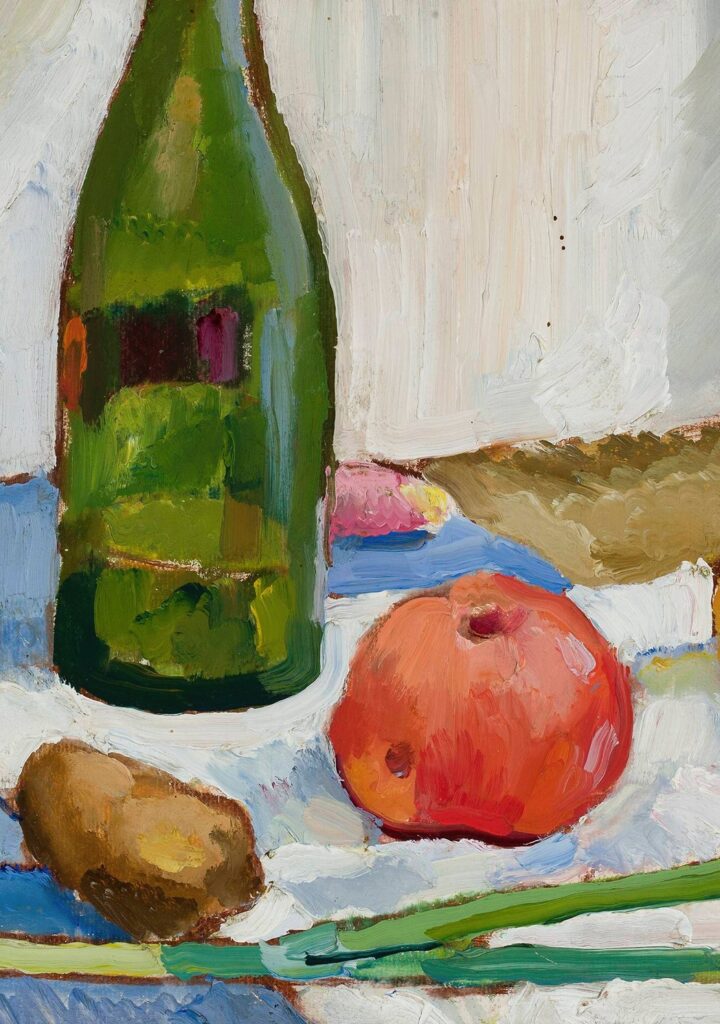
As the poem progresses, the imagery shifts toward bodily markers of age—gray hair falling out of braids, paper-thin skin, and matching age spots. The extended metaphor of the wine bottle ("just as each drop / of wine remembers the green of the dark bottle, then all the light coming / through / the convex crystal vista") brilliantly captures how memory inhabits the physical vessel. The body absorbs light, time, and history, storing them within the dark glass of lived experience.
The Closing Resolution: The Tongue in the Shoe
The poem concludes with one of the most striking domestic metaphors in contemporary poetry: purpose compared to the tongue of a shoe or the tongue in a mouth. It is "perfectly functional. / Easy to ignore but when bent wrong, / just the worst pain of my life. I always knelt down quick to fix it."
This ending encapsulates the core thesis of Eileen’s work: survival is not an abstract political concept; it is an active, physical maintenance. When the machinery of life gets bent out of shape by systemic hostility or the natural indignities of aging, the speaker kneels down to fix it, choosing care over despair.
Author’s Perspective: Eileen on Fear, Form, and the Half-Truth
In a deeply revealing author’s note accompanying the publication, David Eileen unpacks the psychological architecture underpinning the poem.
"If everyone’s afraid to age, that fear is expressed uniquely through every person who feels it," Eileen writes. "Layer that fear, then, with the fear of violence that I’m worried over every day: physical violence that targets trans & queer people, the violence of erasure that threatens even our peaceful survivors."
Eileen highlights how personal romance and systemic oppression intersect on the surface of the body. The shared bathroom anxieties—even within institutions dedicated to queer art—demonstrate how external political hostility infiltrates the most private moments of self-perception.
Addressing the poem’s title, Eileen reflects on the nature of the final lines:
"It ends with a beautiful lie that is really a half-truth: there have been times when (maybe after hesitation) I have reached down deep to adjust a bent-up sense of purpose. I felt better afterward, like if I’m really to be given the rest of my life, I won’t have to dread living it."
This admission elevates the poem from a simple exercise in romantic nostalgia to an act of profound self-preservation. The "beautiful lie" is the conscious choice to manufacture hope in the face of statistical and political grimness—an insistence that the remainder of life can be lived without the crushing weight of dread.
Future Outlook: The Ongoing Legacy of Rural Queer Literature
The publication of "Sonnet with Beautiful Lies" in The Missouri Review marks a significant moment for contemporary poetry, signaling a growing appetite for work that addresses the intersection of rural isolation, trans embodiment, and long-term queer joy.
As David Eileen continues to cultivate poetry from the mountains of Virginia—balancing the care of tomato plants with the rigorous demands of literary creation—the cultural footprint of this work is poised to expand. For readers, scholars, and advocates alike, Eileen provides a vital blueprint: how to take the rigid forms of the past, inject them with the messy, urgent realities of modern trans survival, and build something enduring, beautiful, and fiercely alive.
“Sonnet with Beautiful Lies” is available to read in full via The Missouri Review. Readers can connect directly with David Eileen and subscribe to their electronic newsletter at david-eileen.com.





Comments
Facebook App ID not configured. Please add it in the Customizer.