
Navigating the shifting currents of the contemporary art market is no small feat, yet New York’s venerable Armory Show has spent the better part of the last decade doing little else. As the fair unfurled its 32nd edition at the Javits Center on Manhattan’s West Side, it bore the scars and benefits of an eventful recent history: a relocation from its charmingly gritty historic piers on the Hudson River, a subsequent acquisition in 2023 by Frieze (operators of London’s flagship fair and New York’s venue-challenged event at the Shed), a revolving door of directors, a completely overhauled exhibitor list, and yet another calendar shift to late September.
Against this backdrop of continuous reinvention, the opening morning of the 2026 edition prompted a fundamental question among dealers, collectors, and critics alike: What, and who, is the Armory Show actually for?
Initially, the answer seemed as elusive as the morning foot traffic. Following a doors-opening at 11 a.m.—an hour earlier than in previous years—the expansive Javits Center offered a welcome sense of breathing room, though at times it bordered on anemic. The convention hall’s notorious architecture creates a literal and psychological chasm; its two halves are bisected by a sprawling VIP lounge, upscale restaurant, and champagne bar. Consequently, one side of the floor could feel entirely deserted while, a few hundred feet away, another buzzed with eager buyers.
Read Also
Yet, as the day progressed, the initial quietude gave way to a robust, familiar hum of commerce and socializing. By mid-afternoon, the aisles were thick with notable collectors, celebrities, and art world heavyweights. More importantly, steady sales materialized across all price points. Proving that a slower, more deliberate morning is not indicative of failure, gallerists reported brisk transactions, cementing the Armory’s resilient role as both a commercial engine and the definitive bellwether for the commencement of New York’s competitive fall art season.

Detailed Chronology: From Dawn Quiet to Afternoon Momentum
The 11:00 AM Opening: A Measured Dawn
As the doors swung open on Thursday morning, the exhibition floor presented a study in contrast. The earlier opening time was implemented to inject a degree of pacing into the day, but the initial hours revealed surprisingly lean attendance across several aisles. Part of this early-morning lull was attributed to direct competition from Independent 20th Century, which opened simultaneously on the Upper East Side at the Breuer building—now the newly minted headquarters of Sotheby’s. Whispers among dealers suggested that Frieze had experienced eleventh-hour difficulties filling every corner of the cavernous Javits Center, with several exhibitors receiving invitations at the very last minute.
However, rather than panicking over the sparse early crowds, seasoned dealers viewed the calm environment not as a warning sign, but as a welcome adaptation to contemporary market realities. Jayne Drost Johnson of New York’s JDJ Gallery noted that the art world has collectively adjusted to a slower, more sustainable rhythm.
"We’ve all noticed that fairs have a different pace the last couple of years," Johnson observed. "It’s more consistent, not just all about one crazy morning, and this way you can have better conversations. Even at [last year’s] Art Basel Miami Beach, which was great for me, I was making as many sales the last day as the first. So a slow first morning is not a sign of how things are going to go."
Art adviser Augusto Arbizo, operating out of Allan Schwartzman’s firm, echoed this sentiment. "I actually found the new dates gave the Armory a much more relaxed energy," he remarked. "There was a nice sense of anticipation when I walked in, but without that immediate feeling of being swept up in the frenzy that can sometimes accompany a fair opening."

The 2:00 PM Surge: Familiar Rhythms and Star Power
By 2 p.m., the atmospheric temperature of the fair had entirely transformed. Crowds arrived in steady waves, restoring the traditional, high-stakes energy of a major New York opening. Crucially, the fair demonstrated its enduring utility as a cultural anchor: it officially signals to the city that the summer hiatus has concluded and the intellectual and social machine of the fall season is open for business.
By moving away from the chaotic window immediately following Labor Day—a congested period that previously pitted the fair against a crushing wave of gallery openings, dinners, and private events—the new September 24–27 dates provided critical breathing room. This shift also strategically distanced the Armory from Frieze’s concurrently running fair in Seoul.
The resulting atmosphere was markedly more civilized, allowing the fair to function as a genuine marquee event rather than a claustrophobic obligation. The VIP preview drew an eclectic mix of culture and capital. Notable attendees spotted traversing the aisles included New York City First Lady Rama Duwaji; silver-screen icons Jodie Foster and Paul Rudd; and New York Knickerbocker Karl-Anthony Towns. They were joined by a formidable cohort of blue-chip collectors, including Beth Rudin DeWoody, Estrellita Brodsky, Komal Shah, Lisa Goodman, Allison Berg, and Jill and Peter Kraus.
Supporting Context & Metrics: Sales and Market Realities
Despite initial anxieties regarding foot traffic, advance previews via email had already laid the groundwork for robust sales. Once the physical doors opened, transactional momentum picked up rapidly across galleries both established and emerging.

High-End Triumphs and Blue-Chip Sales
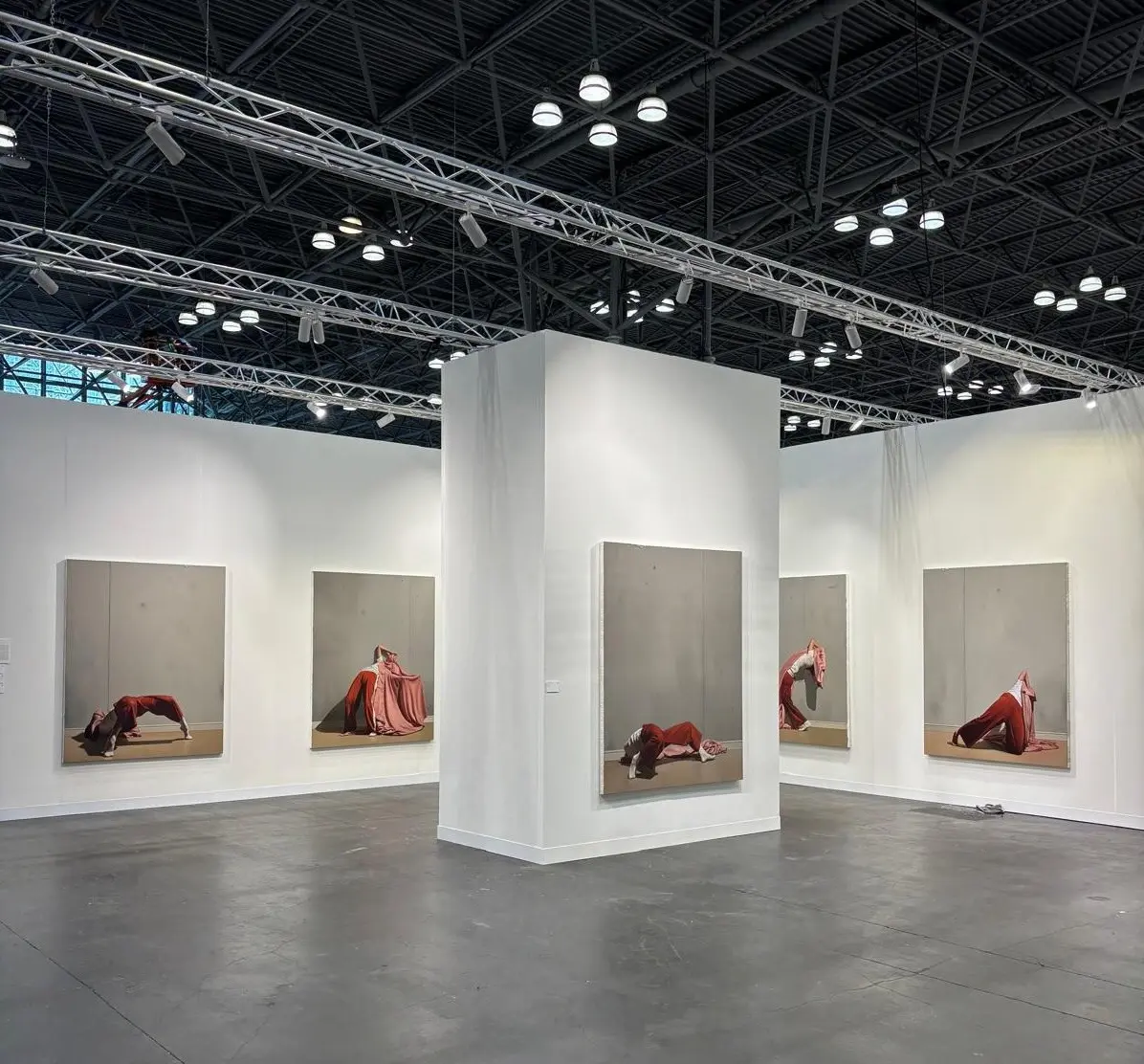
- Kamel Mennour: Participating as a first-time exhibitor with spaces in Paris and New York, the gallery achieved a swift sell-out of its solo presentation. By 1 p.m., seven out of nine paintings by Dhewadi Hadjab had sold—with the remaining two placed on reserve—at $110,000 each. The figurative works depict a dancer navigating complex choreography, drawing conceptual parallels to Eadweard Muybridge’s historic motion studies.
- Norr Cohan: In its first outing since long-time director David Norr assumed co-ownership alongside James and Jane Cohan, the New York gallery enjoyed a stellar opening day. Transactions included a large multimedia piece by Yinka Shonibare sold to a private collector for between $180,000 and $220,000; two large-scale gold-and-geometric mosaics by Eamon Ore-Giron fetching between $80,000 and $120,000; and a suite of 25 watercolors by Spencer Finch moving for $50,000 to $75,000.
- Sean Kelly Gallery: Proving that institutional-grade spending remained robust, Sean Kelly reported six sales by early afternoon. Highlights included Janaina Tschäpe’s large-scale oil painting Picking Flowers Quietly for $170,000, and Sam Moyer’s sculptural fusion of marble and plaster, Magic Number, for $125,000. Additional sales featured works by Laurent Grasso (€60,000), Jose Dávila ($65,000), and Magdiel García Almanza and Lindsay Adams ($28,000 each).
- Gazelli Art House: Fresh off expanding its footprint to New York with a massive 10,000-square-foot Chelsea space in the former Marlborough location, the Azerbaijan-founded gallery brought ambitious historical offerings. Paintings by Color Field pioneer Alice Baber started at $200,000, while Abstract Expressionist Grace Hartigan’s canvases—including her 1945 work Frustration, historically signed with the male pseudonym "Jachens"—started at $130,000. By mid-afternoon, Gazelli sold a significant historic piece by Lilly Fenichel to a major European private museum for approximately $200,000.
Mid-Tier and Emerging Successes
- Perrotin: By 4 p.m., the global mega-gallery had sold six intricate, tapestry-like layered paintings by Haitian-born artist Kathia St. Hilaire, priced between $5,000 and $45,000. The works explicitly engage with the harrowing history of François "Papa Doc" Duvalier’s regime and the 1960s Spiralist literary movement.
- Southern Guild: The Cape Town-based gallery, which recently established a permanent Tribeca outpost, saw strong early numbers. By 1 p.m., they had sold Zanele Muholi wallpaper works printed on aluminum for $52,000 each, and black velvet paintings by Roméo Mivekannin for $56,000 apiece, alongside securing two high-value reserves on monumental Muholi sculptures priced at $250,000 each.
- Shrine: New York gallery Shrine found quick success with Canadian-born artist Michelle Paterok, whose sun-drenched landscape Lake Huron, Late August and companion paintings—discovered by gallery partner Marge Rendell on Instagram—sold out roughly 10 pieces priced between $5,500 and $11,000 by mid-afternoon.
- A Hug From the Art World: Capitalizing on pre-fair buzz that included an exclusive VIP preview at Zero Bond attended by Michael Rubin, Gayle King, and George Condo, the gallery completely sold out its booth of vibrant figurative paintings by Camille Fishel before noon. The works, drawn from her "Bending Over Backwards" series, commanded prices between $18,000 and $24,000.
- Dimin: Illustrating the diverse micro-market that anchors the fair’s lower price tiers, Dimin sold four paintings by Kelli Vance ($14,000–$20,000), a Taj Poscé work ($3,500), and Michelle Im’s witty ceramic sculpture The Auctioneer—an effigy immortalizing Sotheby’s prominent auctioneer Phylis Kao—for $4,800.
Official Statements and Strategic Vision
Behind the operational machinery of the 2026 Armory Show is a deliberate rethinking of the fair’s identity under Frieze’s stewardship and the directorship of Kyla McMillan. Speaking on the strategic realignment, McMillan emphasized that the later September calendar slot has fundamentally improved the business dynamics of the event.
"Collectors are back from summer holidays," McMillan noted, adding that pre-fair dialogues with galleries felt "a bit more intentional this year." Rather than attempting to muscle past or compete head-on with the market’s absolute highest-tier mega-fairs, McMillan envisions the Armory occupying a unique, complementary niche.
"This fair has always been one about discovery," she stated, drawing attention to the expanded young-gallery section (Presents, which grew to 55 galleries) and dedicated solo presentations (Solo, hosting 25 exhibitors). Furthermore, specialized curated sectors directed our attention toward the broader Caribbean basin: Platform, overseen by SculptureCenter curator Jovanna Venegas, highlighted large-scale installations, while Focus, curated by María Elena Ortiz of the Modern Art Museum of Fort Worth, prioritized solo- and dual-artist presentations.
Veteran New York art adviser Lara Björk offered an analytical perspective on Frieze’s acquisition and the fair’s structural evolution. Over the past six to eight years, Björk noted, the Armory has cycled through locations, dates, and identities while attempting to regain its footing in a hyper-competitive landscape.

"They’re capitalizing on the lower-priced, more ‘red-chip’-leaning artists and galleries," Björk observed regarding Frieze’s strategy. "Perhaps that’s just what the art market needs." Summing up the current macroeconomic reality of the New York art ecosystem, Björk concluded with a pragmatic assessment: "In a market that has many markets and layers, there is in fact room for everyone."
Sean Kelly echoed this sentiment from a dealer’s perspective: "It’s the beginning of our season. Everybody wants to get back at it. And this is them getting back at it. What matters is that people are spending money; they’re in here doing it. For me, that’s what the fair is for."
Future Outlook: Finding Identity in a Crowded Hierarchy
As the Armory Show concludes its 32nd iteration, the event appears to have successfully navigated its identity crisis. By relinquishing the futile pursuit of becoming an ultra-exclusive, top-tier blue-chip monolith—a territory heavily defended by Art Basel and Frieze’s flagship events—the Armory has leaned into its historical strengths: discovery, mid-market accessibility, institutional curation, and serving as New York’s unofficial autumnal cultural kickoff.
The integration into Frieze’s corporate ecosystem, combined with a more civilized September scheduling window, has given the fair a renewed sense of operational stability. While challenges remain regarding the physical layout of the Javits Center—specifically the divisive spatial barrier of the central VIP lounges—the commercial outcomes of the 2026 edition signal robust health.

Moving forward, the fair’s longevity will likely depend on its commitment to nurturing younger galleries, championing underrepresented regions like the Caribbean, and acting as a incubator for dynamic, non-traditional presentations that major international fairs often overlook. In an art market increasingly characterized by stratification and economic caution, the Armory Show has carved out a sustainable, vital path forward—proving that by embracing its identity as a space for exploration and seasonal renewal, it remains indispensable to New York’s cultural fabric.





Comments
Facebook App ID not configured. Please add it in the Customizer.