
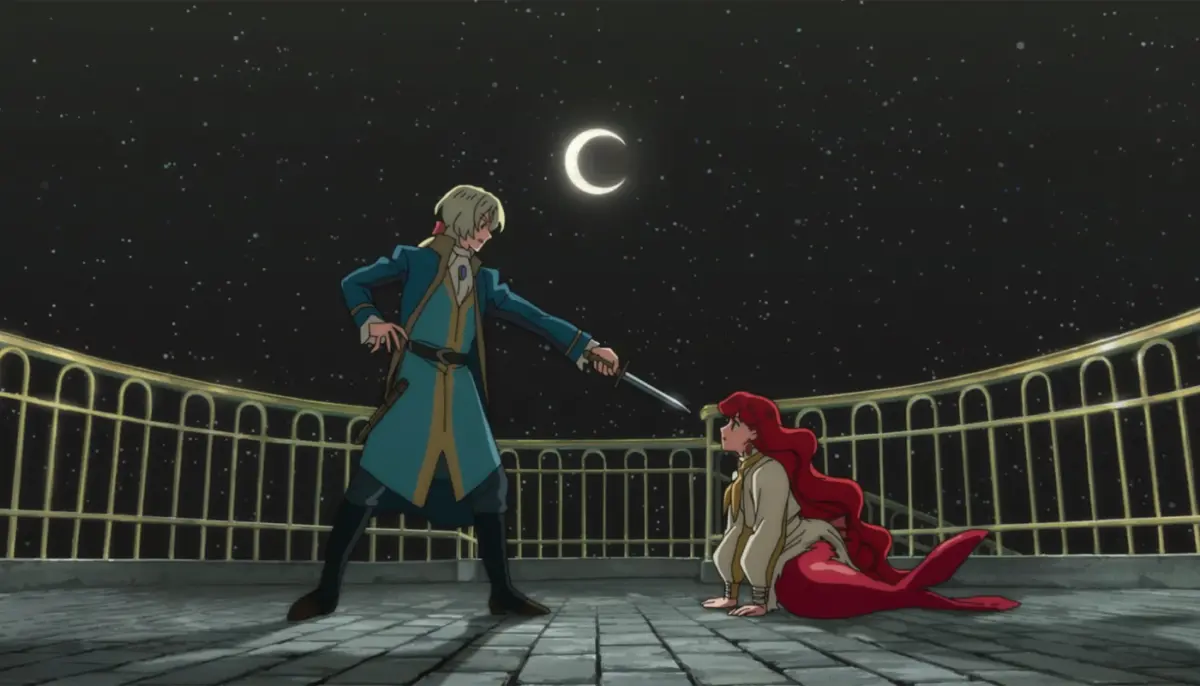
As anime milestone projects go, Kinema Citrus’s 12-episode anniversary production Goodbye, Lara arrived with monumental expectations. Blending the maritime tragedy of Hans Christian Andersen’s The Little Mermaid with a contemporary, localized Japanese setting centered on Lake Biwa, the series immediately captivated critics and audiences alike with its breathtaking visual palette. Evoking the surreal, avant-garde framing of Revolutionary Girl Utena, the whimsical aquatic weight of Studio Ghibli’s Ponyo, and the sharp-edged character designs of classic 1990s shōjo animation, the series presents a gorgeous sapphic reimagining of a doomed fairy tale heroine.
Yet, beneath its immaculate linework, vivid worldbuilding, and deeply atmospheric set pieces, Goodbye, Lara operates as a narrative paradox. The series attempts to deconstruct the toxic social architectures placed upon young women—drawing unexpected, sharp parallels between the self-erasure of the modern "tradwife" and the existential weight placed upon special mermaid princesses to secure "true love" for the survival of their species. However, as the series progresses toward its conclusion, it ultimately fumbles its ideological footing. By relying on narrative ambiguity, hesitant physical representation, and a protagonist whose paralyzing passivity frustrates the very liberation it promises, Goodbye, Lara leaves viewers caught between profound artistic admiration and lingering narrative disappointment.

Detailed Chronology: From the Depths of the Sea to the Shores of Lake Biwa
Act I: The Weight of Inheritance and the Fall from Grace
From its opening moments, Goodbye, Lara establishes that its aquatic universe is governed by brutal, survivalist realities rather than saccharine Disneyfied wonder. Hatching from a giant clamshell, protagonist Lara immediately bites the head off a nearby floating fish, signaling a gritty, morally gray ecosystem. Within this world, Lara—unlike her "unspecial" older sisters—bears the crushing burden of her civilization’s survival. Her life force and the fate of her entire undersea city are intrinsically tethered to her ability to secure a pure, true love story on the surface world.
Read Also
When Lara ventures ashore and assumes a human facade, she meets a human prince. The narrative confronts trauma head-on when the prince discovers Lara’s true identity; her transformation into a mermaid triggers visceral horror, and he pulls a knife on her in a lonely moonlit tower. While undeniably cruel, the sequence introduces a complex power dynamic: Lara has deceived him about a fundamental aspect of her biology. Rejected and broken, Lara dissolves into sea foam, only to be resurrected decades or centuries later to find her family hibernating in giant clamshells at the bottom of Lake Biwa, their survival still entirely dependent on her ability to fix the system.

Act II: Modern Mundanity and the Introduction of Mari
Upon her second arrival on land, Lara’s trajectory shifts dramatically when she is punched in the face by Mari Otsu, a junior high school student carrying boxing gloves. Mari quickly emerges as Lara’s true anchor and romantic foil. Unlike the prince from her past, Mari—alongside her eclectic human family, including a photographer father, a Christian priest grandmother, and a burnout older brother—embraces Lara without hesitation.
This middle stretch of the series shines brightest as a classic "fish-out-of-water" narrative. Lara navigates the mundane wonders and bureaucratic absurdities of modern Japan. Whether she is causing minor public commotions on a crowded train, experiencing the genuine pride of running errands independently at a local department store, or declaring that she will "die for cake" to secure a bakery job, Lara’s earnestness is endearing. Alongside this, the introduction of the sea witch Grace—now living as a straight-talking betta fish adopted by Mari in her youth—adds a layer of delicious moral ambiguity. Grace is a woman ruined by the same patriarchal and societal pressures that bind Lara, yet she remains delightfully unrepentant and sharp-tongued.

Act III: The Climax, the Fatal Blow, and the Ambiguous Resolution
As the 12-episode run barrels toward its conclusion, the narrative’s structural hesitance becomes glaringly apparent. Lara spends substantial blocks of the series moping, paralyzed by the fear that her very heart—transformed into a massive, razor-toothed fish-like obelisk hovering menacingly over Lake Biwa due to rejection—will bring destruction.
In the final episodes, the tragedy foreshadowed by the lore strikes: Mari crosses the fog-shrouded lake to reach Lara, and the blade of Lara’s heart pierces Mari, killing her instantly. Only in these final fifteen minutes does Lara finally fight back, forcing her fins into human feet through sheer willpower. She realizes she does not care about abstract "true love"; she simply wants to inhabit Mari’s world.

Yet, it is here that the series pulls its final, frustrating punch. Although Lara’s love for Mari saves her ungrateful mermaid society, the show conspicuously avoids an on-screen romantic kiss between the two girls. Instead, the narrative leans into a vague, ambiguous definition of love, leaving Lara to eventually leave town with faded hair and aching legs—resigned to her fate rather than truly liberated.
Supporting Context & Metrics: Production Pedigree and Thematic Parallels
To fully understand the artistic heights and ideological stumbles of Goodbye, Lara, one must examine the production framework and the cultural landscape it enters.

Studio Pedigree and Animation Metrics
Goodbye, Lara serves as the 15th-anniversary project for Kinema Citrus, a prominent animation studio founded by alumni of legendary houses like Bones and Production I.G. Known for delivering emotionally resonant and visually striking titles such as Tokyo Magnitude 8.0 and Made in Abyss, Kinema Citrus brought top-tier talent to this production.
- Visual Benchmarks: The series runs at a cinematic aspect ratio with meticulously layered background art. Otsu’s urban sprawl—down to the specific linoleum patterns and aging signage of a rundown regional department store—demonstrates hyper-realistic attention to spatial design.
- Allusions and Homages: The art direction deliberately echoes 1990s shōjo aesthetics while incorporating sharper, more aggressive character linework. Directoral flourishes directly reference the body horror of Hayao Miyazaki’s Princess Mononoke (specifically the writhing boar god, mirrored in the sea witch’s dissolution) and the existential dread of Hideaki Anno’s Neon Genesis Evangelion (via the towering, geometric threat of Lara’s heart-blade hovering over Lake Biwa).
The Subplot of Lisa and Kota: The True Heart of the Narrative
While Lara’s narrative arc occasionally stalls under the weight of her indecision, the supporting subplot involving her "unspecial" older sister, Lisa, offers a masterclass in resilient character writing. Sold to a Victorian-style freak show after being caught in a fishing net, Lisa loses all will to live until she is rescued by Kota—her childhood anglerfish companion who consumed the sea witch’s stolen potion to assume human form and abandon the safety of the ocean.

Kota and Lisa’s decades-long partnership on land, utilizing human science to seek survival and liberation without the burden of magical prophecies, presents a far more compelling depiction of perseverance and queer devotion than the central romance. It highlights the systemic flaw in the narrative: the show’s most radical ideas often sidelined in favor of the titular character’s cyclical despair.
Official Statements and Critical Reception
Industry analysts and critics have responded to Goodbye, Lara with a mixture of awe and analytical frustration, noting its dual nature as both a triumph of modern animation and a narrative cautionary tale about the limits of subversion.

"Kinema Citrus has delivered one of the most visually arresting pieces of media in recent memory. Goodbye, Lara possesses a textural magic that demands to be studied frame by frame. Yet, the reluctance to fully commit to its own progressive premises turns what could have been a revolutionary queer masterwork into an exercise in stylistic hesitation."
— Excerpts from contemporary anime review retrospectives.
Cultural critics have likewise pointed out the poignant, if accidental, commentary on modern womanhood. By drawing parallels between the mythological mermaid who surrenders her voice, her body, and her identity for an idealized romance, and the modern influencer or "tradwife" performing happiness for societal approval, the series strikes a resonant emotional chord. As commentary notes, the tragedy lies not in the fantasy elements, but in the psychological conditioning that convinces young women they must smile through self-abnegation to achieve validation.

Future Outlook: The Legacy of Goodbye, Lara and the State of Sapphic Anime
As Goodbye, Lara concludes its broadcast run, its legacy within the broader landscape of Girls’ Love (GL) and speculative anime will likely be fiercely debated.
- The Evolution of Queer Representation: The series highlights an ongoing industry hurdle: the persistent reluctance of creators to depict explicit physical confirmation of sapphic romance in mainstream, non-explicit crossover titles. Much like the historical debates surrounding Yuri!!! On Ice, the ambiguity built into Goodbye, Lara‘s final moments demonstrates that while the medium is increasingly willing to adopt queer aesthetics and emotional stakes, it remains hesitant to cross the threshold into undeniable, physical validation.
- Impact on Studio Kinema Citrus: Despite narrative shortcomings in its second half, the sheer technical mastery displayed in Goodbye, Lara cements Kinema Citrus’s reputation as a studio capable of blending high-concept folklore with deeply grounded, everyday environments. Future projects from the studio will undoubtedly inherit this visual ambition, though audiences will likely demand tighter narrative payoffs.
- Fairy Tale Retellings Moving Forward: Goodbye, Lara proves that traditional fairy tales still hold vast potential for dark, psychological reinterpretations. However, it also serves as a warning to writers: when deconstructing an oppressive, systemic hierarchy within a story, the protagonist must ultimately dismantle or reject that system rather than simply submit to a modified version of it.
Ultimately, Goodbye, Lara is an essential watch—not because it succeeds flawlessly in every narrative ambition, but because its breathtaking artistry, bold thematic swings, and frustrating missteps provide a vital conversation piece for the future of feminist and queer storytelling in animation.




Comments
Facebook App ID not configured. Please add it in the Customizer.