
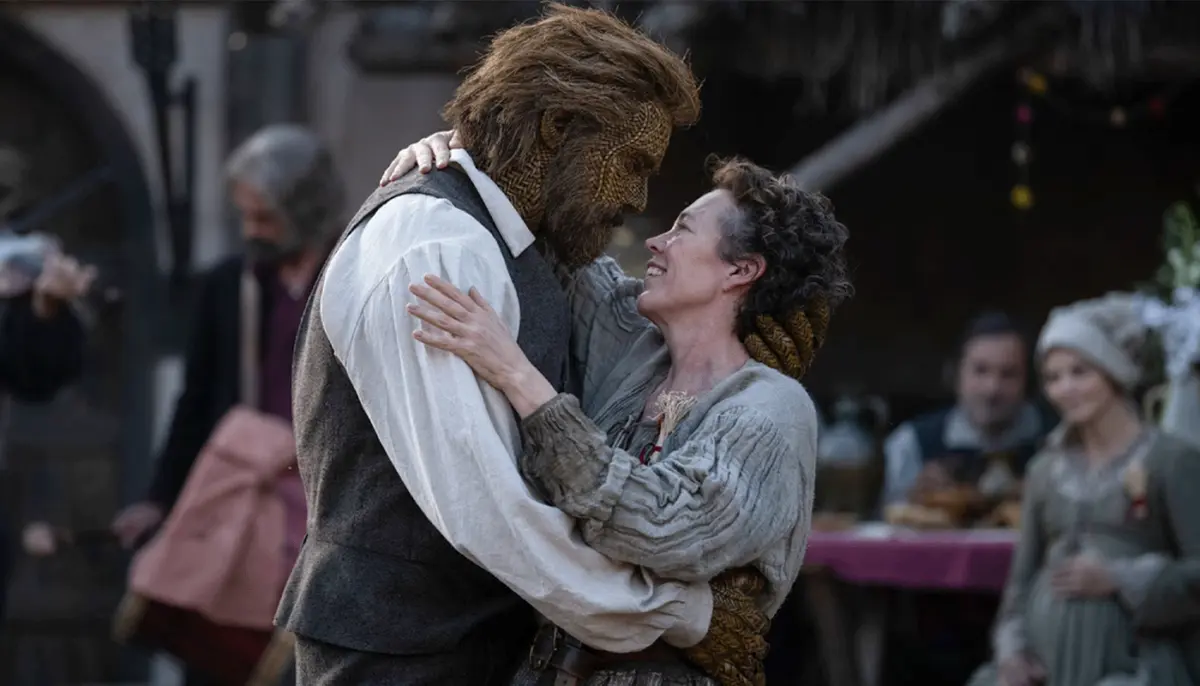
The arrival of the trailer for the upcoming feature film Wicker—instantly and playfully dubbed the "sexy Wicker Man movie" across social media channels—has reignited a broader cultural conversation regarding humanity’s age-old obsession with manufactured companions. While the film itself bears little resemblance to either the iconic 1973 British folk-horror classic or its universally maligned 2006 American remake (opting instead for a whimsical, romantic premise), it has unwittingly tapped into a fascinating mythological and literary lineage: the cinematic evolution of the "sexy golem."
In Wicker, a lonely fisherwoman living in a fairy-tale-esque village, portrayed by Academy Award winner Olivia Colman, enlists the help of Peter Dinklage to find a husband. Dinklage’s character obliges by delivering Alexander Skarsgård, who functions as a literal "wicker man"—a romantic partner woven from organic materials and entirely engineered to please his bride. The resulting trailer, complete with enthusiastic creaking noises and online speculation regarding wicker anatomy, highlights a notable cultural shift. For centuries, folklore and fantasy have treated artificial beings, constructs, and clay creations as protectors, monsters, or philosophical thought experiments. Today, however, popular culture has transformed them into romantic and sexual prospects.
This investigative cultural analysis explores the intersection of mythological folklore, modern romance literature, and classical archetypes like Pygmalion. By examining how contemporary storytelling subverts traditional gender dynamics—moving away from the male-creator/female-creation trope toward female-driven narratives of manufactured companionship—we can better understand why audiences are embracing the "sexy golem" era. Far from being a mere passing cinematic trend, this phenomenon reflects modern anxieties surrounding the loneliness epidemic, the rise of artificial intelligence companionship, and the eternal human desire for a partner designed exclusively for one’s own needs.
Read Also
Detailed Chronology: From Ancient Myth to the Silver Screen
The conceptual trajectory of the artificial companion did not begin in Hollywood writers’ rooms; its roots stretch back deep into ancient mythology, evolving steadily through centuries of literature before finding a home in contemporary cinema.
The Clay Foundations: Traditional Folklore
In traditional Jewish folklore, the golem is an animated anthropomorphic being fashioned entirely from inanimate matter, typically clay or mud. Unlike the organic, bespoke wicker husband of modern fiction, traditional golems were brought to life through divine intervention, sacred incantations, and the mystical application of Hebrew letters (such as Emet, meaning "Truth") invoking the power of the Kabbalah.
The most famous iteration of this lore is the legend of the Golem of Prague, purportedly created in the late 16th century by Rabbi Judah Loew ben Bezalel. According to the legend, the rabbi fashioned the giant to protect the Jewish ghetto of Prague from violent anti-Semitic pogroms and blood libel accusations. These early folkloric golems were decidedly unromantic, utilitarian, and tragic. They possessed no free will, could not speak, and were designed strictly as protectors or laborers. Once their protective duties were fulfilled, their life-giving inscriptions were erased, and they were rendered inert, often relegated to dark synagogue attics to sleep until the next crisis demanded their strength.
The Literary Evolution: Pratchett and Wecker
As storytelling evolved, fantasy and speculative fiction authors began to imbue these rigid archetypes with psychological depth, wit, and emotional capacity.
Sir Terry Pratchett revolutionized the concept within his satirical Discworld series, most notably in the 1996 novel Feet of Clay. Pratchett retained the traditional trappings—the sacred scrolls animating the clay, the heavy reliance on Yiddish nomenclature—but updated the entities for an industrial society. Pratchett’s golems are intelligent, hardworking, and philosophically minded. Characters like Dorfl the golem achieve legal personhood, join the City Watch, and engage in theological debates, calmly dismissing attempts at religious conversion by noting that lightning cannot harm a body made entirely of clay.
In contemporary literary fiction, Helene Wecker’s critically acclaimed 2013 novel The Golem and the Jinni introduced a romantic yet poignant dynamic. Wecker’s golem, Chava—a woman-shaped construct brought to New York City—finds herself navigating a complex, decades-long emotional and romantic relationship with a fire-born jinni named Ahmad. While Wecker’s work is not a "sexy golem" rom-com in the modern pulp sense, it deeply humanized the construct, exploring what it means to love, suffer, and belong when you are fundamentally "other."
The Modern Rom-Com and Cinematic Awakening
The twenty-first century marked a sharp pivot toward explicitly romantic and comedic interpretations of artificial constructs. Authors like Beth Kander (I Made It Out of Clay) and Jean Meltzer (Magical Meet-Cute) introduced premises where modern protagonists—frustrated with modern dating apps and societal pressures—literally sculpt or magic their ideal partners into existence.
Now, with the release of the Wicker trailer, this literary subgenre has officially breached the mainstream cinematic barrier. By swapping clay for wicker and casting Alexander Skarsgård as a literal, eager-to-please plant-matter husband for Olivia Colman’s character, cinema has fully embraced the trope of the bespoke, tailor-made romantic partner.
Supporting Context & Metrics: The Loneliness Epidemic and Digital Pygmalions
To fully appreciate why the "sexy golem" narrative resonates with modern audiences, one must examine the socio-cultural landscape from which it emerges. Contemporary society is currently grappling with a well-documented "loneliness epidemic," alongside an unprecedented explosion in artificial intelligence companionship, parasocial relationships, and customizable digital boyfriends and girlfriends.
The Pygmalion Paradigm in the Digital Age
The conceptual ancestor to the golem romance is Ovid’s Metamorphosis, which tells the story of Pygmalion, a Phoenician sculptor who becomes so disillusioned by the perceived flaws of real-world women that he carves an ivory statue of his ideal female partner—Galatea. Falling desperately in love with his creation, he prays to the goddess Venus, who brings the statue to life.
For millennia, the Pygmalion narrative has served as a cornerstone of Western storytelling, adapted through George Bernard Shaw’s Pygmalion, the musical My Fair Lady, and dark cinematic comedies like Ruby Sparks. However, cultural critics have long noted that the Pygmalion myth is rigidly gendered: it is almost universally the story of a male creator fashioning a female object of perfection who lacks independent agency or a voice of her own.
In the twenty-first century, this dynamic has manifested digitally. The multi-million-dollar industry surrounding AI companion apps (such as Replika, Character.ai, and various virtual partner platforms) allows users to program, customize, and converse with a synthetic lover tailored precisely to their emotional and psychological specifications.
The Genders Reversed: Agency and the Bespoke Partner
What makes the modern "sexy golem" trope—as seen in Wicker and recent romance novels—so distinct is that it inverts the traditional Pygmalion dynamic.
In these modern narratives, it is a woman who finds the pool of flesh-and-blood suitors wanting—not due to misogynistic isolationism, but out of exhaustion with patriarchal, transactional marriages and the societal stigma attached to female autonomy. Rather than inadvertently falling in love with a statue she sculpted, the female protagonist actively commissions, orders, or crafts a male partner to escape the trap of conventional domesticity.
Furthermore, these modern constructs are not silent Galateas. From Pratchett’s Dorfl to Wecker’s Chava and Skarsgård’s Wicker Husband, these artificial beings possess agency, humor, and distinct points of view. They force audiences to confront a central philosophical question: If a partner is custom-made for your exact needs, does their love hold genuine value, or is it merely a sophisticated form of self-reflection?
Official Statements & Industry Perspectives
Cultural commentators, literary critics, and filmmakers have increasingly weighed in on the cultural implications of manufactured romance in media, highlighting a dual perspective on the trend.
The Critique of Convenience: Escapism vs. Isolation
Sociologists and cultural critics have expressed concern over the growing appeal of ready-made, customizable romance. In an era where human connection is increasingly mediated by screens, algorithms, and artificial intelligence, the fantasy of a partner who is "delivered" or crafted to order can be viewed through a melancholy lens.
"When we look at the rise of ready-made partner tropes in modern fiction and film—whether it’s a wicker man built for marriage or an algorithmic chatbot designed never to disagree—we are seeing a symptom of profound social exhaustion," notes cultural theorist Dr. Elena Vance. "There is a fine line between healthy fantasy and a retreat from the difficult, messy compromises required by authentic human relationships."
The Feminist Subversion: Reclaiming the Myth
Conversely, literary analysts champion the subversion of the Pygmalion myth as a necessary and empowering storytelling evolution. By allowing female protagonists to commission or conjure their own companions, storytellers dismantle centuries of passive female tropes.
"For centuries, men have written stories where they sculpt the ideal woman who exists solely to validate them," explains romance historian Marcus Vance. "What we are seeing now with ‘golem romance’ and films like Wicker is a playful, sometimes biting reclamation of that power. Women are saying: What if we get to design the partner who meets our emotional and physical standards, and what if that partner actually has a voice?"
Future Outlook: What the Rise of the "Sexy Golem" Means for Cinema
As Hollywood continues to greenlight high-concept, genre-bending romantic comedies and satires, the success of films like Wicker will likely pave the way for more explorations of artificial and mythological companionship.
Several key trends are expected to shape this burgeoning cinematic subgenre over the coming years:
- Expansion of Queer and Non-Binary Narratives: While current iterations primarily focus on heterosexual dynamics (women commissioning male constructs), future speculative romance stories are primed to explore LGBTQ+ golems, gender-fluid constructs, and non-traditional domestic partnerships that further shatter archaic relationship molds.
- Satire of Tech and AI Culture: As public anxiety surrounding AI boyfriends and synthetic intimacy grows, filmmakers are uniquely positioned to use mythical constructs like golems and animated flora as satirical stand-ins for Silicon Valley’s promises of frictionless love.
- The Humanization of the Inanimate: Ultimately, the enduring appeal of the golem—from the defensive clay giant of Prague to Alexander Skarsgård’s comedic wicker husband—lies in its mirror to humanity. By exploring what it means to love something manufactured, storytellers continually interrogate what it means to be genuinely human.
According to Prague folklore, the Golem remains dormant in the synagogue attic, waiting for a time of ultimate need. As modern audiences navigate an increasingly disconnected digital landscape, the cinematic resurrection of the "sexy golem" suggests that our need for escapist fantasy, humor, and custom-tailored comfort has never been greater. Whether these whimsical creations are a symptom of modern loneliness or a joyful reclamation of ancient mythologies, one thing is certain: the era of the bespoke partner has arrived on the silver screen, and it is here to stay.





Comments
Facebook App ID not configured. Please add it in the Customizer.