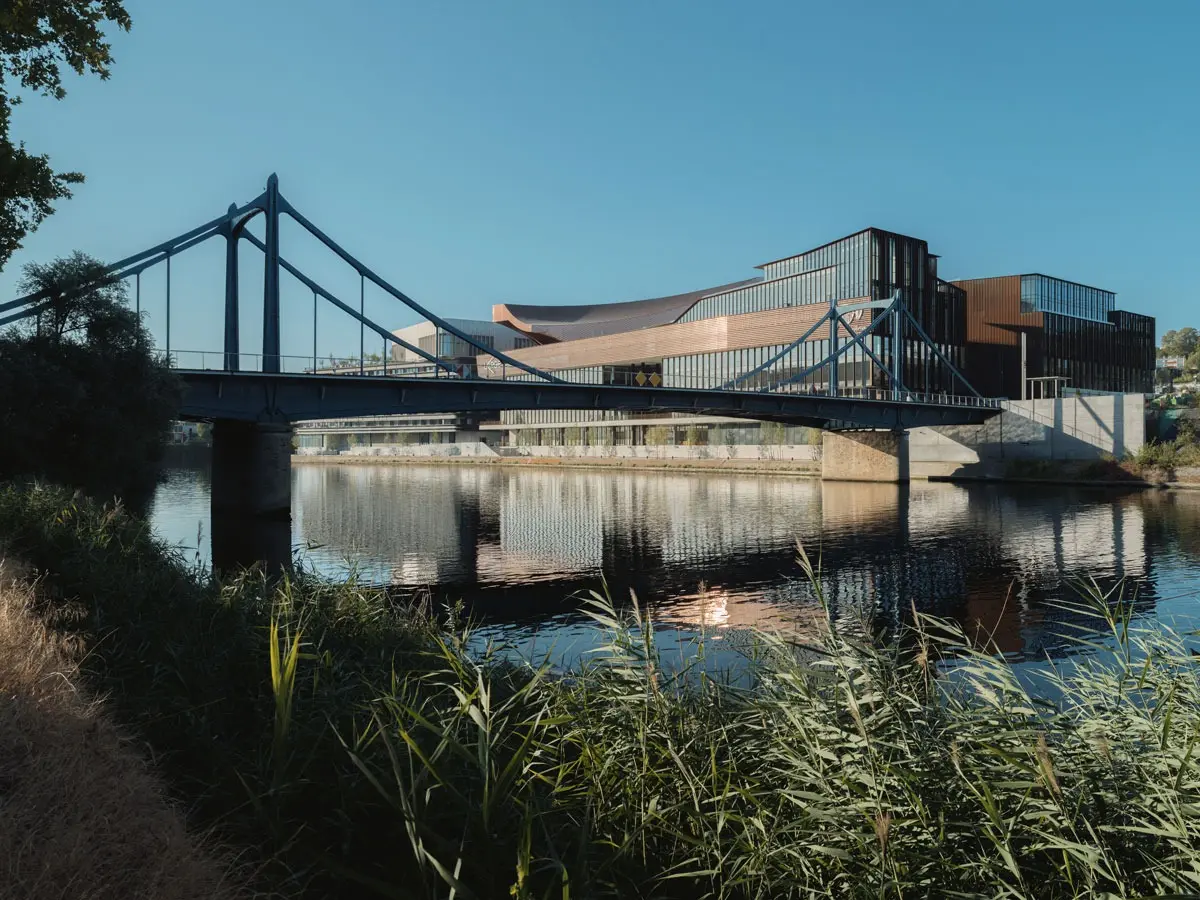
Parisian cultural geography has expanded to the west with the grand opening of Le Large, France’s newest contemporary art center. Situated on the historic, water-locked Île Seguin in Boulogne-Billancourt, Le Large represents a monumental €450 million ($504.5 million) cultural investment known as the Pointe des Arts development. Featuring a striking architectural design by Pritzker Prize laureates RCR Arquitectes, the center anchors a transformative chapter for an island whose identity was forged in the fires of 20th-century industrial manufacturing.
For decades, the site was dominated by the sprawling Renault factory, a monumental industrial fortress that employed thousands and outputted approximately 30 million vehicles. Today, the soot and assembly lines have been replaced by a shimmering, copper-colored anodized-aluminum facade designed to engage the public, foster community dialogue, and present world-class contemporary art.
Operated under a hybrid funding model led by collector Laurent Dumas and chaired by the Emerige Endowment Fund, Le Large operates with an estimated annual operating budget of €5 million ($5.6 million). To mark its historic debut, the institution has enlisted Cecilia Alemani—renowned curator of the 2022 Venice Biennale and director of High Line Art in New York—to curate its inaugural exhibition, "Moteur Imaginaire" (Imaginary Engine). Bringing together more than 100 works by 55 artists from 23 countries, the exhibition weaves the industrial ghosts of the Renault empire into contemporary creative discourse.
Detailed Chronology: From Industrial Titan to Cultural Frontier
The Renault Era: The Industrial Heart of Boulogne-Billancourt
To fully comprehend the significance of Le Large’s arrival, one must understand the profound history of Île Seguin. For the better part of the 20th century, the island was synonymous with French industrial might. The massive Renault factory dominated the landscape, serving as both a major economic engine for the western suburbs of Paris and a crucible for labor relations, social movements, and working-class identity. Day and night, trucks and barges ferried manufactured goods from its gates, cementing the island’s reputation as a hard-nosed temple of production.
When the factory finally ceased operations and was systematically dismantled, Île Seguin was left in a state of liminal suspension. For years, urban planners, politicians, and cultural figures debated the fate of the abandoned land. The vision for a cultural hub gradually took shape, culminating in the Pointe des Arts master plan—a multifaceted urban development project integrating a cinema, a luxury hotel, and public amenities alongside Le Large.
The Architectural Conception and Construction of Le Large
The physical realization of Le Large began with an ambitious architectural commission awarded to the Catalan studio RCR Arquitectes. Winners of the prestigious Pritzker Architecture Prize, the firm conceived a building that visually and conceptually dialogues with its aquatic and industrial surroundings.
The building features a distinctive, expanding geometry: its footprint measures a modest 5,382 square feet at the base, expanding outward to 16,146 square feet on its fifth floor. Encased in a warm, copper-colored anodized-aluminum facade composed of diamond-shaped, overlapping scales, the building directly references its name. In French, the idiom prendre le large translates to "heading out to sea" or "setting sail."
The Inaugural Launch: "Moteur Imaginaire"
Opening its doors with blockbuster ambition, Le Large launched its inaugural programming under the curatorial stewardship of Cecilia Alemani. Titled "Moteur Imaginaire," the exhibition functions as a conceptual bridge connecting the site’s automotive past with the boundless horizons of contemporary art.
Alemani collaborated closely with French designer Pascal Rodriguez to architect the exhibition layout across four sequential spaces. These zones are punctuated by partition walls featuring large, perfectly circular central apertures aligned along a single axis. The resulting perspective mimics the rhythm of an industrial assembly line, drawing visitors through a physical and metaphorical engine cylinder.
The exhibition gathers more than 100 works spanning from the 1930s to the present day. Approximately 50 of these pieces originate from the historic Renault art collection, which famously invited artists-in-residence—including Jean Dubuffet, Arman, Jean Tinguely, and Victor Vasarely—directly onto the factory floor during the 20th century. Complementing these historical artifacts are 17 newly commissioned contemporary works, archival photographs, and deeply personal homages by a younger generation of artists processing the island’s legacy.
Supporting Context & Metrics
Financial Architecture and Governance Model
Le Large operates on an innovative hybrid financial and administrative model designed to ensure long-term institutional resilience. The center is governed by a nonprofit association that manages an endowment fund, working hand-in-hand with a commercial entity tasked with overseeing venue rentals, commercial partnerships, and private events.
Total Cultural Development Cost: €450 million ($504.5 million) for the broader Pointe des Arts complex on Île Seguin.
Annual Operating Budget: Estimated at €5 million ($5.6 million).
Total Exhibition Space: 26,910 square feet distributed across multiple vertical levels.
Public Accessibility: Approximately 40 percent of the building’s public-facing ground and mezzanine spaces are entirely free to enter, emphasizing community integration.
Architectural Footprint: Ranges from 5,382 sq. ft. at the base to 16,146 sq. ft. on the fifth floor.
Navigating the Space: Architecture Meets Public Engagement
The journey to Le Large is intentionally immersive. Visitors traveling from central Paris take Métro Line 9 to its western terminus at Pont de Sèvres, followed by a scenic 15-minute walk or a five-minute bus ride onto Île Seguin.
Upon crossing the bridge, the dense urban fabric of Paris drops away, replaced by sweeping views of the Seine and the rolling hills of Meudon. Entering the building, visitors are greeted by a sun-drenched, open-concept ground floor featuring expansive seating arrangements, a curated bookshop, a concept store, and a monumental multipurpose staircase that doubles as an amphitheater.
Ascending via escalators to the fifth floor, visitors encounter two specialized public hubs designed by acclaimed designer Constance Guisset:
Extra Large: An 80-seat panoramic coffee shop serving seasonal gastronomy paired with sweeping views of the river.
Le Petit Atelier: A dedicated educational and creative workshop space tailored specifically for children aged six to ten.
Official Statements and Curatorial Vision
The philosophy underpinning Le Large bridges escapism, industrial heritage, and public accessibility. Paula Aisemberg, director of Le Large, shared her insights during an exclusive on-site interview with ARTnews ahead of the opening:
"The expression [prendre le large] resonates with the island setting and its relationship to the water. It conveys the possibility of escape, departure, and discovery."
Aisemberg also underscored the institution’s curatorial flexibility regarding its 26,910 square feet of gallery space:
"We will oscillate between a single exhibition that takes over the entire museum, as our opening show does, or having several shows running simultaneously, one on the fifth floor, another across the sixth and seventh floors. That will be the case for our second season."
Curator Cecilia Alemani expanded on the conceptual framework driving "Moteur Imaginaire," detailing how she sought to mirror the operational logic of the former factory within the gallery walls:
“[The display] follows the car on an imaginary journey, from the factory floor to the assembly line, out into the world as an object of desire, and finally into the algorithm. That metamorphosis, from mechanism to living organism, is what drives the whole exhibition.”
Alemani further elaborated on the industrial metaphor:
"For almost a century, the Île Seguin was home to the Renault factory, a fortress of production that turned out some 30 million cars: a machine for making machines. I wanted the exhibition to work the same way, as an assembly line for machines and for ideas."
Reflecting on her engagement with contemporary French creators, Alemani noted:
"Johanna Benainous learned that her grandfather had worked on the island. I met a generation that treats history as living matter. They went into the archives, sat with former workers, and came back with pieces that are urgent, tender, and very much their own."
Future Outlook: Positioning Within the Parisian Art Ecosystem
Le Large’s emergence on Île Seguin instantly draws inevitable comparisons to Paris’s other titan private museums founded by billionaires: Bernard Arnault’s Fondation Louis Vuitton and François Pinault’s Bourse de Commerce.
While all three institutions represent premier private philanthropic interventions in the French cultural landscape, their structural and curatorial DNA diverge significantly:
Fondation Louis Vuitton shares an architectural lineage with Le Large as a purpose-built contemporary structure, historically focusing on major international retrospectives and museum-scale scholarship.
Bourse de Commerce occupies a historic municipal building transformed by architect Tadao Ando, acting primarily as a showcase for François Pinault’s formidable private holdings.
Le Large, by contrast, establishes a hybrid identity. Rather than housing a permanent collection of its founder Laurent Dumas’s personal acquisitions, the center is engineered as a dynamic site for shifting, temporary contemporary art exhibitions paired with deep site-specific commissions.
Looking Ahead
As Le Large settles into its role as the cultural crown jewel of Boulogne-Billancourt, its long-term impact will be watched closely by the international art community. By successfully marrying private philanthropic vision with public accessibility—dedicating nearly half of its ground footprint to free community engagement—the institution offers a progressive model for contemporary art centers in the 21st century.
As curator Cecilia Alemani aptly summarized:
"Opening a new institution is always rare, and doing it on an island so charged with memory is a real privilege. The Renault factory was dismantled long ago, and today a brand-new building rises in its place, open to everyone. Le Large gives this extraordinary site back to the public, and ‘Moteur Imaginaire’ brings its stories back to life."




Comments
Facebook App ID not configured. Please add it in the Customizer.