
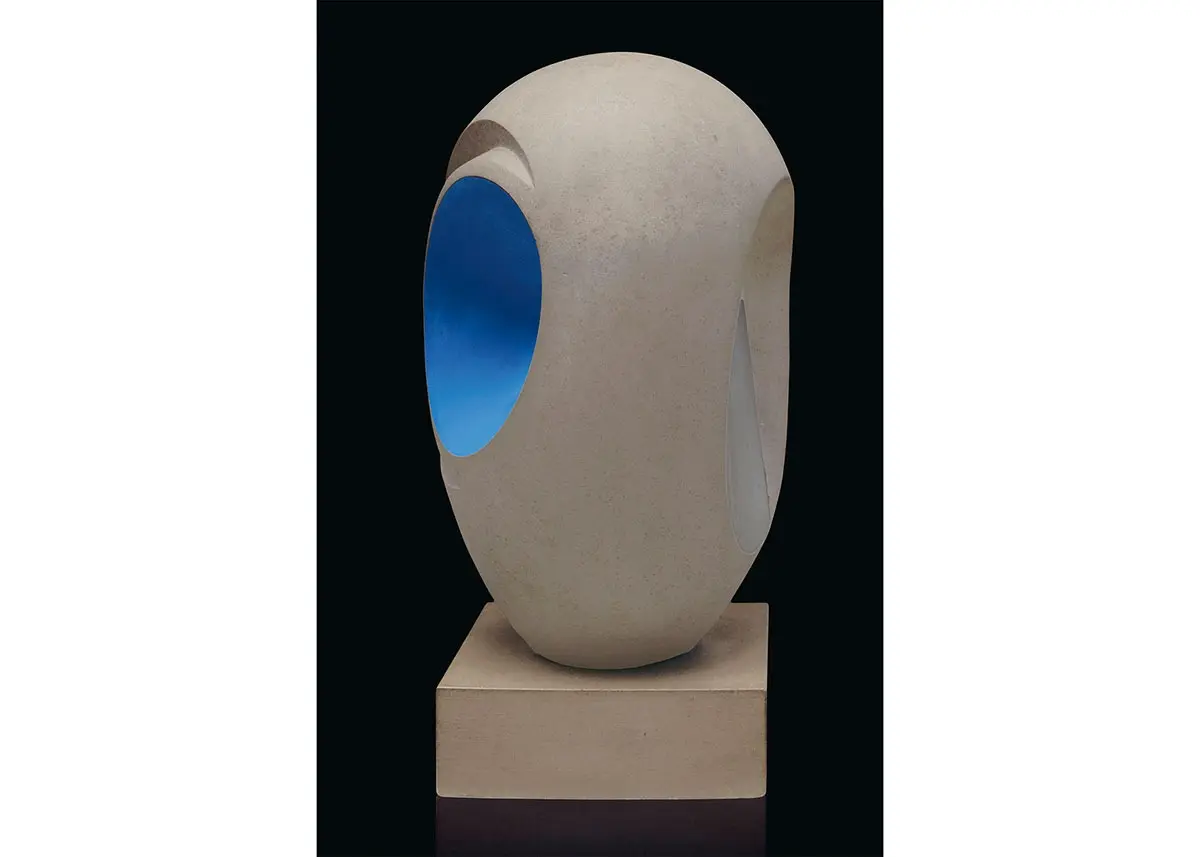
LONDON — In the upper echelons of the international art market, certain objects possess a gravitational pull that transcends their physical dimensions. Such is the case with Sculpture with Colour (Eos), a seminal mid-career masterwork by British modernist sculptor Barbara Hepworth. Fashioned in 1946 from a solitary block of Hopton Wood limestone, this compact, two-foot-tall egg-shaped marvel stands as a towering achievement in post-war sculpture.
On October 21, the piece will take center stage at Christie’s Modern British and Irish Art Evening Sale in London, carrying a robust pre-sale estimate of £5 million to £8 million ($6.6 million to $10.5 million). Its upcoming appearance at auction is not merely a commercial transaction; it is a cultural event that reunites the contemporary art world with a foundational artifact of 20th-century British modernism—one steeped in rich provenance, historic artistic friendships, and institutional prestige.
Executive Overview
The upcoming offering at Christie’s London headquarters represents a significant moment for collectors of modernist sculpture and institutional curators alike. Estimated at up to £8 million, Sculpture with Colour (Eos) is more than a valuable market commodity; it is a physical manifestation of Hepworth’s post-war psychological and artistic reckoning.
Read Also
Carved during a pivotal transitional era in British art history, the sculpture is celebrated for several pioneering breakthroughs within Hepworth’s oeuvre. Most notably, it stands as one of the very first works in which the artist deliberately integrated polychromatic paint into her stone carvings—a technique designed to evoke the infinite expanses of the cosmos, the depths of the ocean, and the limitless sky. Furthermore, its illustrious pedigree includes historical documentation by legendary war and portrait photographer Lee Miller, a prestigious exhibition history spanning nearly eight decades, and past ownership by some of the 20th century’s most discerning collectors, including American philanthropists David and Geraldine Pincus.
As the international art market continues to recalibrate around scarcity, museum-quality provenance, and historical significance, Sculpture with Colour (Eos) arrives as an irresistible anchor for the autumn auction season.
Detailed Chronology: From the Cornish Coast to the Global Stage
To fully comprehend the cultural weight of Sculpture with Colour (Eos), one must trace its journey across nearly eighty years of social, historical, and art-world transformations.
1939–1946: The Crucible of Cornwall and Post-War Renewal
The genesis of this masterwork is inextricably linked to a profound geographical and psychological shift in Barbara Hepworth’s life. In 1939, on the precipice of the Second World War, Hepworth, alongside her husband, fellow artist Ben Nicholson, and their young family, fled the vulnerability of London for the remote coastal landscape of Carbis Bay in Cornwall.
The rugged cliffs, tidal rhythms, and expansive skies of the Cornish coast provided a restorative sanctuary away from the Blitz. Yet, the war years were physically and emotionally demanding; stone was scarce, and materials were hard to come by. Despite these logistical hurdles, the Cornish landscape acted as a visual catalyst for Hepworth. It fundamentally reframed her understanding of organic forms, hollows, piercing, and the human relationship to the natural world.
By 1946, as Europe began the arduous process of rebuilding, Hepworth reached a triumphant creative zenith. It was in this charged atmosphere that she carved Sculpture with Colour (Eos) from a single piece of Hopton Wood stone—a dense, pale British limestone prized for its fossiliferous texture and fine grain.
1946–1949: Exhibitions, Lee Miller, and Vogue
Almost immediately upon its completion, the sculpture was thrust into the public eye. It served as a crown jewel in Hepworth’s first post-war solo gallery exhibition in 1946, signaling a bold new direction for British modernism.
Its cultural footprint expanded dramatically in 1948 when the pioneering American photographer, surrealist artist, and war correspondent Lee Miller visited Hepworth at her Carbis Bay studio. Miller, a close friend of the sculptor, captured an intimate, now-legendary series of black-and-white photographs that were subsequently published in the October 15, 1949, issue of American Vogue.
The resulting photograph is an extraordinary historical document. It presents Hepworth seated gracefully with her arms and legs crossed, surrounded by the domestic and creative detritus of her life: a delicate tea set rests in the foreground, a cat is curled comfortably on a couch, and Sculpture with Colour (Eos) sits purposefully on a nearby table. This juxtaposition of high avant-garde sculpture with the quiet, lived-in reality of a female artist working on the remote periphery of Britain offers a rare, humanizing window into Hepworth’s daily existence.
Shortly after Miller’s visit, Hepworth relocated down the coast to St. Ives—a move that cemented the town’s status as a mecca for international modernism. Today, her former home and studio there operates as the Barbara Hepworth Museum and Sculpture Garden, managed by the Tate.
1962–2016: The American Philanthropic Legacy
As Hepworth’s international reputation crystallized, her works began crossing the Atlantic, finding homes within elite American collections. In 1962, Sculpture with Colour (Eos) was acquired from the renowned Martha Jackson Gallery in New York by David and Geraldine Pincus, prominent American philanthropists and legendary modern art collectors based in Philadelphia.
The Pincuses were renowned for their uncompromising eye and deep commitment to post-war abstraction. Their collection was a testament to a golden age of patronage. Decades later, following the passing of the Pincuses, their estate dispersed several cornerstone works of 20th-century art. Most famously, the Pincus estate sent Mark Rothko’s monumental 1961 canvas Orange, red, yellow to Christie’s in 2012, where it fetched a staggering $86.9 million, setting an auction record that still reverberates through the market.
When Sculpture with Colour (Eos) itself came to the auction block at Christie’s in 2016, it sparked a fierce bidding war. Estimated modestly at $1.2 million to $1.8 million, the sculpture obliterated expectations, ultimately hammering down at $5.4 million to a savvy consignor who recognized its exceptional historical and aesthetic value.
Supporting Context & Metrics: Decoding Sculpture with Colour (Eos)
To understand why this specific sculpture commands a multi-million-pound valuation, one must analyze its physical characteristics, material innovation, and market positioning within Hepworth’s broader portfolio.
The Anatomy of an Icon
Standing at approximately two feet tall, Sculpture with Colour (Eos) is meticulously proportioned. The egg-shaped limestone body rests securely on a short, integrated platform, grounding its celestial and oceanic metaphors in solid architectural weight.
What elevates the piece from a traditional carving into a radical modernist statement is Hepworth’s use of interior color. The exterior of the Hopton Wood stone retains its natural, weathered limestone complexion, communicating the texture of the earth. However, three carefully carved, hollowed-out concave areas reveal interior planes painted in pale gray, off-white, and deep blue.
According to archival research and statements from Christie’s specialists, these pigments were not chosen at random. They are calculated chromatic interventions designed to evoke "the depths of the ocean, the boundless sky and the infinite reaches of the cosmos." By painting the interior recesses, Hepworth forced a dynamic dialogue between shadow and light, solid mass and illusory depth, interior sanctuary and exterior environment.
Market Performance and Comparative Valuations
Barbara Hepworth occupies a towering position in the global sculpture market, alongside contemporaries like Henry Moore and Alberto Giacometti. While Moore has historically commanded the highest figures for British sculpture at auction, Hepworth’s market has undergone a dramatic re-evaluation over the past decade. Institutional retrospectives—such as major exhibitions at Tate Britain, the Kröller-Müller Museum, and most recently, the Courtauld Gallery in London—have recalibrated critical and collector consensus regarding her radical contributions to carving and spatial abstraction.
The £5 million to £8 million ($6.6 million to $10.5 million) estimate for Sculpture with Colour (Eos) reflects both the current health of the top-tier modern British art market and the extreme scarcity of major 1940s polychrome works by the artist. Pieces from this critical decade rarely leave institutional holdings or blue-chip private collections, making the upcoming October 21 sale a rare acquisition window.
Official Statements and Curatorial Perspectives
The significance of the offering has been underscored by leadership at Christie’s, who emphasize the sculpture’s central place in the narrative of 20th-century art.
"Sculpture with Colour (Eos) has been at the heart of Hepworth’s story for 80 years," noted Alice Murray, Head of Modern British and Irish Art at Christie’s London. Murray highlighted the sculpture’s remarkable exhibition pedigree, pointing not only to its historical debut in Hepworth’s 1946 postwar solo exhibition but also to its prominent inclusion in the critically acclaimed summer exhibition Hepworth in Colour at the Courtauld Gallery in London.
That institutional endorsement—having the piece featured prominently in a museum survey just months prior to its sale—provides undeniable validation for prospective bidders. Curatorial validation of this caliber effectively functions as a gold standard for risk-averse collectors operating at the highest tier of the art market.
Future Outlook: Implications for the Autumn Auction Season
As the global art community turns its gaze toward the autumn sales in London, all eyes will be on Christie’s King Street saleroom on October 21. The performance of Sculpture with Colour (Eos) will serve as a vital bellwether for the resilience of the high-end modern British art market amid broader economic fluctuations.
In recent seasons, collectors have increasingly favored "flight-to-quality" strategies—allocating capital exclusively to blue-chip works with immaculate provenance, pristine condition reports, and deep art-historical relevance. By every metric, Sculpture with Colour (Eos) fits this exacting profile.
Whether the sculpture achieves its upper estimate of £8 million or shatters expectations entirely, its journey from the windswept cliffs of Carbis Bay to the pages of Vogue, through the hands of legendary American philanthropists, and finally to the auction podium, ensures its enduring legacy. For Barbara Hepworth, whose carved forms continue to teach us how to inhabit space, air, and color, this moment is a resounding reaffirmation of her status as an titan of modern sculpture.


Comments
Facebook App ID not configured. Please add it in the Customizer.