The American Library Association (ALA) conference is traditionally characterized by bustling exhibition halls, networking events, and lively professional discourse. However, for a dedicated cohort of educators, authors, and literary advocates—including Alison Goldberg, Kathy Choi, and the author—the recent trip to Chicago offered an opportunity to look beyond the immediate convention schedule. Spurred by an itinerary curated to balance professional obligations with historical exploration, these attendees set out to experience the Jane Addams Hull-House Museum and participate in the prestigious Jane Addams Peace Association Children’s Book Awards ceremony.
What began as a straightforward logistical plan quickly collided with the stark realities of metropolitan traffic management. Navigating a Friday afternoon arrival in Chicago proved to be an unexpected obstacle, underscoring the complexities of urban mobility during peak commuting hours. Yet, overcoming these transit hurdles ultimately opened the door to a deeply enriching immersion into American social history.
From exploring the progressive foundations of the Hull House—long recognized as a historical beacon for marginalized communities and progressive thought leaders—to reflecting on the broader implications of government surveillance through historical lenses, the journey transcended a routine conference side trip. This report chronicles the logistical challenges, the profound historical revelations uncovered during the museum tour, and the emotional resonance of the children’s book awards ceremony, all contextualized within the broader landscape of contemporary children’s literature and civil rights history.
Detailed Chronology: From Boston to the Hull House
Departure and Initial Optimism
The journey commenced at Boston’s Logan International Airport, where Kathy Choi and the author boarded a midday flight bound for Chicago’s O’Hare International Airport. Touching down at precisely 2:30 PM local time, the travelers felt a comfortable margin of error. Their destination was the Jane Addams Hull-House Museum tour, scheduled for 4:30 PM.
Operating under the assumption that a two-hour window was more than sufficient to transition from the airport, check into their downtown hotel, drop off heavy luggage, and make their way to the museum, the pair maintained an optimistic outlook. As seasoned travelers accustomed to managing tight conference schedules, they underestimated the specific kinetic energy of a Friday afternoon in the Midwest’s largest metropolis.
The Chicago Traffic Crucible
The illusion of a seamless transit schedule evaporated shortly after entering their Uber vehicle outside the terminal. Rather than cruising along the interstate, the vehicle immediately encountered the signature gridlock that defines Chicago’s vehicular arteries at the end of the workweek.
According to the local rideshare driver, the city’s traffic pattern is uniquely demanding. The congestion is not merely an end-of-the-day rush hour; it is a persistent snarl that blankets the urban core from Monday through Friday, kicking off aggressively as early as 2:00 PM. Compounding the travelers’ surprise was a counter-intuitive phenomenon: incoming highway traffic heading directly into the city center was just as heavily bottlenecked as outbound commuter lanes.
Having previously visited Chicago numerous times to visit her daughter at Northwestern University in Evanston—where transit times typically hovered around a predictable one-hour window—the author quickly realized that standard travel assumptions did not apply to downtown Friday gridlock. To bypass the paralyzed interstate arteries, the resourceful driver took to the local side streets. Weaving through neighborhood corridors and surface roads, the vehicle navigated a labyrinth of urban bypasses, turning what should have been a straightforward highway commute into an impromptu tour of Chicago’s neighborhoods.
Arrival at the Hull House
Despite the delays, precise navigation and a healthy dose of persistence paid off. The travelers arrived at the Jane Addams Hull-House Museum just in time to join the heavily attended public tour.
The museum, situated on the campus of the University of Illinois at Chicago, occupies two of the original thirteen buildings of the historic settlement house complex: the resident’s dining hall and the Hull Mansion. Stepping across the threshold immediately transported the visitors from the frantic pace of modern Chicago traffic into the contemplative, radical history of the late 19th and early 20th-century social reform movement.
Historical Context & Analytical Insights: The Legacy of Hull House and Surveillance
A Progressive Safe Haven
The guided tour provided deep insights into the foundational ethos established by Jane Addams and Ellen Gates Starr when they opened the settlement house in September 1889. Designed to provide social and educational services to working-class people and recent European immigrants, Hull House operated as an incubator for progressive reform, labor rights, and women’s suffrage.
Of particular note during the tour was the revelation regarding the institution’s inclusive culture. Long before contemporary mainstream protections were codified, Hull House functioned as a remarkably safe space for queer individuals and non-conformist intellectuals. It attracted a diverse mosaic of thinkers, artists, pacifists, and labor organizers who challenged the prevailing socioeconomic norms of the Gilded Age.
The Shadow of State Surveillance
This very diversity of thought, however, made the settlement house a subject of intense scrutiny. The tour highlighted how federal authorities—specifically the Federal Bureau of Investigation (FBI) and its predecessor agencies—kept a close and continuous watch on Hull House participants. Government officials viewed the convergence of radical intellectuals, pacifists, and labor activists not as a manifestation of democratic free speech, but as a potential threat to institutional stability.
This historical reality sparked deeper reflections on state surveillance, connecting the experiences of Hull House pioneers to subsequent generations of American activists.
+-------------------------------------------------------------------+
|               EVOLUTION OF STATE SURVEILLANCE                    |
+-------------------------------------------------------------------+
|  Era        | Target / Institution      | Primary Motivator       |
+-------------+---------------------------+-------------------------+
| Late 1800s  | Hull House / Reformers    | Diversity of Thought /  |
|             |                           | Labor Activism          |
+-------------+---------------------------+-------------------------+
| Pre-WWII    | Yuri Kochiyama Family     | Middle-Class Status in  |
|             | (San Pedro, CA)           | White Neighborhood /    |
|             |                           | Fish Business           |
+-------------+---------------------------+-------------------------+
| Mid-1900s   | Malcolm X & Associates    | Civil Rights Advocacy   |
+-------------------------------------------------------------------+
Drawing parallels from her own historical picture book research—specifically Postcards from Malcolm X: How Yuri Kochiyama Became a Civil Rights Activist—the author noted striking similarities in how federal intelligence agencies monitored progressive figures.
For instance, historical records reveal that the FBI covertly rented a house directly across the street from the family home of civil rights activist Yuri Kochiyama in San Pedro, California, years before the outbreak of World War II. The justification used by the surveillance apparatus was tenuous at best: Kochiyama’s father operated a wholesale fish business, which elevated the family into a middle-class economic bracket that allowed them to reside in a predominantly white neighborhood. This historical precedent raises persistent, probing questions regarding the operational scope, motivations, and civil liberties implications of federal surveillance programs throughout American history.
The Jane Addams Children’s Book Awards Ceremony
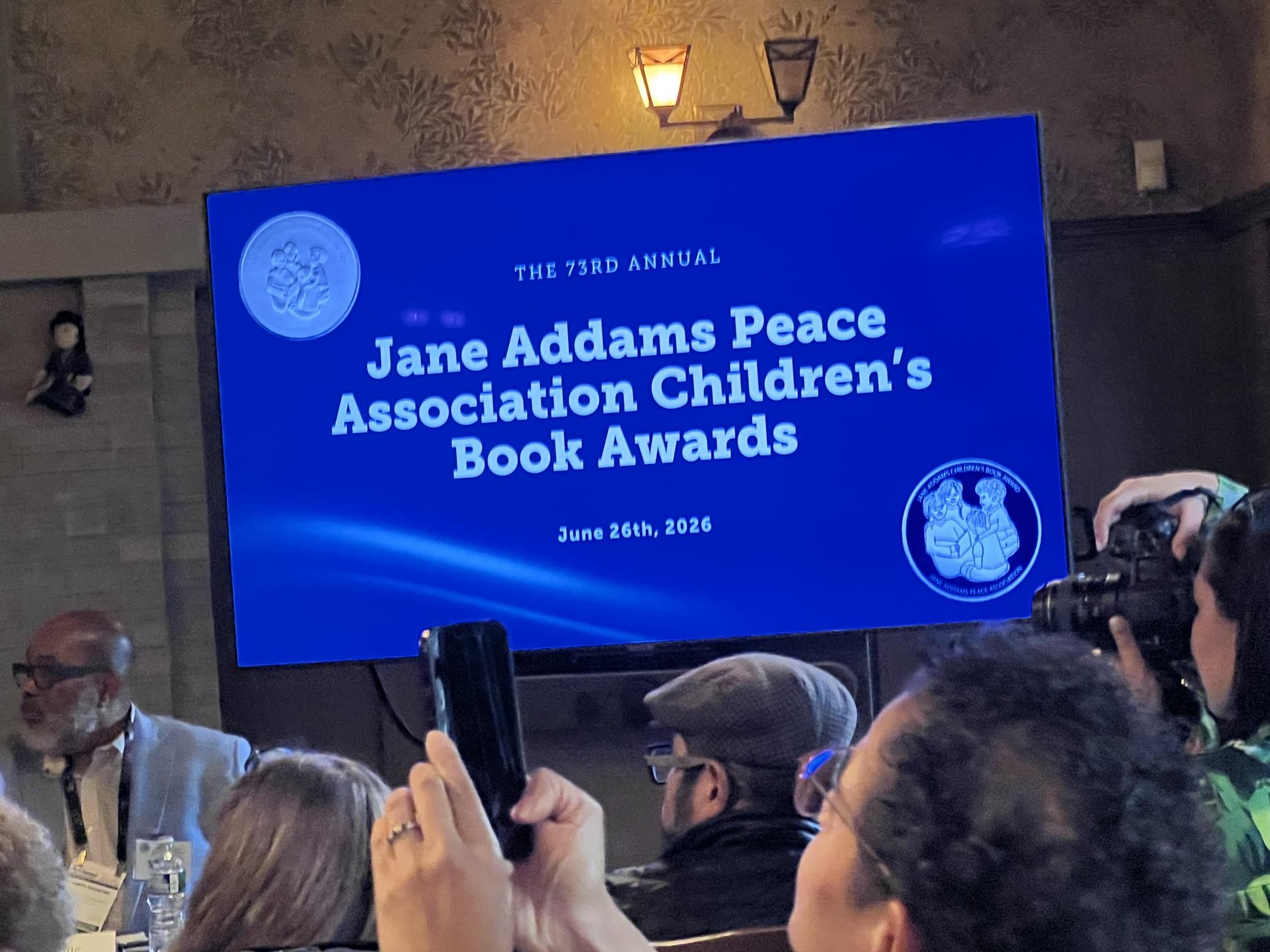
Shifting from historical analysis to contemporary celebration, the evening transitioned to the main literary event: the Jane Addams Peace Association Children’s Book Awards ceremony.
The annual awards recognize children’s books of exceptional literary and artistic merit that effectively engage children in thinking about peace, social justice, global community, and equity. The event proved to be a vibrant gathering of creators, publishers, and educators dedicated to fostering empathy and critical thinking through literature.
Highlights of the Ceremony
Author Testimonials: Attendees were treated to deeply moving speeches by winning and honor authors who shared the personal motivations behind their writing.
The Stories Behind the Stories: Hearing the creative genesis of each title provided context that transformed how readers viewed the final published works.
Community Engagement: The palpable enthusiasm of the audience underscored the vital role that children’s literature plays in navigating complex social issues with young readers.
Reflecting on the evening, the consensus among the attendees was clear: enduring the Chicago traffic snarl was a minor inconvenience compared to the intellectual and emotional rewards of witnessing the ceremony firsthand.
Official Perspectives and Statements
While the trip combined personal narrative with professional exploration, leaders within the children’s literature and library advocacy spaces have frequently commented on the significance of awards like those given by the Jane Addams Peace Association.
"Books recognized by the Jane Addams Children’s Book Awards serve as essential navigational tools for the next generation. They do not shy away from difficult truths; instead, they provide young readers with the vocabulary of peace, equity, and social responsibility necessary to build a more just society."
— Excerpt from Jane Addams Peace Association advocacy guidelines.
Furthermore, library science professionals attending the ALA conference emphasized the increasing importance of preserving historical institutions like Hull House. In an era where educational curricula face intense public scrutiny, physical touchstones of social reform serve as vital anchors for experiential learning.
Future Outlook: Literature, History, and Advocacy
As the literary community looks toward upcoming conferences and publishing seasons, the intersection of historical education and contemporary children’s literature remains more critical than ever. Works that explore the roots of social activism—ranging from biographies of civil rights pioneers to examinations of sustainable agriculture and free speech—continue to shape how educators approach civic education.
The journey to the Jane Addams Hull-House Museum and the Peace Association Book Awards serves as a microcosm of the broader mission of children’s literature advocates: to seek out truths, challenge institutional complacency, and ensure that the historic struggles for equality and justice are communicated effectively to future generations. Despite the hurdles posed by urban transit and the sobering historical reminders of state surveillance, the overarching takeaway is one of enduring resilience, intellectual curiosity, and creative celebration.











Comments
Facebook App ID not configured. Please add it in the Customizer.