
Executive Overview
For millions of devoted readers, the dedicated e-reader—most notably Amazon’s ubiquitous Kindle—remains the gold standard for long-form literary immersion. Designed with ergonomic precision for extended sofa sessions, bed-time reading, and lazy afternoons, traditional e-readers excel at replicating the feel of physical paper without digital eyestrain. Yet, they possess a glaring, inherent flaw in today’s hyper-mobile lifestyle: they simply do not fit in your pocket.
Because standard e-readers are typically left behind during brief transitions—such as a morning subway commute, a frustrating queue at the bank, or a lingering wait in a physician’s office—most modern consumers resort to reaching for their smartphones. This reflexive habit exposes them to a barrage of distracting notifications, blue light, and social media rabbit holes.
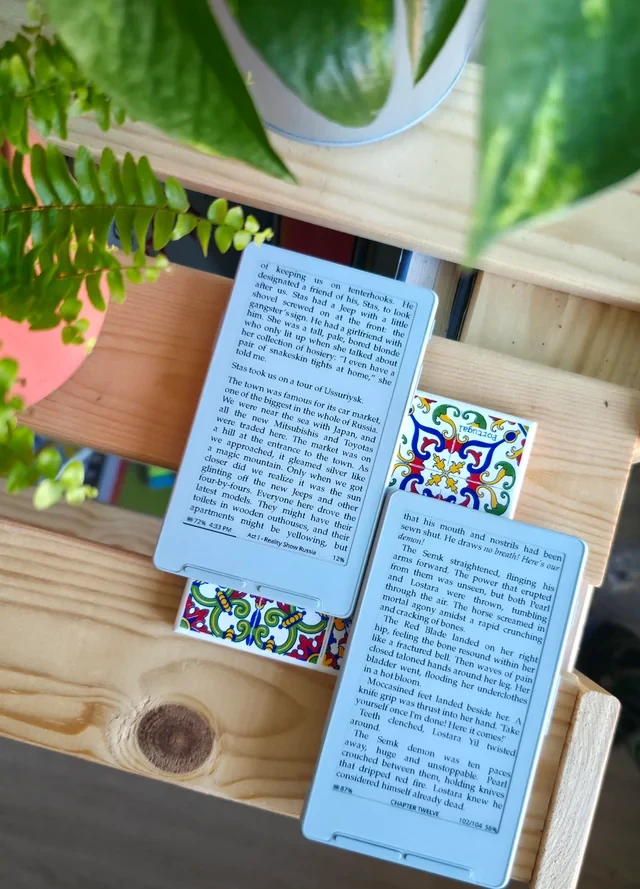
Enter the XTEINK X3, an ultra-minimalist, pocket-sized E Ink reader engineered specifically to bridge this gap. Weighing a mere 58 grams and measuring an astonishing 5.1 millimeters in thinness, the X3 introduces a novel form factor to the consumer electronics market. It features a magnetic mounting system that attaches flush to the back of a compatible smartphone, allowing users to seamlessly transition between reading on-the-go and detached, standalone use. Rather than positioning itself as a disruptive Kindle killer, the X3 establishes a new product category: the hyper-portable micro-reading companion designed to reclaim the fragmented, fleeting moments of the modern day.
Read Also
Detailed Chronology: The Evolution of Micro-Form Factor E-Readers
The journey toward ultra-compact reading devices has been a gradual evolution within the niche e-reader sector. For years, manufacturers chased larger, more expansive screens, pushing past 7 inches, 8 inches, and even 10 inches to accommodate PDFs, manga, and note-taking capabilities. However, a parallel demand quietly festered among minimalist readers and digital minimalists seeking relief from smartphone addiction.
The Rise of XTEINK’s Lineup
XTEINK positioned itself at the forefront of this micro-reading renaissance by developing a tiered ecosystem of pocket-friendly E Ink devices. The product roadmap systematically addressed different user preferences across three primary models:

- The X3 (The Ultra-Lightweight Pioneer): Designed for maximum portability, weighing 58g with a 3.7-inch display, physical page-turn buttons, and a focus on stripped-down, distraction-free reading.
- The X4 Classic (The Balanced Intermediary): Scaling up slightly to a 4.3-inch screen, dual-side page-turn buttons, and a weight of 68g, offering extended screen real estate while retaining pocketability.
- The X4 Pro (The Feature-Rich Flagship): Maintaining the 4.3-inch display while introducing a responsive touchscreen and an adjustable warm/cool front light system. Weighing 72g, the X4 Pro captured widespread industry recognition, earning a coveted spot as one of TIME’s Best Inventions of 2026.
The Promotional Horizon (October 2026)
To capture market share ahead of the critical year-end holiday shopping season, XTEINK rolled out an aggressive promotional schedule in late October 2026. Running explicitly from October 21 to October 31, the promotional window featured targeted discounts across the X3 and X4 Classic lines. Specifically, the X3 received a 13% price reduction starting October 24, bringing its retail price down to approximately $69 USD in North American markets, with parallel deals echoing across Amazon and direct-to-consumer channels.
Supporting Context & Metrics: Hardware Specifications and Ecosystem Realities
To understand the operational scope of the XTEINK X3, one must examine its technical architecture, design compromises, and software limitations. The device is not a general-purpose Android tablet; rather, it is a single-purpose reading tool stripped of unnecessary bloatware to maximize battery efficiency and physical lightness.
Technical Specification Matrix
| Feature | XTEINK X3 Specification |
|---|---|
| Display Technology | E Ink panel with 259 PPI resolution |
| Screen Size | 3.7 inches |
| Dimensions | 97.6 × 63.7 × 5.1 mm |
| Weight | 58 grams |
| Input Controls | Physical page-turn buttons and innovative "shake-to-turn" sensor |
| Battery Capacity | 650mAh (Estimated 10 to 14 days based on 1–3 hours of daily reading) |
| Storage Capacity | 16GB microSD card included (Expandable up to 256GB) |
| Connectivity | 2.4 GHz Wi-Fi and Bluetooth |
| Front Light / Touchscreen | None (Relies on external light or separate magnetic accessory) |
| File Format Support | EPUB and TXT (Native); PDF and MOBI require companion app conversion |
Design and Ergonomics
Measuring just under 10 centimeters in length and barely thicker than a credit card stack, the X3’s primary engineering triumph is its physical footprint. Users can manipulate the device entirely with one hand. Whether holding onto a crowded bus handrail or balancing a coffee cup, the inclusion of physical page-turn buttons—supplemented by an intuitive "shake-to-turn" gyroscope mechanism—ensures effortless navigation.
However, prospective buyers must navigate certain hardware compromises. The omission of a built-in front light means that reading in dim environments requires an external light source, prompting XTEINK to offer a proprietary magnetic reading light as a separate accessory. Furthermore, the magnetic attachment system relies on adhesive metal rings. Users are strongly advised to test the magnetic fit with their specific phone cases before committing to daily carry.
The Content Ecosystem Dilemma
For existing Kindle owners, transitioning to the X3 requires an adjustment in digital library management. The device operates entirely outside the Amazon ecosystem. Books purchased directly from the Kindle Store are protected by Digital Rights Management (DRM) native to Amazon hardware and apps, rendering them incompatible with XTEINK’s proprietary architecture.

Instead, the X3 relies on a streamlined, closed-loop workflow:
- Direct Format Support: The device reads EPUB and TXT files natively.
- Conversion Protocols: Legacy files such as PDF and MOBI must be converted via the official XTEINK mobile application to ensure optimal text rendering.
- Transfer Methods: Files can be pushed wirelessly via Wi-Fi through the XTEINK companion app or loaded physically onto the expandable microSD card slot.
Crucially, the X3 does not support third-party reading applications, keeping its interface strictly limited to local file playback.
Official Statements and Industry Insights
Industry analysts have noted that the launch of micro-E Ink devices reflects a broader psychological shift among consumers suffering from digital fatigue. Markus Reily, a technology and hardware expert specializing in compact consumer tech, emphasizes the psychological benefit of form-factor specialization:
"Many readers already own a fully-featured e-reader, but convenience dictates behavior. When a device is too large to slip into a casual pocket, it loses the battle against the smartphone. The X3 doesn’t attempt to dethrone the Kindle for home reading; instead, it successfully targets the micro-moments of daily life where doom-scrolling usually wins. By offering an E Ink screen that lives on the back of your phone, XTEINK has engineered a practical defense against digital distraction."
Market observers also point out that while devices like the X4 Pro capture headlines with touchscreens and adjustable warm/cool lighting systems, the ultra-lightweight X3 remains the purest expression of the minimalist design philosophy. By shedding excess weight and complex backlighting layers, it achieves exceptional structural thinness and battery longevity that heavier hybrid devices cannot replicate.

Future Outlook: The Viability of Micro-E Ink in a Smartphone-Dominated Era
As the consumer electronics market continues to mature, the tension between hyper-connected smartphones and dedicated single-purpose devices is intensifying. While smartphones grow increasingly powerful, their screens remain fundamentally unsuited for comfortable, glare-free reading under direct sunlight, and their notification streams actively fragment human attention spans.
The success of the XTEINK X3 and its sibling models—the X4 Classic and the award-winning X4 Pro—signals a growing consumer appetite for modular, task-specific technology. Rather than demanding that users carry an entirely separate bag or pouch for digital media, accessories that integrate directly with existing hardware (such as magnetic phone-back attachments) represent a frictionless pathway to adoption.
Looking ahead, the evolution of micro-E Ink technology will likely hinge on three critical developments:
- Broader Ecosystem Interoperability: Easing the friction of file conversion and expanding support for open-source library platforms.
- Advanced Display Efficiency: Achieving higher resolutions and integrated front lighting without compromising the ultra-thin profiles that make these devices attractive in the first place.
- Universal Magnetic Standards: Ensuring that modular accessories can adapt seamlessly across rapidly changing smartphone form factors and case designs.
For now, the XTEINK X3 carves out a vital, highly specialized niche. It serves as a gentle reminder that technology does not always need to do more to be valuable; sometimes, doing one specific thing exceptionally well—while fitting quietly in the palm of your hand—is more than enough.



Comments
Facebook App ID not configured. Please add it in the Customizer.