
By the Tech & Consumer Affairs Desk
Executive Overview
In the fast-evolving landscape of consumer electronics, unboxing a newly purchased gadget has historically been a ritualistic experience defined by peeling back plastic, unrolling protective sleeves, and unspooling tightly bound cables. However, a silent shift has swept through the industry over the past several years, driven ostensibly by environmental initiatives and corporate optimization. Leading the charge into a minimalist, stripped-down packaging era is retail giant Amazon, whose latest release of the 13th-generation Kindle line of e-readers has fundamentally upended customer expectations.
For the first time in the history of the world’s most popular e-reader family, the entire 13th-generation lineup—spanning the base Kindle, the Kindle Paperwhite, the Kindle Colorsoft, various Signature Editions, and the newly introduced aluminum back-plate models—ships entirely without a USB-C charging cable in the box. Even premium accessory bundles that include wall chargers and custom cases omit the standard charging cord.
Read Also
This omission would perhaps be easier for consumers to digest if it were accompanied by steady pricing. Instead, the 13th-generation rollout has introduced staggering price hikes ranging from $30 to $60 per device compared to their 12th-generation predecessors. Predictably, this combination of soaring retail prices and stripped-down box contents has ignited a wave of consumer frustration. Critics and loyal Kindle users alike have accused Amazon of "nickel-and-diming" its user base, transforming what should be a celebratory hardware upgrade into a frustrating exercise in hidden costs.
As regulatory bodies globally scrutinize electronic waste and corporate sustainability claims, Amazon’s move sits at a precarious intersection of ecological justification and profit-margin optimization. This in-depth report examines the rollout of the 13th-generation Kindle accessories controversy, the financial implications for buyers, the company’s official justifications, and what this signals for the future of consumer tech unboxing.
Detailed Chronology of the 13th-Generation Kindle Rollout
The seeds for this unboxing controversy were planted quietly in the months leading up to the official hardware announcements. As supply chain pressures evolved and regulatory frameworks surrounding electronic waste tightened across the European Union and North America, tech giants began experimenting more aggressively with "slim-box" initiatives.
The October 2026 Launch Phase
The tipping point arrived in October 2026. Amazon officially unleashed its 13th-generation Kindle portfolio, introducing a wave of fresh models designed to capture both entry-level readers and tech enthusiasts. The lineup included:
- The redesigned base Kindle.
- New vibrant colorways such as Ube and Graphite.
- The premium Kindle Aluminum series featuring a robust metal backplate.
- The long-awaited next iterations of the Kindle Paperwhite and the groundbreaking Kindle Colorsoft.
Anticipation was high. Early reviews praised the screen clarity, improved battery efficiencies, and the sleek new aesthetic profiles of the aluminum builds. However, as the first wave of devices arrived on doorsteps globally, online forums, review boards, and customer service chat logs lit up with a common point of confusion: Where is the cable?
Discovering the "Slim" Reality
Buyers unboxing their newly released 2026 models—whether a base Kindle or a top-tier Paperwhite Signature Edition—discovered that the packaging intentionally contained only two items: the e-reader itself and a minimalist quick-start guide. Gone was the familiar coiled white or black USB-C cable tucked neatly beneath the device tray.
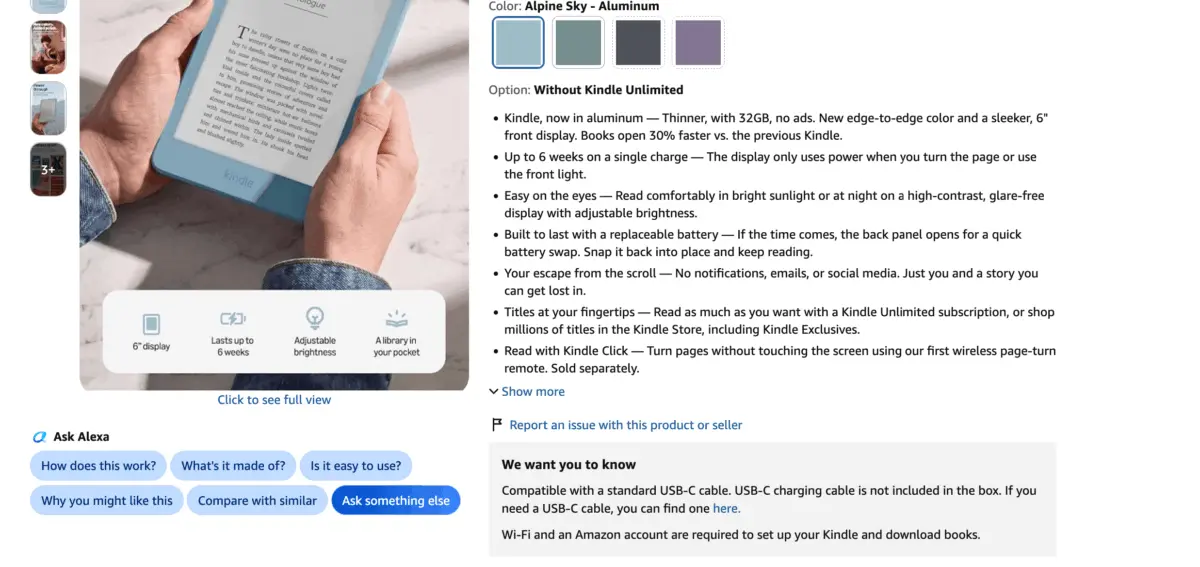
Realizing that this was not a packaging oversight or a localized factory error, consumers rushed to check Amazon’s official product pages. There, newly updated, straightforward notices awaited them. Amazon had quietly integrated a dedicated disclosure box across its retail listings, explicitly stating:
"We want you to know: Compatible with a standard USB-C cable. USB-C charging cable is not included in the box. If you need a USB-C cable, you can find one here."
Simultaneously, to address the immediate demand for standalone connectors, Amazon quietly launched an official branded USB-C to USB-C cable on its storefront on October 1st, 2026. This tactical release confirmed what consumer advocates had suspected: the omission of the cable was a calculated, systemic policy change implemented across the entire product ecosystem.
Supporting Context & Metrics: The Cost of Going Cable-Free
To fully understand the scale of the backlash, one must examine the macroeconomic and microeconomic realities facing the modern e-reader buyer. The controversy is not merely about a missing piece of wire; it is a question of value proposition.
Price Hikes Meet Bare-Bones Boxes
When comparing the 12th-generation Kindle models to the current 13th-generation ecosystem, price points have escalated dramatically. Depending on the specific tier and features selected, consumers are facing price surges between $30 and $60 per device.
When a consumer invests heavily in a premium piece of hardware—particularly devices marketed as complete, self-contained reading solutions—expectations scale accordingly. Removing a component as fundamental as a charging cable while simultaneously raising hardware costs creates a stark psychological disconnect. To the average buyer, the omission feels less like an environmentally conscious choice and more like a hidden tax on hardware ownership.

The Global Disparity of Standalone Cable Costs
For those users who genuinely do not possess a compatible USB-C cable (a demographic smaller than Amazon assumes, but certainly inclusive of elderly users, children receiving their first e-reader, or switchers from older micro-USB ecosystems), acquiring a replacement cable introduces an unexpected logistical and financial hurdle.
Amazon’s official replacement cables come with their own set of controversies regarding regional pricing:
- United States: Available for $4.99. While relatively inexpensive, it represents an unwanted post-purchase add-on fee for a device that already costs significantly more than its predecessor.
- Canada: Priced at a staggering $16.99 CAD. This steep markup shocked Canadian consumers, turning a minor inconvenience into an exorbitant localized surcharge.
The Wireless Workaround for Signature Editions
Amazon has pointed out that owners of certain 13th-generation Signature Editions—such as the Paperwhite Signature or Colorsoft Signature—have alternative charging pathways available. These models support wireless charging docks and proprietary pogo-pin dock accessories, allowing users to bypass cables entirely.
However, critics point out that this defense falls flat for two reasons:
- Wireless charging docks and pogo-pin accessories are significantly more expensive than a basic USB-C cable, often retailing upwards of $30 to $50.
- Base models and non-signature variants do not support wireless charging, leaving wired power delivery as the sole mechanism for keeping the device operational.
Official Statements and Corporate Rationale
Amazon’s official stance mirrors a broader corporate trend pioneered by smartphone giants like Apple and Samsung. When these mobile titans began removing chargers and cables from their packaging years ago, the justifications centered almost universally on two pillars: environmental sustainability and consumer redundancy.
The Environmental Argument: Reducing E-Waste
From a corporate communications perspective, Amazon frames the exclusion of USB-C cables as a vital step in minimizing global electronic waste. The rationale goes as follows:
- Billions of USB-C cables are already in circulation globally, driven by the widespread adoption of the USB-C standard across smartphones, tablets, laptops, and gaming accessories.
- Including a new cable with every single device sold results in millions of redundant cords sitting unused in junk drawers, eventually degrading or ending up in landfills.
- Smaller packaging footprints allow for more efficient shipping logistics. By shrinking the box size, Amazon can fit more units onto cargo planes, freight trucks, and delivery vans, thereby reducing the carbon footprint associated with global distribution.
The Consumer Redundancy Assumption
Amazon’s operational thesis relies on the assumption that the vast majority of Kindle buyers are already technologically integrated. The product listings explicitly note that the device works with "a standard USB-C cable," implying that households are saturated with compatible wires.
Furthermore, during the initial device setup, Amazon mandates both Wi-Fi connectivity and an active Amazon account to register the e-reader and download books. The company infers that a consumer capable of managing a modern Wi-Fi network and a digital account profile inevitably possesses at least one USB-C power source.
The Counter-Argument: A Thin Green Veil
Consumer advocacy groups and tech analysts have pushed back against these justifications, labeling the move as "greenwashing"—using environmental language to mask profit-driven motives. Critics raise several valid counter-points:
- Price Disconnect: If Amazon truly removed the cable to reduce manufacturing and packaging costs in the name of sustainability, those savings should logically be passed down to the consumer. Instead, prices jumped by $30 to $60.
- The Marginal Cost Myth: A standard USB-C cable costs pennies to manufacture at scale. Removing it yields negligible environmental savings compared to structural changes in device manufacturing, yet its absence forces consumers to purchase replacements separately—generating additional packaging, shipping materials, and individual transit emissions if ordered ad-hoc.
Future Outlook: Where the E-Reader Industry Goes From Here
The 13th-generation Kindle controversy serves as a bellwether for the consumer electronics industry at large. As hardware manufacturers search for new avenues to protect profit margins against rising inflation, supply chain volatility, and material costs, unboxing experiences are undeniably becoming more austere.
Will Competitors Follow Suit?
Rivals in the e-reader and e-paper space—such as Kobo, Boox, and PocketBook—will be watching Amazon’s customer retention metrics closely. If Amazon successfully weathers this consumer revolt without sustaining meaningful drops in Kindle adoption, competitors may feel emboldened to adopt similar unboxing policies to shave down production costs and streamline logistics.
Conversely, if the backlash translates into sustained negative public relations, abandoned shopping carts, or increased regulatory scrutiny regarding bundled hardware essentials, rival brands might use the inclusion of a full accessory suite as a key market differentiator.
The Regulatory Horizon
Governments are increasingly casting a legislative eye on consumer tech packaging. While current European Union regulations have successfully forced the universal adoption of USB-C charging ports to reduce waste, future mandates could theoretically target what manufacturers are required to include inside the box. If consumer frustration reaches critical mass, lawmakers may eventually debate whether essential power delivery accessories constitute an inseparable part of a functional electronic device.
Final Thoughts for Consumers
For the everyday reader looking to upgrade their digital library device, the 13th-generation Kindle lineup presents a frustrating new normal. The days of opening a self-contained gadget box ready for immediate operation out of the box are officially waning.
As the dust settles on the 2026 launch, the message to buyers is clear: check your junk drawers before you check out. Whether Amazon’s bold gamble becomes an industry standard or a cautionary tale in corporate overreach will ultimately be decided by the consumers voting with their wallets.




Comments
Facebook App ID not configured. Please add it in the Customizer.