
Executive Overview
Every writer recognizes the specific, heavy friction of a difficult creative day. The cursor blinks with metronomic judgment against a blank white screen. The deadline looms closer, the inbox overflows with revisions, editorial notes, or rejection letters, and a single paragraph begins to look less like native English and more like an untranslatable ancient script. Stress, burnout, and cognitive fatigue are occupational hazards of the writing life. Yet, for generations, literary culture has romanticized the notion that creative output must be forged through relentless self-flagellation and emotional exhaustion.
The modern writing landscape—characterized by hyper-connectivity, relentless 24-hour content cycles, algorithmic pressures, and precarious freelance economies—demands a paradigm shift. Writers no longer need to simply "push through" acute psychological overwhelm at the expense of their well-being. Instead, contemporary wellness science and cognitive psychology point toward a more sustainable approach: the curation of a personal mental health toolkit.
This article explores the systemic nature of creative stress and offers an authoritative, actionable framework for writers seeking to protect their mental health. Rather than adding another burdensome obligation to an already exhaustive to-do list, an effective mental health toolkit provides low-friction, high-impact strategies that can be deployed instantly when the brain feels overwhelmed. By integrating grounding exercises, physiological resets, environmental shifts, structured checklists, and definitive end-of-day boundaries, writers can safeguard their cognitive vitality and foster a resilient, lifelong creative practice.
Read Also
Detailed Chronology: The Anatomy of a Creative Breakdown
To understand why a mental health toolkit is essential, we must first examine the chronological progression of a typical acute writing block and the psychological descent into stress. Recognizing these distinct phases allows writers to intervene before minor friction escalates into full-scale burnout.
Phase 1: The Micro-Stuckness (Minutes 0–30)
The day begins with intention. The writer sits at the desk, opens the manuscript, and attempts to bridge the gap from yesterday’s final sentence. However, the transitional friction is higher than anticipated. The sentences feel wooden; the internal editor is hyperactive, deleting words almost as fast as they appear.
- The Cognitive Trap: The writer assumes this is a failure of discipline rather than a normal cognitive transition. They double down, narrowing their focus and tightening their posture, which immediately triggers a mild physiological stress response.
Phase 2: The Paralysis and Rumination Loop (Hours 1–3)
As the clock ticks forward, the initial frustration hardens into anxiety. The writer stares fixedly at a single paragraph for twenty minutes, paralyzed by the gap between their artistic vision and the messy reality on the page. External pressures—approaching deadlines, pending emails, financial anxiety—bleed into the mental space.
- The Cognitive Trap: The brain enters a loop of hyper-vigilance. The prefrontal cortex, responsible for executive function and creative synthesis, begins to shut down under the influence of cortisol and adrenaline, making the text appear even more incomprehensible.
Phase 3: The Shame Spiral and Exhaustion (Hours 4+)
By late afternoon, the creative well is completely dry. The writer has produced two hundred unusable words and spent four hours wrestling with self-doubt. They close the laptop feeling defeated, carrying a pervasive sense of inadequacy that bleeds into their personal relationships and evening rest.
- The Cognitive Trap: The writer resolves to work twice as hard tomorrow to "make up for lost time," setting the stage for chronic burnout and deep-seated aversion to the craft.
The Intervention Point: A mental health toolkit is designed to short-circuit this chronology at Phase 1 or Phase 2, preventing the descent into the exhaustion of Phase 3.
Supporting Context & Metrics: The Hidden Toll of Creative Labor
The myth of the tortured artist has long masked a profound public health crisis within the creative industries. Recent studies on occupational stress among freelance and professional writers reveal alarming statistics regarding anxiety, depression, and cognitive fatigue.
The Numbers Behind the Page
- Prevalence of Anxiety: According to occupational health surveys tracking independent creators, approximately 73% of professional writers report experiencing chronic anxiety directly tied to project deadlines, financial instability, and editorial scrutiny.
- Cognitive Fatigue and Decision Paralysis: Creative work requires an immense expenditure of executive function. Research in cognitive psychology indicates that decision fatigue sets in after just three to four hours of deep, unstructured creative output. Attempting to force productivity beyond this window yields diminishing returns and significantly elevates stress hormones.
- Isolation and Burnout: Over 60% of writers operate in physical isolation, lacking the built-in social support systems found in traditional office environments. This isolation exacerbates rumination, making minor creative setbacks feel like catastrophic career failures.
Understanding these metrics reframes self-care not as a luxury or a sign of weakness, but as a critical professional competency. Just as a runner invests in proper footwear to prevent injury, a writer must invest in psychological infrastructure to protect their most vital asset: their mind.
The Components of the Writer’s Mental Health Toolkit
An effective toolkit must be minimalist. When a writer’s brain feels like "a pile of mush," complex multi-step protocols are bound to fail. The following five tools are engineered for immediate deployment, requiring zero specialized equipment and minimal cognitive bandwidth.
1. Grounding Exercises: The 5-4-3-2-1 Technique
When stress takes over, the mind projects itself into catastrophic futures (missed deadlines, hated books, professional failure) or agonizing pasts (bad reviews, clumsy sentences). Grounding exercises yank the nervous system forcibly back into the absolute safety of the present moment.
The 5-4-3-2-1 technique is a sensory engagement protocol that interrupts the panic loop. When feeling overwhelmed, the writer pauses, breathes deeply, and silently identifies:
- 5 things they can see around the room (e.g., a coffee mug, the texture of the wooden desk, a stray pen, light on the wall, the blinking cursor).
- 4 things they can physically feel (e.g., the cool air on their skin, the weight of their feet on the floor, the fabric of their shirt, the chair supporting their back).
- 3 things they can hear (e.g., the hum of the refrigerator, distant traffic, their own rhythmic breathing).
- 2 things they can smell (e.g., old paper, coffee, fresh air from a window).
- 1 thing they can taste (e.g., lingering mint, water, tea).
This exercise takes less than three minutes. By forcing the brain to process raw sensory data, it dampens the amygdala’s panic response and clears space for higher-level cognitive processing.
2. Physiological Resets: Getting Up and Stepping Away
Sitting immobile in front of a monitor for hours creates a feedback loop of physical tension and mental stagnation. When a paragraph stubbornly refuses to cooperate, the absolute worst thing a writer can do is force themselves to stare at it longer.
- The Kinesthetic Shift: Physically leaving the workspace triggers a neurological gear change. Walking to the kitchen for a glass of water, doing a set of shoulder rolls, stepping out onto a balcony for fresh air, or even walking to the restroom breaks the trance of frustration.
- The Incubation Effect: Cognitive science shows that when we consciously step away from a problem, our subconscious mind (specifically the brain’s default mode network) continues to process the information in the background. By the time the writer returns to the desk—even ten minutes later—the intractable plot hole or clunky sentence often appears entirely solvable.
3. Structural Support: The "Bad Writing Day" Checklist
When motivation evaporates and self-doubt sets in, cognitive capacity drops. Trying to figure out what to do to feel better becomes an insurmountable task. A "Bad Writing Day" checklist removes decision-making from the equation.
Writers should keep a physical note taped to their monitor or saved as a quick-access widget on their phone. When facing a disastrous writing session, the checklist provides simple, compassionate instructions:
- Having a rough writing day? Check this list:
- Have I eaten anything nutritious in the last four hours?
- Have I drank a full glass of water today?
- Have I stood up and walked away from the screen for at least ten minutes?
- Am I holding my breath or clenching my jaw right now?
- Am I trying to write and edit at the same time? (Rule: Shut off the internal editor).
- Can I lower the stakes for today? (Write a terrible sentence on purpose; grant yourself permission to produce garbage).
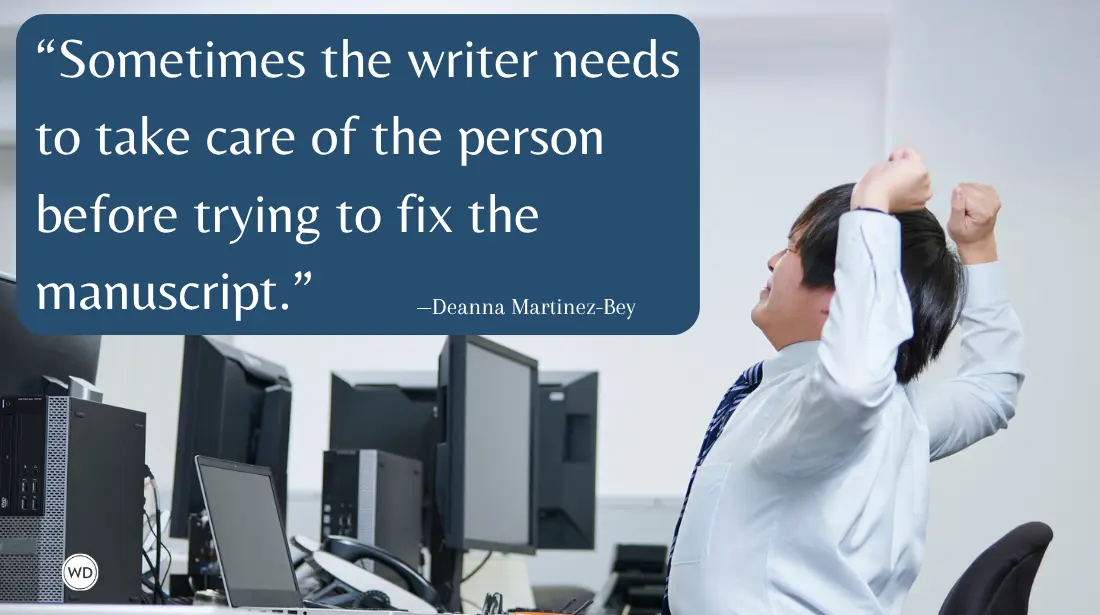
This checklist is not a prescription for forced productivity; rather, it is a reminder to care for the human being operating the keyboard before attempting to fix the manuscript.
4. Auditory Cues: Curating Stress Playlists
Sound is a powerful environmental cue that can regulate the nervous system or accelerate focus. Writers often rely on background noise, but relying on the same playlist indefinitely can lose its psychological efficacy.
A robust mental health toolkit includes multiple curated playlists tailored to specific emotional states:
- The Focus Stream: Instrumental, lyric-free compositions (ambient electronic, neoclassical piano, or lo-fi beats) designed to drown out distractions without introducing linguistic interference.
- The Cathartic Reset: Upbeat, high-energy tracks intended for active physical breaks—such as tidying the workspace or stretching—providing a somatic outlet for pent-up frustration.
- The Decompression Mix: Gentle, spacious acoustic tracks used during transitional moments to signal to the brain that deep concentration is ending and rest is beginning.
5. Somatic Regulation: 4-6 Breathing
Breath is the remote control of the autonomic nervous system. When writers experience performance anxiety, their breathing naturally becomes shallow and rapid (chest breathing), signaling to the body that it is under threat.
The 4-6 breathing technique requires no equipment and can be performed discreetly at a desk.
- Inhale gently through the nose for a count of four.
- Exhale slowly and completely through the mouth (or nose) for a count of six.
- Repeat this cycle for two to three minutes.
The extended exhale actively stimulates the vagus nerve, triggering the parasympathetic nervous system (the "rest and digest" response). This lowers heart rate, reduces blood pressure, and instantly defuses acute performance panic.
Future Outlook: Redefining Professional Longevity in Literature
As we look toward the future of the publishing industry and independent writing ecosystems, the conversation around creator mental health must move from the margins to the mainstream. Historically, literary success has been measured exclusively by output volume, word counts, and commercial distribution metrics. However, this metrics-driven obsession has fueled an epidemic of burnout, creative stagnation, and premature retirement from the craft.
The integration of structured mental health toolkits into daily writing practices represents a vital cultural correction. Moving forward, sustainable writing careers will rely heavily on boundary-setting, emotional literacy, and self-compassion. Editors, agents, and literary organizations are increasingly recognizing that the healthiest creators produce the most authentic, enduring work.
Furthermore, technology will likely play a supportive role in future wellness frameworks. Specialized productivity software is beginning to incorporate wellness prompts—encouraging screen breaks, monitoring continuous typing hours, and offering integrated breathing exercises during intense revision phases.
Ultimately, the goal of a writer’s mental health toolkit is not to eliminate the inherent challenges of storytelling. The creative process will always involve struggle, doubt, and hard labor. Instead, the toolkit equips the writer to navigate those inevitable valleys with grace, resilience, and deep respect for their own humanity. By prioritizing the person behind the manuscript, writers ensure that their creative voice remains vibrant, sustainable, and resilient for decades to come.




Comments
Facebook App ID not configured. Please add it in the Customizer.