
Executive Overview
The publishing landscape is experiencing a fascinating structural transformation, characterized by shifting reader preferences, economic adjustments, and format-specific surges and contractions. Newly released trade sales data for August—alongside comprehensive year-to-date figures—presents a vivid snapshot of an industry in transition. While traditional print continues to flex its muscles with robust growth in both hardback and paperback sales, the digital reading sector reveals a widening ideological divide between digital audiobooks and electronic text.
Digital audiobooks have cemented their status as an unstoppable force, posting strong, double-digit growth month after month. Conversely, e-books continue a modest, steady retreat from pandemic-era highs, showing consecutive declines both for the single month of August and across the broader year-to-date timeline. Meanwhile, physical print formats—once widely predicted to fade into obsolescence in the face of digital innovations—are driving the market’s overarching financial health. Paperbacks and hardbacks alike are enjoying widespread consumer enthusiasm, easily offsetting steep, long-term declines in legacy formats like mass-market paperbacks.
This report delves deeply into the financial metrics governing the contemporary book trade. By analyzing the performance metrics of digital versus physical platforms, industry stakeholders can better understand where consumer dollars are flowing, which formats are losing ground, and how publishers must adapt their distribution, marketing, and acquisition strategies to meet the demands of modern readers.
Read Also
Detailed Chronology and Monthly Performance Analysis
To truly grasp the trajectory of the modern publishing economy, one must examine the specific month-over-month shifts captured in the recent August reporting cycle. The data outlines a dynamic marketplace where distinct consumer segments behave in contrasting ways depending on the medium they choose for consuming content.
The August Landscape: A Mixed Bag for Digital and Print
During the month of August, the publishing industry experienced significant momentum in traditional print categories, coupled with a notable divergence within digital formats.
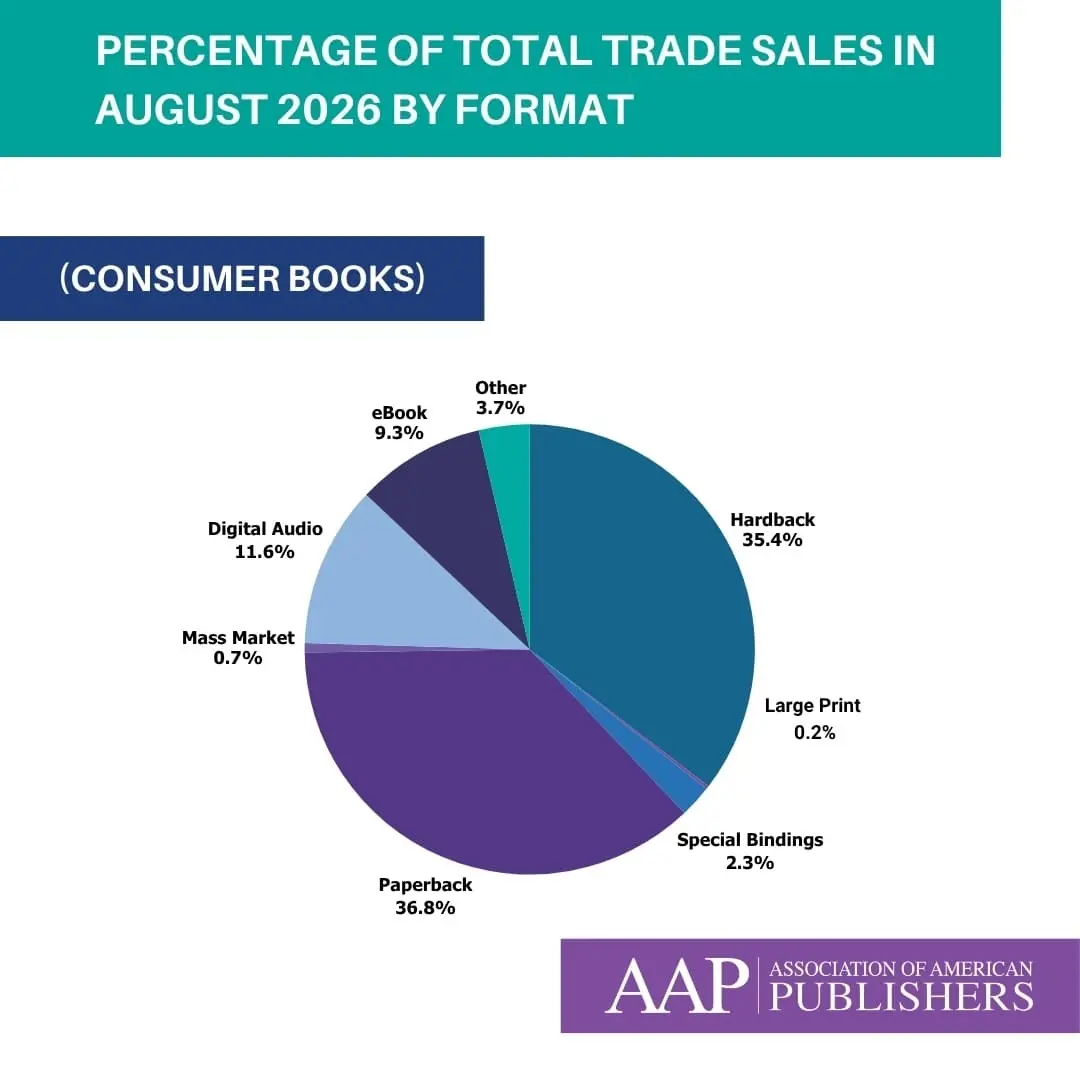
- Hardback Books: Proving that the tangible, collectible nature of physical books remains a powerful draw, hardback revenues surged by an impressive 13.8% during August, pulling in a massive $320.2 million. This points to a strong release slate or robust backlist purchasing behavior among collectors and gift-buyers during the late-summer retail period.
- Paperback Books: Paperbacks outperformed hardbacks in raw volume and growth velocity for the month, jumping 17.6% to reach $333.3 million. This reflects consumer price-consciousness alongside the enduring appeal of trade paperbacks as preferred formats for fiction, non-fiction, and beach reads during the summer months.
- Special Bindings & Mass Market: Special bindings saw a modest upward tick of 3.7%, generating $20.4 million. Conversely, mass market paperbacks continued their prolonged, structural decline, dropping 14.6% to $6.2 million, highlighting the ongoing industry-wide phase-out of traditional pocket-sized racks in favor of trade paperbacks.
The Digital Divergence: Audio Soars While E-Books Stall
The most striking narrative within the August data is the ongoing split within the digital publishing ecosystem.
- Digital Audiobooks: Continuing an unbroken trend of audience adoption, digital audio revenues climbed 12.6% in August, hitting $105.4 million. This medium benefits heavily from multitasking consumers, subscription models (such as Audible, Spotify, and library apps like Libby), and the booming popularity of celebrity-narrated memoirs and immersive fiction.
- E-Books: Digital text told a different story. E-book revenues declined by 5.7% for the month, settling at $83.9 million. While e-books retain a massive, loyal user base, the format is facing headwinds from reader fatigue, increased competition from streaming audio, and shifting leisure habits that favor physical immersion over screen time.
- Physical Audio: Once a staple of libraries and road trips, physical audio format revenues plummeted by 35.2% in August, bringing in a negligible $400 thousand. This decline underscores the near-total migration of listeners from CDs and cassettes to cloud-based streaming.
Supporting Context & Metrics: Year-to-Date Performance
A single month of data can occasionally be skewed by seasonal anomalies, blockbuster book releases, or supply chain fluctuations. However, looking at the year-to-date (YTD) metrics confirms that these August figures are part of broader, long-term structural trends reshaping the literary trade.
Cumulative Financial Breakdown (YTD)
| Format | YTD Revenue | Percentage Change vs. Previous Year |
|---|---|---|
| Paperback Books | $2.3 Billion | +11.8% |
| Hardback Books | $2.1 Billion | +3.1% |
| Digital Audiobooks | $806.3 Million | +12.6% |
| E-Books | $685.1 Million | -3.4% |
| Special Bindings | $152.6 Million | +14.5% |
| Mass Market | $26.9 Million | -57.2% |
| Physical Audio | $3.5 Million | -11.9% |
Analyzing the Print Dominance
The year-to-date numbers underline the undeniable resilience of physical print. Paperbacks have grown by 11.8% to reach a staggering $2.3 billion, making it the single largest revenue-generating category in the trade. Hardbacks follow closely, up 3.1% to $2.1 billion. Combined, print books command the lion’s share of consumer spending, proving that reports of the "death of print"—frequently predicted by digital evangelists over the last decade—were vastly exaggerated.
Readers continue to place a high value on physical bookshelves, tactile reading experiences, and the aesthetic appeal of beautiful covers. Furthermore, the extraordinary 14.5% year-to-date growth in special bindings ($152.6 million) highlights the booming market for collector’s editions, sprayed edges, and deluxe sprayed-edge variants popularized by platforms like BookTok and subscription boxes (such as FairyLoot and Illumicrate).
Conversely, mass market paperbacks are effectively facing extinction as a major retail category. Down 57.2% year-to-date to $26.9 million, retailers and publishers are actively phasing out the small-format, newsstand-style paperbacks in favor of larger trade editions.
The Digital Split: Audio’s Ascent and E-Book Consolidation
The digital sector is characterized by two entirely different trajectories.

Digital audiobooks are on track to shatter previous records, jumping 12.6% year-to-date to cross the $806.3 million threshold. Audio’s frictionless integration into daily routines—commuting, exercising, and household chores—has created an engaged, loyal subscriber base that treats listening as an additive behavior rather than a replacement for reading.
E-books, meanwhile, are experiencing a cooling period. With year-to-date revenues down 3.4% to $685.1 million, the digital reading sector has plateaued following the massive acceleration it saw during the early 2020s. While e-books remain a vital, highly profitable segment for publishers—especially in genres like romance, sci-fi, and self-publishing—they are no longer capturing aggressive market share growth from print.
Official Statements and Industry Insights
Publishing executives, literary agents, and market analysts have weighed in on these shifting numbers, offering critical context on why consumer habits are evolving in this specific direction.
Market analysts note that the modern reader is increasingly hybrid in their consumption habits. It is no longer a matter of "print versus digital," but rather "format selection by use case." Industry experts observe that readers who prefer immersive, distraction-free experiences are investing in physical hardbacks and special editions for their home libraries. Meanwhile, those same consumers are utilizing digital audiobooks for long commutes and workouts, while relying on smartphones and e-readers for portable reading during travel.
"The extraordinary performance of trade paperbacks and special editions proves that books are increasingly viewed as lifestyle items and collectible pieces of art, rather than merely vessels for text," notes a prominent trade publishing consultant. "At the same time, the runaway success of audiobooks demonstrates that the definition of ‘reading’ has permanently expanded to include auditory storytelling."
Publishers are responding to these metrics by reallocating marketing budgets. Audio production quality has risen dramatically, with publishers frequently investing in full-cast voice acting, immersive soundscapes, and high-profile celebrity narrators to drive listener acquisition. On the print side, publishers are collaborating closely with independent bookstores and specialty retailers to design exclusive editions featuring sprayed edges, foil stamping, and exclusive author notes—tactics that directly target the demographic driving the growth in hardbacks, paperbacks, and special bindings.
Future Outlook: What Lies Ahead for the Book Trade?
As the publishing industry looks toward the final quarter of the year—historically the most lucrative period, driven by the holiday shopping season—several key questions and trends will define the market.
1. The Continued Rise of Audio
With digital audiobooks approaching the $1 billion milestone on an annual basis, the format is poised for continued expansion. Future innovations may include deeper integration with generative AI voice synthesis for backlist titles that would otherwise be too expensive to produce via traditional narration, as well as enhanced subscription models that bundle e-books and audiobooks seamlessly.
2. The Special Edition Phenomenon
The explosive growth in special bindings and trade paperbacks suggests that publishers will lean heavily into collector culture. Expect to see traditional publishers forge deeper partnerships with direct-to-consumer book subscription services and indie retailers to produce collectible iterations of bestselling titles. This strategy not only combats digital piracy and used-book leakage but also commands higher retail price points.
3. E-Book Re-engagement Strategies
To reverse the minor downward trend in e-book revenues, digital publishers will likely need to experiment with new pricing strategies, serialized content delivery, and interactive reading experiences. Platforms that can successfully gamify digital reading or offer frictionless cross-device syncing between e-readers and audio players will likely capture the next wave of digital growth.
Conclusion
The latest publishing data paints a picture of a remarkably resilient, adaptable industry. Far from being a zero-sum game where digital formats cannibalize physical ones, the contemporary book trade is expanding across multiple dimensions. Print is thriving through aesthetic appeal and tactile value, digital audio is unlocking new listening hours from busy consumers, and e-books are maintaining a stable, foundational baseline. As publishers continue to innovate across all formats, the literary market enters the closing months of the year on exceptionally solid financial footing.





Comments
Facebook App ID not configured. Please add it in the Customizer.