
Executive Overview
In a series of recent weekly catecheses, Pope Leo has turned his focus toward Gaudium et Spes (The Pastoral Constitution on the Church in the Modern World), one of the most intellectually consequential and fiercely debated documents to emerge from the Second Vatican Council (Vatican II). Promulgated in the closing days of the council in December 1965, Gaudium et Spes represented an ambitious, paradigm-shifting pivot in how the Roman Catholic Church understood its relationship with secular society, science, politics, and culture.
Critics of the text have long argued that by softening the Church’s historic, uncompromising condemnations of liberal modernity, the institution effectively capitulated to the shifting winds of secularism. This friction led the late Joseph Ratzinger—later Pope Benedict XVI—to famously characterize the document as a "counter-syllabus," casting it as a direct revision of Pope Pius IX’s uncompromising 1864 Syllabus of Errors.
Yet, as Pope Leo’s recent teachings demonstrate, Gaudium et Spes ought not to be read as a surrender to modernism, but rather as a profound theological recalibration. By anchoring its pastoral posture in the shared dignity of the human person—redeemed by Christ—the document abandoned the fortress mentality of the nineteenth century in favor of a grammar of dialogue, cooperation, and evangelical solidarity. In doing so, it established a framework that continues to shape Catholic social teaching, directly inspiring Leo’s recent encyclical, Magnifica Humanitas.
Read Also
Detailed Chronology: From the Syllabus of Errors to the Council Floor
To understand the tectonic shift represented by Gaudium et Spes, one must trace the historical trajectory of the Church’s engagement with modernity over the preceding century.
1864: The Defensive Posture of Pius IX
The intellectual precursor to the mid-twentieth-century crisis was forged during the pontificate of Pius IX. Faced with the rise of aggressive secular nationalism, rationalism, and liberalism across Europe, the Vatican issued the encyclical Quanta Cura, accompanied by the Syllabus of Errors. This latter document cataloged and condemned eighty propositions central to modern thought, ranging from absolute separation of church and state to secularized public education and rationalism.
While intended to protect the deposit of faith, the Syllabus was treated by critics as an absolute declaration of war against the modern world. Even nineteenth-century luminaries like John Henry Newman viewed the document with strategic reservation, noting that it was "nothing more than a digest of certain errors made by an anonymous writer" and arguing that it did not preclude Catholics from being loyal, constructive citizens within democratic states. Newman correctly recognized that the Syllabus lacked serious, cohesive doctrinal depth, functioning instead as a hodgepodge of disparate citations wrenched from their original contexts.
1962–1965: Vatican II and the Pastoral Turn
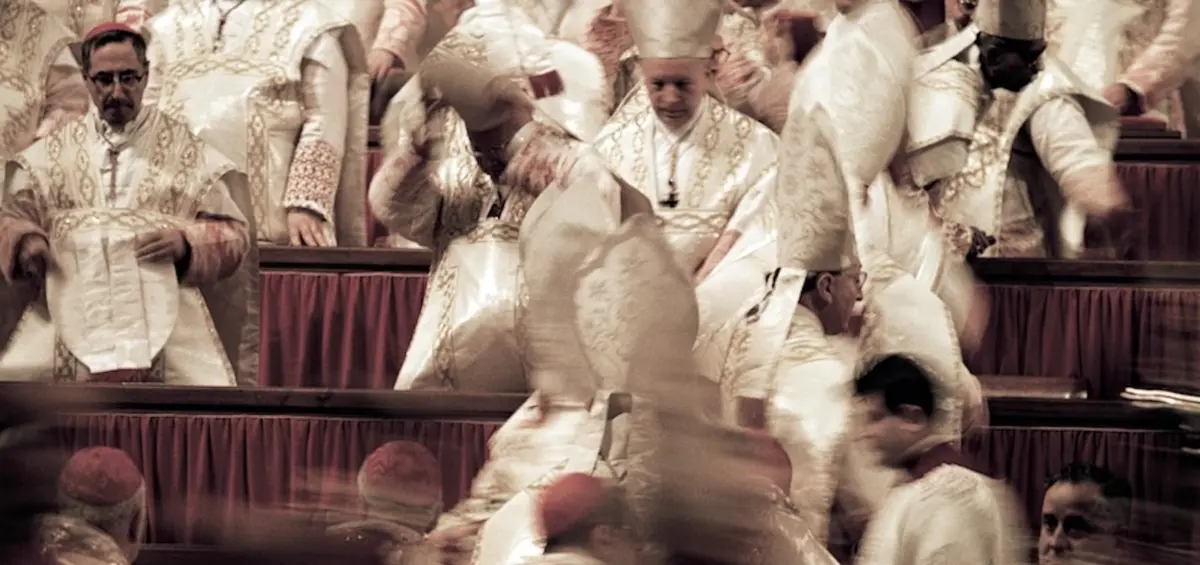
Fast forward a century through the trauma of two World Wars, the horrors of the Holocaust, and the glacial standoff of the Cold War. The bishops gathered at Vatican II confronted a global landscape teetering on the edge of nuclear annihilation and ideological fragmentation. Under the leadership of Pope John XXIII and later Pope Paul VI, the council fathers concluded that the Church’s primary task was no longer to hurl anathemas at its perceived enemies, but to articulate what unites the human family.
Out of this consensus emerged Gaudium et Spes. Unlike dogmatic decrees defining strict internal boundaries, the constitution opened with an iconic, radically relational embrace of humanity:
"The joys and the hopes, the griefs and the anxieties of the men of this age, especially those who are poor or in any way afflicted, these are the joys and hopes, the griefs and anxieties of the followers of Christ."
This framing completely inverted the defensive posture of the nineteenth century. Instead of framing the world as an enemy territory to be fortified against, Gaudium et Spes reimagined global culture as a field ripe for dialogue, where the Church could walk alongside humanity in its shared quest for truth, justice, and peace.
Supporting Context & Metrics: Theology, Analogy, and the "Signs of the Times"
The theological machinery driving Gaudium et Spes is deeply rooted in Thomistic analogical reasoning. Rather than deploying a rigid, binary dichotomy between the sacred and the profane, the council utilized an analogical framework wherein the Catholic Church possesses the fullness of divine revelation, yet recognizes that other Christian bodies, non-Christian religions (most notably Judaism), and secular institutions participate in that truth with varying degrees of intensity.
The Problem of Optimism and the "Counter-Syllabus"
This openness provoked intense debate. Young theological experts like Joseph Ratzinger worried that the document’s warm embrace of human progress lapsed into a naive, nearly "Pelagian" optimism about human nature. Ratzinger harbored reservations for decades, though his perspective evolved significantly; by 2013, shortly before his retirement, he twice praised Gaudium et Spes as a "great" text. This shift was largely catalyzed by the unwavering advocacy of Pope John Paul II, who integrated the document’s anthropology into his own foundational teaching—most famously repeating that Jesus Christ "fully reveals man to man himself and makes his supreme calling clear."
Correcting the "Signs of the Times"
A critical flashpoint in the drafting of Gaudium et Spes involved the famous phrase "scrutinizing the signs of the times." In the immediate post-conciliar era, progressive factions weaponized this phrase to argue that cultural shifts should act as the primary normative guide for Church doctrine and practice—effectively reducing theology to sociology.
However, historical records reveal a crucial intervention by Protestant observers during the council. Lukas Vischer, a Swiss Reformed theologian representing the World Council of Churches, critiqued early drafts of the document, asking whether it was truly the Church’s task to simply dance to the tune of secular trends. Vischer argued that what was desperately needed was not accommodation, but a rigorous critique of the times evaluated through the lens of the Gospel.
Responding to these ecumenical insights, the council adjusted its language. The Latin term signa temporum appeared only once, modified by the verb perscrutandi (to scrutinize or examine thoroughly). This nuanced phrasing ensured that the Church’s engagement with culture remained an exercise in discernment under the Gospel, soothing anxieties expressed by conservative theologians like Henri de Lubac, who feared that an uncritical "opening to the world" might dilute Christian liturgy and doctrine.
Official Statements & Ecclesiastical Responses: The Posture Toward Communism
The practical efficacy of this new pastoral mindset was tested most dramatically during the council regarding the Church’s stance on global communism. Approximately 400 bishops petitioned the Theological Commission to issue a formal, explicit condemnation of atheistic communism—a move entirely consistent with pre-conciliar precedent.
Pope Paul VI intervened directly, rejecting the petition on pastoral grounds. According to historical accounts, Paul VI reasoned:
"This [condemnation] would be anti-pastoral and bad politics. . . . People, whether atheists or communists, ought to know that the Church loves them and is concerned with them."
The Dominican theologian Yves Congar captured this pivotal moment in his journal, writing that "the Pope and the Council opted for a pastoral attitude directed towards caring for people and trying to heal them." This refusal to weaponize dogma against political enemies epitomized the core ethos of Gaudium et Spes: prioritizing human healing over ideological warfare.
In his ongoing catecheses, Pope Leo has leaned heavily into this legacy, bypassing obsolete polemics in favor of a unified anthropology. In his encyclical Magnifica Humanitas, Leo builds directly upon the groundwork laid by Gaudium et Spes, positioning human dignity not as a concession to secularism, but as an inescapable corollary of the Incarnation.
Future Outlook: The Ongoing Reception of Gaudium et Spes
Decades after its promulgation, Gaudium et Spes remains a living battleground within Catholic ecclesiology. Traditionalist critics continue to view its optimistic anthropology as the root cause of post-conciliar liturgical and moral confusion. Conversely, progressive voices sometimes stretch its framework to justify accommodations with contemporary secular ethics that bypass orthodox doctrinal constraints.
Pope Leo’s recent catechetical intervention cuts through these polarized extremes. By framing Gaudium et Spes not as a break with divine truth, but as a "renewed fidelity to the Mystery of Christ," Leo asserts that the document’s mandate is as urgent today as it was in 1965.
As the global Church navigates a digital age marked by hyper-polarization, artificial intelligence, resurgent nationalism, and deep existential anxiety, the core challenge of Gaudium et Spes remains unanswered: Can the Church engage contemporary culture without losing its soul? For Pope Leo, the answer is a definitive yes—provided that the Church continues to look outward, defending the sacred dignity of every human person not with the armor of condemnation, but with the radical, healing love of the Gospel.





Comments
Facebook App ID not configured. Please add it in the Customizer.