
Executive Overview
For generations, the standard historiography of early modern global Christianity has marched to a well-worn rhythm. In this conventional narrative, the initial phase of global religious expansion—spanning roughly from 1520 to 1760—was an overwhelmingly Catholic enterprise. Anchored by the missionary zeal of the Counter-Reformation, heroic Catholic orders such as the Jesuits, Franciscans, and Dominicans spanned the globe, fueled by the sprawling imperial ambitions of Spain, Portugal, and France. From the grand conversions of Latin America to the intellectual inroads of Matteo Ricci in Ming Dynasty China and Francis Xavier across maritime Asia, Catholic missionaries reshaped the cultural, linguistic, and spiritual topography of non-European worlds.
In this framework, early modern Protestantism is cast as a provincial, inward-looking phenomenon—insulated within European bastions, constrained by geopolitical weakness, and arriving "strangely late to the missionary party." The rise of global Protestantism is traditionally understood to have commenced only in the late eighteenth century, driven by the juggernaut of the British Empire and celebrated figures like William Carey in India.
A monumental new study shatters this conventional paradigm. In The World’s Reformation: How Protestantism Became a Global Religion (Yale University Press, 576 pages, $45), historian Alec Ryrie presents a sweeping, meticulously researched corrective that demonstrates Protestants were active globally much earlier than previously acknowledged. While frankly confronting the reality that many of these early Protestant ventures suffered from dismal conversion rates and severe structural limitations, Ryrie’s work serves as an indispensable contribution to the study of world Christianity. Beyond uncovering forgotten histories, The World’s Reformation acts as a brilliant case study in historical memory and amnesia, prompting scholars and general readers alike to re-examine the ideological underpinnings of European expansion, empire, and religious identity.
Read Also
Detailed Chronology of Global Religious Expansion
To fully grasp the disruptive thesis of Ryrie’s book, one must first trace the chronological milestones that have long dominated our historical consciousness—and then overlay them with the diffuse, overlooked currents of early Protestant endeavor.
The Catholic Ascendancy (1520–1760)
- The 1540s–1550s: The Society of Jesus (Jesuits) solidifies its global footprint. Francis Xavier traverses India, the Malay Archipelago, and Japan, establishing a template for elite engagement and cultural translation.
- The 1570s: A pivotal decade for globalization. The Catholic diocese of Manila is created as a suffragan see of Mexico City. For the next three centuries, the Manila-Acapulco galleon trade route serves as the primary axis for Catholic transpacific missions, linking the Americas, Asia, and Europe in a unified commercial-religious network.
- The Late Sixteenth and Seventeenth Centuries: Matteo Ricci and his successors penetrate the imperial court of China, mastering Confucian texts and utilizing Western science to win favor. Concurrently, massive missionary efforts transform the linguistic and social structures of societies as diverse as Vietnam, Bolivia, and Tamil South India.
The Overlooked Protestant Undercurrents
While Catholic apologists historically delighted in contrasting their tropical successes with a Protestantism supposedly confined to a diet of European herring, Ryrie reveals that Protestant global engagement began taking shape far earlier than standard timelines suggest.
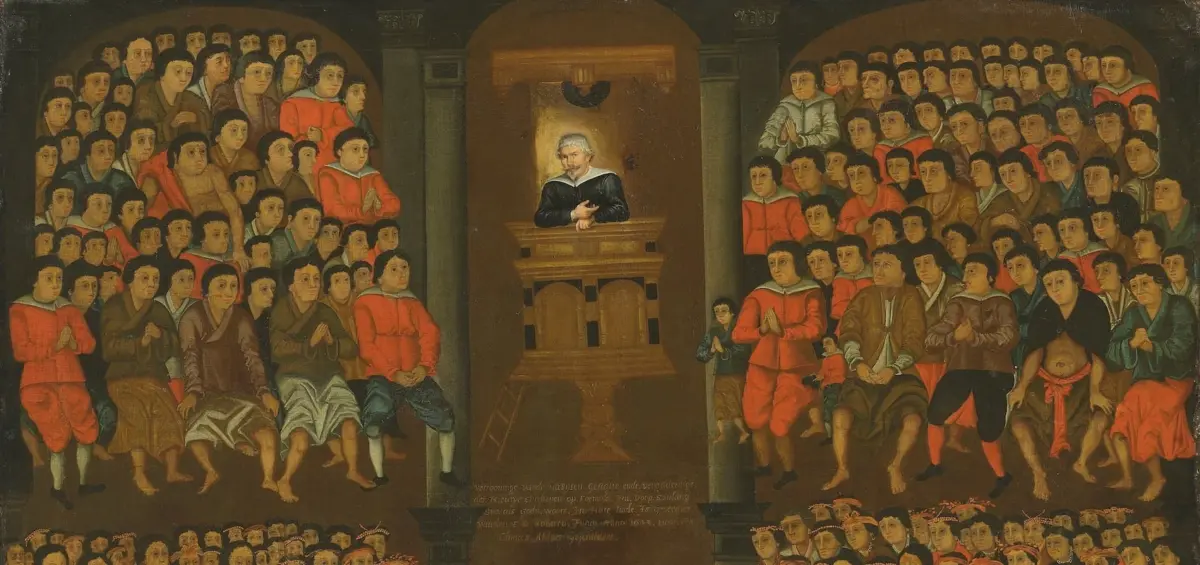
- The Early Seventeenth Century: The Dutch Republic achieves true global imperial status. Moving beyond the traditional caricature of the Dutch as purely secular agents driven by commercial profit, recent scholarship—highlighted by Charles H. Parker’s Global Calvinism: Conversion and Commerce in the Dutch Empire, 1600–1800 (2022)—demonstrates that Dutch Reformed churches established far-reaching networks from New Amsterdam and Suriname to Jakarta and the Cape of Good Hope.
- The Mid-to-Late Seventeenth Century: Early English settlers in North America justify colonization through the nominal lens of indigenous evangelism, giving rise to John Eliot’s famous translation of the Bible into Massachusett and his network of "praying towns."
- The Turn of the Eighteenth Century: Institutionalized Protestant missions begin to formalize. The English Society for the Propagation of the Gospel in Foreign Parts (SPG) is founded in 1701. Shortly thereafter, in 1706, German-Danish ventures inaugurate sustained Protestant missionary efforts in Tranquebar, India.
- The Late Eighteenth Century Onward: The watershed moment where British imperial dominance converges with a massive surge in domestic missionary societies, bringing figures like William Carey to the forefront and permanently altering the global Protestant landscape.
Supporting Context and Metrics: Archives, Geographies, and Outcomes
One of the greatest analytical achievements of The World’s Reformation lies in its thematic organization, which allows Ryrie to navigate an extraordinary geographical scope—ranging, as he notes, "from Lapland to Chile and Barbados to Taiwan"—without getting bogged down in linear narratives of isolated church bodies.
The Archival Bias
Why has the early Protestant global footprint been so systematically minimized? Ryrie offers shrewd observations concerning archival logistics. Catholic religious orders operated as institutional "pack rats," centralizing their documentation in strategic urban hubs like Rome. This makes tracing their worldwide efforts comparatively straightforward for modern historians.
In contrast, early Protestant missions were frequently decentralized, precarious, and administratively fragmented. Furthermore, Ryrie is unflinchingly honest about the stark realities on the ground: most early Protestant missionary projects secured dismally few conversions, despite the immense investments of money, effort, and prayer. Because flourishing, self-perpetuating local churches were rare in these early decades, they left behind few indigenous documentary archives for posterity to collect.
The Four Pillars of Ryrie’s Analysis
Ryrie structures his 576-page opus into four thematic pillars:

- Principles: An exploration of the broad assumptions, motives, and rationales driving believers. Apocalyptic expectations and an acute, defensive obsession with the Antichrist—identified directly with the Papacy—fueled the psychological drive of societies that had broken free from Rome.
- Templates: A deep dive into the models and precedents that shaped Protestant encounters with non-Christian ideas. This includes early interactions with Jews and Muslims, as well as the conceptual category of "barbarians." In a brilliant cross-national comparison, Ryrie notes how British Protestants viewed the Catholic Irish and Highland Scots through a similar lens of demonic alterity as Scandinavian Lutherans viewed the indigenous Sámi populations of the far north. Strikingly, early English translators produced a usable Bible in Tamil before performing the same task for Scots Gaelic, illustrating the complex hierarchies of marginality in the Protestant mind.
- Approaches: An examination of the rhetorical tactics, educational initiatives, and "civilizing" influences deployed to ensure recruitment was followed by retention. This section addresses a perpetual Protestant dilemma: the fear that evangelization would destroy traditional identities and replace them with a heavy-handed, Europeanized cultural mold. The unresolved tension between becoming "Christian" versus becoming "English" or "Dutch" dogged every missionary enterprise. Moreover, an over-reliance on the sheer, unmediated power of translated Scripture—bordering at times on bibliolatry—often blinded missionaries to the local socioeconomic contexts necessary for sustained reception.
- Outcomes: A critical appraisal of the nexus between missions, colonization, and empire. Here, the linguistic slippage between "planting" religion and establishing a "plantation" becomes glaringly apparent.
Official Statements and Critical Reception
Scholarly reception of The World’s Reformation has underscored its paradigm-shifting value, even as experts grapple with the enduring asymmetry between Catholic and Protestant early modern achievements.
In academic and theological circles, the book has been widely hailed as a masterclass in historical revisionism. Reviewers emphasize that Ryrie does not manufacture false equivalencies. While he successfully proves that Protestants were thinking globally, writing globally, and acting globally much earlier than previously assumed, he does not claim that Protestantism matched the sheer institutional heft or structural integration of the Catholic missions in East Asia.
In a reflective appraisal of the text, leading historians of Christianity note:
"If Protestants were indeed highly active in missions, as we now realize that they were, still they never produced anything comparable to the Catholic experience in China or Japan. In those two critical lands above all, the religious orders acquired vast power and prestige… With all due caveats, I would still retain the conventional focus on Catholic missions in the early modern centuries, and I might even speak of the ‘Age of Francis Xavier.’"
Nevertheless, commentators universally agree that Ryrie’s greatest service is not merely expanding our data points, but exposing how our historical narratives are constructed. By interrogating the mechanisms of historical amnesia—showing why historians chose to ignore seventeenth-century Protestant failures while canonizing eighteenth-century triumphs—The World’s Reformation redefines the baseline for all future scholarship on global Christianity.
Future Outlook: Re-writing the Curricula of Christian Expansion
As the study of global Christianity increasingly occupies a central place in modern theological, sociological, and historical curricula, the implications of Alec Ryrie’s work will reverberate for decades.
Transforming Pedagogical Approaches
Future courses in church history can no longer afford to treat the seventeenth century as a Protestant "dark age" regarding global engagement. Instructors will be forced to incorporate the fragmented, often frustrating, yet globally ambitious efforts of early Reformed and Lutheran actors. This inclusion bridges the gap between the European Reformation and the nineteenth-century missionary explosion, presenting a continuous, albeit messy, evolutionary trajectory.
Re-evaluating Empire and Religion
Furthermore, as contemporary debates regarding the entanglement of religion, colonialism, and globalization intensify, The World’s Reformation provides a sophisticated framework for analyzing how religious ideologies rationalized, resisted, and reflected imperial power structures. By examining how Protestants wrestled with the evangelization of enslaved populations and indigenous groups—frequently paralyzed by the fear that spiritual equality would demand social liberation—modern scholars gain vital insight into the foundational racial and social fault lines of the modern Western world.
In sum, Alec Ryrie has delivered a landmark study. The World’s Reformation is indispensable not merely for what it teaches us about forgotten missionaries in Lapland, Chile, Barbados, and Taiwan, but for what it reveals about the architecture of our own historical memory.




Comments
Facebook App ID not configured. Please add it in the Customizer.