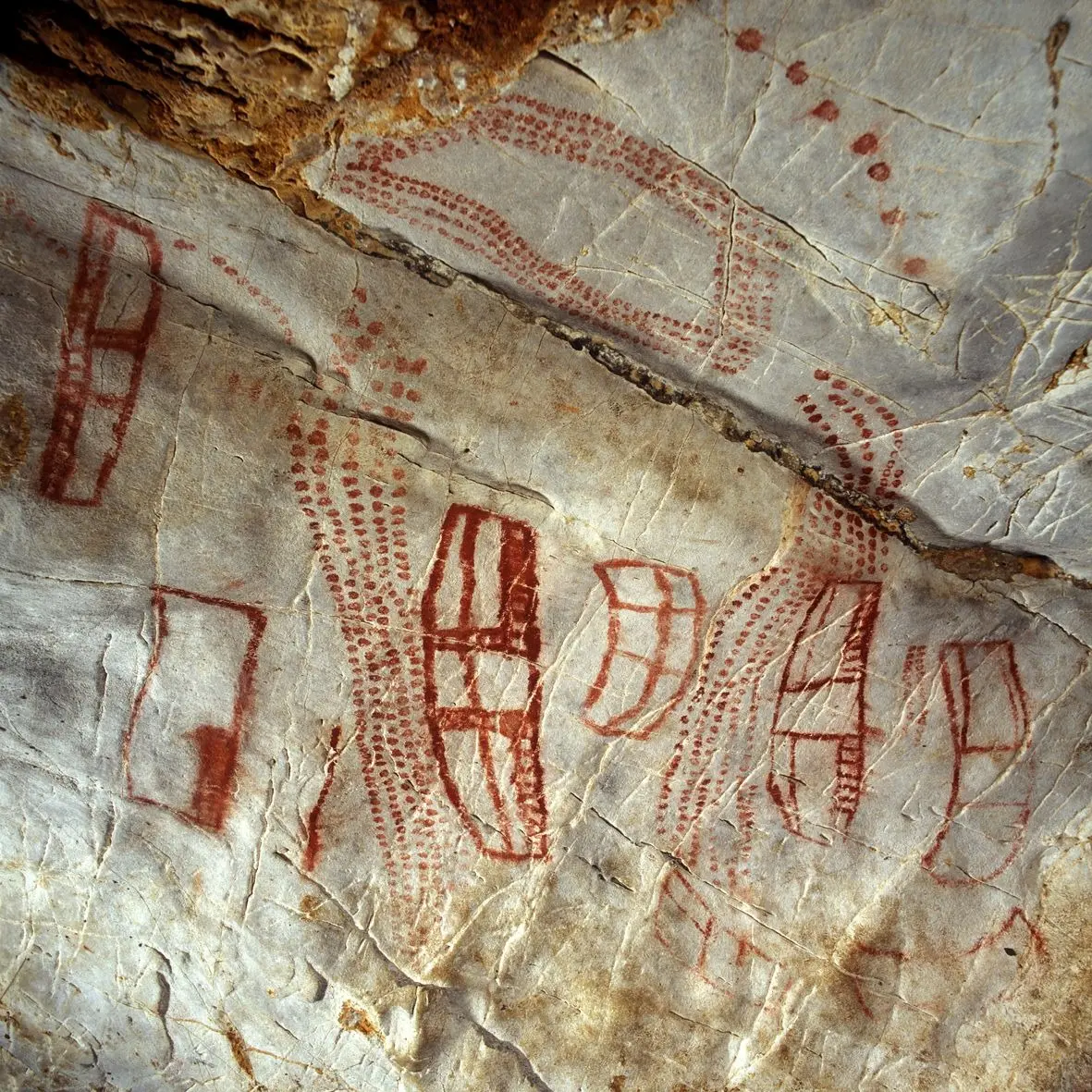
Deep within the subterranean networks of Western Europe, far beyond the reach of natural sunlight and shadowed by the jagged remnants of an ancient wilderness, prehistoric artists carved and painted a profound visual record of their world. For decades, modern observers have analyzed these Paleolithic masterpieces—found in illuminated tourist-friendly spaces like Spain’s Cave of El Castillo—as static galleries frozen in time.
However, a revolutionary paradigm shift is underway among archaeologists, cognitive scientists, and anthropologists. Investigators are abandoning the sterile confines of white-light gallery perspectives to study cave art in its native, visceral context. Emerging research reveals that these ancient creations were never meant to be viewed as static pictures on a flat wall. Instead, they were deeply immersive, sensory experiences brought to life by the flickering dance of primitive torchlight, the tactile contours of raw stone, and the echoing acoustics of deep chambers.
Far from being mere aesthetic expressions, these dynamic installations served as crucial cognitive anchors. They signaled a monumental evolutionary leap in the human capacity for symbolic thought, abstract reasoning, and the externalization of complex cultural knowledge.
Detailed Chronology: Unlocking the Depths of Prehistory
To understand the trajectory of Upper Paleolithic cave art, researchers trace a sweeping timeline of human habitation and artistic evolution that spans tens of thousands of years:
41,000 to 13,000 Years Ago: Artists repeatedly visit the subterranean chambers of El Castillo in northern Spain, braving total darkness and apex predators like cave bears to leave behind nearly 3,000 legible engravings, hand stencils, red disks, and geometric patterns.
1879: The iconic, multi-colored bison ceiling of the Altamira cave in northern Spain is discovered, igniting more than a century of intense academic debate regarding the true motivations, symbolic meanings, and psychological triggers behind prehistoric cave art.
The Mid-20th Century: El Castillo is retrofitted with electric lighting and concrete stairs to accommodate public tourism, transforming a perilous, sensory-heavy dark zone into a brightly lit, accessible walkthrough exhibit.
The 2010s: Landmark documentary projects, such as Werner Herzog’s Cave of Forgotten Dreams, bring global attention to subterranean spaces like Chauvet Cave, prompting renewed scholarly focus on the immersive, multi-sensory environment of early art.
Recent Years: Archaeologists employ advanced technologies—including laser mapping, virtual reality (VR) torchlight simulations, and trace human DNA extraction from cave walls by the Max Planck Institute—to redefine cave art not as isolated sketches, but as interactive spatial experiences.
Supporting Context & Metrics: The Anatomy of an Immersive Environment
Modern analysis reveals that the relationship between ancient humans and the subterranean canvas was extraordinarily intimate. When British archaeologist Paul Pettitt and his colleagues mapped the distribution of thousands of hand stencils across cave surfaces, they discovered a striking pattern: these markings were rarely placed at random.
Instead, the majority of stencils clustered meticulously around natural fissures, undulations, and concave rock curves. Many were positioned in ways that suggested they served as tactile guides—helping early explorers steady themselves along treacherous, pitch-black pathways. This close physical dialogue with the architecture of the earth persisted as artists transitioned from handprints to sophisticated animal representations approximately 35,000 years ago.
Furthermore, investigators note how natural features dictated the anatomy of the art itself:
Topographic Integration: Outcrops of rock were routinely utilized to represent the muscular bulges of a bison’s back.
Cracks and Ridges: Natural fissures were deliberately completed with paint or etchings to form the branching antlers of elk or the sweeping dorsal lines of horses.
Kinetic Illusions: In the shifting, low-intensity glow of a handheld torch, these strategically placed figures appeared to emerge from or recede into the shadows, creating an early form of dynamic animation.
[Paleolithic Explorer] ---> (Enters Deep Dark Zone with Torch)
                                  |
                                  v
[Flickering Light & Shadow] ---> (Activates Visual System to Detect Obscured Forms)
                                  |
                                  v
[Rock Topography + Pigment] ---> (Immersive, Multi-Sensory "Simulated Hunting Environment")
Official Statements and Scholarly Insights
The transition from cognitive-only interpretations to multi-sensory, ecological analyses has fundamentally altered how experts discuss prehistoric representation.
Eduardo Palacio Pérez, an archaeologist studying the rich layers of El Castillo, contextualizes the scale of the site:
"If the Paleolithic record were a book, then in El Castillo we have every chapter, more or less. We have practically all the themes in Paleolithic rock art in Europe."
Highlighting the physical intimacy required by the medium, Diego Garate, a professor at the University of Cantabria, contrasts the modern experience with that of our forebears:
"For scholars, the wall is sacred. You can’t touch anything, but obviously, for Paleolithic people, it was the contrary. They were in a close relationship with the walls."
Addressing the broader cognitive implications of these visual records, Steven Mithen, an archaeologist at the University of Reading and author of The Prehistory of the Mind, bridges the gap between ancient stone and modern technology:
"Today, much of my mind is contained within my mobile phone, the modern equivalent to a painted animal or carved figurine for an Ice Age hunter-gatherer."
Mithen adds that figurative cave painting elevated the externalization of ideas to an unprecedented level:
"Earlier humans, whether of Homo sapiens or other species, such as the Neanderthals, never mastered this trick of extending their powers of thought by using material objects, constraining them to live in a world without abstract ideas… a level not exceeded until the invention of writing many thousands of years later."
Future Outlook: Virtual Reality and the Re-Enchantment of Prehistory
As heritage management policies rightly restrict physical access to fragile underground ecosystems—banning smoky open fires and limiting human traffic to preserve pristine pigments—researchers are turning to digital innovation to solve enduring archaeological mysteries.
Initiatives led by scholars such as Izzy Wisher and Diego Garate utilize advanced virtual reality systems to reconstruct subterranean environments with physical precision. By simulating the precise lumens, flicker rates, and smoke behaviors of Upper Paleolithic torches inside digital twins of caves like Las Monedas and El Castillo, scientists can finally test long-standing hypotheses. They can determine whether dramatic shadow projections—such as the bipedal "bison man" silhouette cast by sculpted stalagmites—were intentional optical illusions engineered by ancient artists or coincidental byproducts of wandering flame paths.
Ultimately, this convergence of archaeology and advanced digital simulation promises to restore the missing experiential dimension of cave art. By looking past the modern museum glass and stepping virtually into the dancing, smoke-filled shadows of the deep past, humanity gains a clearer appreciation of the moment our ancestors first learned to externalize their inner worlds, turning bare stone into a living canvas of thought, symbol, and story.

/https://tf-cmsv2-smithsonianmag-media.s3.amazonaws.com/filer_public/8e/83/8e837bc6-e2b3-4bb6-bb1c-4f1287b45a6f/castillo-39-rincon_de_los_signos.jpg)
/https://tf-cmsv2-smithsonianmag-media.s3.amazonaws.com/filer_public/8e/83/8e837bc6-e2b3-4bb6-bb1c-4f1287b45a6f/castillo-39-rincon_de_los_signos.jpg)
/https://tf-cmsv2-smithsonianmag-media.s3.amazonaws.com/filer_public/fd/cb/fdcb1447-fea6-4499-80eb-baa875f8216f/castillo-27-techo_de_las_manos.jpg)
/https://tf-cmsv2-smithsonianmag-media.s3.amazonaws.com/filer_public/c5/3d/c53d1353-a5e3-49c7-be3e-f883092fa7fe/castillo-69.jpg)




Comments
Facebook App ID not configured. Please add it in the Customizer.